

On this page
A common way to lose marks on Ohm's law numericals is not forgetting V = IR. It is combining the wrong resistors. An AI tutor can help, but only if you ask it to show the circuit's structure before it does any arithmetic, and then make it prove the answer with two quick sums.
Why do students get series and parallel numericals wrong?
A study of high school and university students by Paula Engelhardt and Robert Beichner found that, during interviews, the idea used most often in answering the questions was that the battery is a constant source of current (American Journal of Physics, 2004). The same study reported that students tended to focus on current and to confuse terms, often giving the properties of current to voltage or resistance.
If you think the battery always pushes the same current, you will not see why adding a branch changes everything. The fix is to know the four rules in the NCERT Class 10 Science chapter on electricity and use them as checks, not just formulas:
In series, the current is the same through every resistor, and the equivalent resistance is R1 + R2 + R3.
In series, the voltages across the resistors add up to the total voltage.
In parallel, every branch has the same voltage, and 1/Rp = 1/R1 + 1/R2 + 1/R3.
In parallel, the branch currents add up to the total current.
If you are still unsure whether current gets "used up" along a wire, read why current is not used up in a series circuit first.
How should you ask an AI tutor to solve an Ohm's law numerical?
Do not paste the question and ask for the answer. Ask for the structure first, with this prompt:
"Before calculating anything, redraw this circuit in words. List which resistors are in series and which are in parallel, and between which two points."
"Wait for me to agree before you combine any resistors."
"Find the equivalent resistance one block at a time, then the total current from I = V/R."
"Work backwards: find the voltage across each block and the current in each branch."
"Show me that the voltages around the loop add to the battery voltage and the branch currents add to the total current."
Step 2 matters most. It makes you look at the redraw and catch a mistake while it is still cheap. Fermi's AI tutor holds a line of reasoning across a session, draws the figure and checks understanding as it goes, so you can stop at the redraw and confirm each block before any arithmetic.
Worked example: do the current and voltage add up?
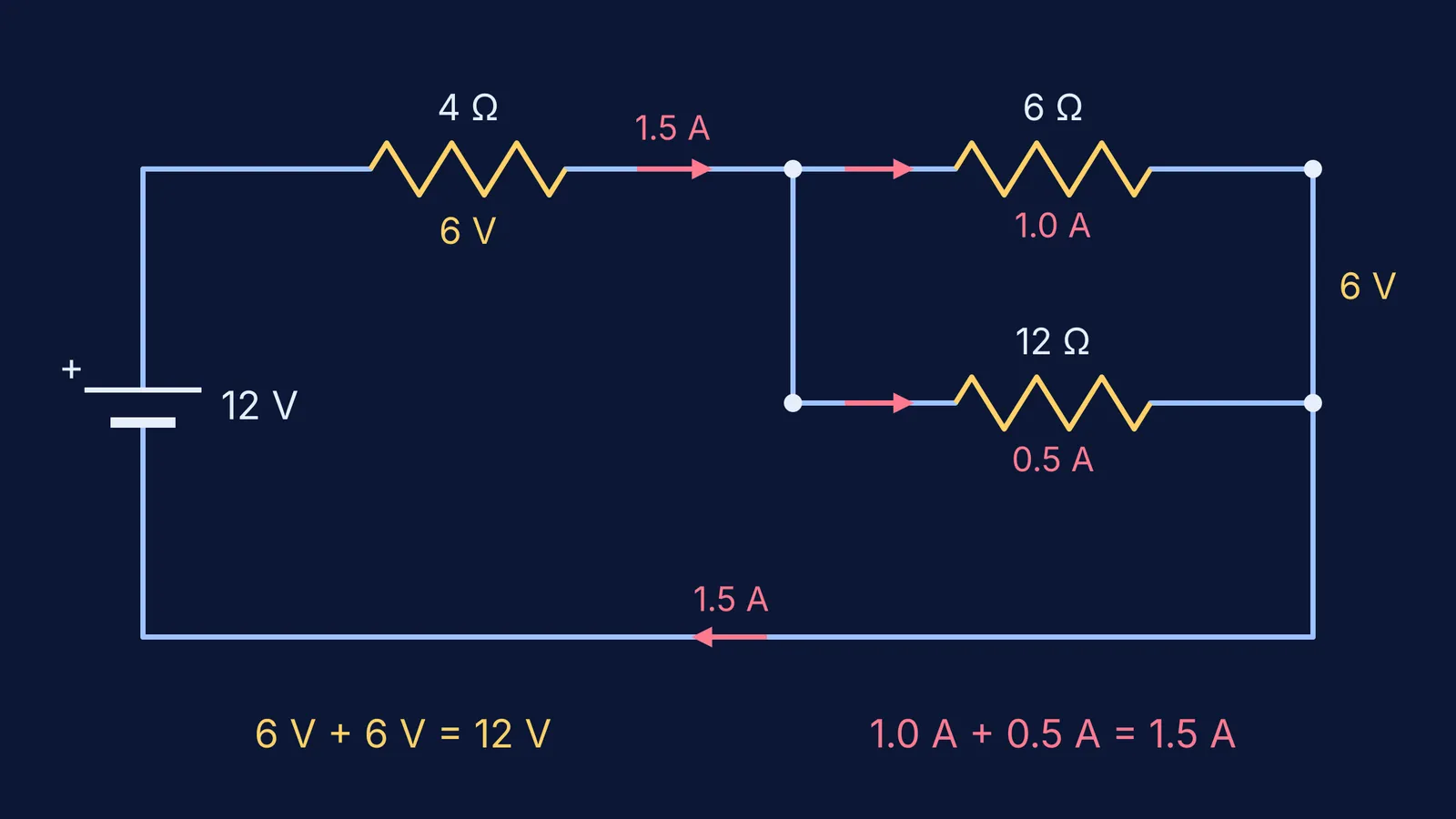
Question: A 12 V battery is connected to a 4 Ω resistor in series with a parallel pair of 6 Ω and 12 Ω. Find the current in each resistor.
Redraw first. The 6 Ω and 12 Ω share the same two end points, so they are in parallel. That block sits in series with the 4 Ω.
Combine. For the parallel block, 1/Rp = 1/6 + 1/12 = 3/12, so Rp = 4 Ω. The total resistance is 4 + 4 = 8 Ω.
Total current. I = V/R = 12/8 = 1.5 A, and all of it flows through the 4 Ω resistor.
Voltages. Across the 4 Ω: 1.5 × 4 = 6 V. Across the parallel block: 1.5 × 4 = 6 V.
Branch currents. Through the 6 Ω: 6/6 = 1.0 A. Through the 12 Ω: 6/12 = 0.5 A.
Check both sums. 6 V + 6 V = 12 V, matching the battery. 1.0 A + 0.5 A = 1.5 A, matching the total current. Both pass, so the answer stands.
For a related skill, see how to combine three resistors to get a required resistance.
What should you do when the numbers don't add up?
When one of the sums fails, go through this list with the AI, one item at a time:
Wrong grouping. Two resistors are in parallel only if both their ends meet at the same two points. Ask: "Which junctions does each resistor connect to?"
Reciprocal not flipped. 1/Rp = 1/4 means Rp = 4 Ω, not 0.25 Ω. A parallel result must be smaller than the smallest branch.
Battery voltage put on one resistor. In the example, the 4 Ω gets 6 V, not 12 V. Only the whole loop gets the full battery voltage.
If your trouble is reading V and I off a graph instead, try finding resistance from the slope of a V-I graph. When a question goes wrong because you picked the wrong method, the Fermi Problem Library has worked problems with a step-by-step solver that explains the reasoning rather than printing an answer.
Pick one mixed circuit, redraw it, and run the two-sum test before you look at the answer key.


