

On this page
In Class 10 physics, you are often given a set of resistors and asked to arrange them to hit a target resistance. It feels like a puzzle because there is no single formula to jump straight to the answer. Instead, you have to map out the possible circuits and test them.
Doing this is more than just an exam trick. When you practice how to solve physics problems step by step, you learn the kind of decision-making that builds real expertise in physics. According to a 2020 study by researchers including Carl Wieman, expert problem solving requires making specific decisions—like choosing a physical model or identifying relevant information—rather than just following a set mathematical procedure (Burkholder et al., 2020).
What is the equivalent resistance of three resistors in series and parallel?
Before you combine them, you need the two basic rules for equivalent resistance. Think of resistance like a narrow corridor that slows down a crowd of people.
In a series circuit, the current has only one path. The resistors are connected end-to-end, so the crowd must walk through every single narrow corridor one after the other. The total resistance is simply the sum of the individual parts.
Formula for series: Rs = R1 + R2 + R3
In a parallel circuit, the current splits across multiple branches. The resistors are connected side-by-side. Even if each new corridor is narrow, opening more corridors gives the crowd more ways to flow, so the total resistance drops.
Formula for parallel: 1/Rp = 1/R1 + 1/R2 + 1/R3
If you get stuck mapping out a circuit, the Fermi Problem Library has worked problems with a step-by-step solver that explains the reasoning rather than printing an answer.
How do you combine three resistors to get a required resistance?
When you have exactly three resistors, there are four standard shapes you can build:
All three in series. This gives the maximum possible resistance.
All three in parallel. This gives the minimum possible resistance.
Two in parallel, connected in series with the third. This gives a value between the minimum and maximum.
Two in series, connected in parallel with the third. This also gives an intermediate value.
Your strategy should be to first calculate the all-series and all-parallel totals. If your target is exactly one of those extremes, you are done. If your target is between those two values, you know you need a mixed circuit. You will use this exact same logic later for capacitors, springs, and even the thermal resistance of rods in series and parallel.
How can three resistors of 2 Ω, 3 Ω and 6 Ω be connected?
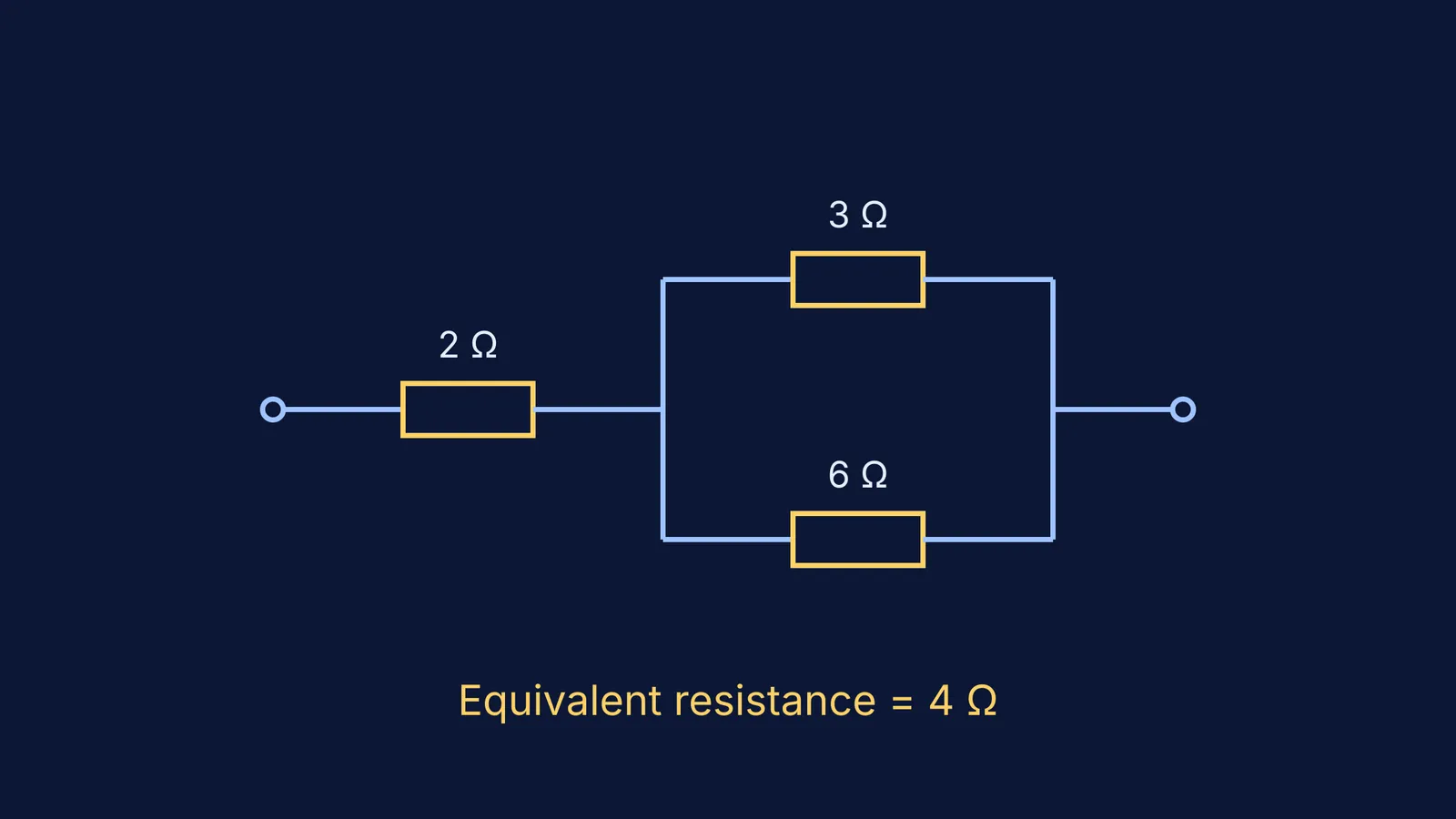
A classic problem from the NCERT Class 10 Science textbook (Chapter 11: Electricity) asks how to connect 2 Ω, 3 Ω, and 6 Ω resistors to get a total resistance of 4 Ω and 1 Ω.
Target: 1 Ω The target is smaller than the smallest resistor (2 Ω). This tells you immediately that all three must be in parallel. 1/Rp = 1/2 + 1/3 + 1/6 1/Rp = 3/6 + 2/6 + 1/6 = 6/6 = 1 Rp = 1 Ω
Target: 4 Ω The target is between the all-parallel minimum (1 Ω) and the all-series maximum (11 Ω). Let us try putting two in parallel and one in series. If we put the 3 Ω and 6 Ω resistors in parallel, their equivalent resistance is: 1/Rp = 1/3 + 1/6 = 3/6 Rp = 2 Ω
Now, take that 2 Ω equivalent resistance and connect it in series with the remaining 2 Ω resistor: Total resistance = 2 Ω + 2 Ω = 4 Ω
What happens if you try the other combinations?
To fully understand the circuit, it helps to see what happens when you build the other possible shapes using the same 2 Ω, 3 Ω, and 6 Ω resistors.
All in series: 2 + 3 + 6 = 11 Ω. This limits the current severely.
2 Ω and 3 Ω in series, parallel with 6 Ω: The series branch is 5 Ω. In parallel with 6 Ω, the total is (5 × 6) / (5 + 6) = 30 / 11, which is about 2.72 Ω.
2 Ω and 6 Ω in series, parallel with 3 Ω: The series branch is 8 Ω. In parallel with 3 Ω, the total is (8 × 3) / (8 + 3) = 24 / 11, which is about 2.18 Ω.
3 Ω and 6 Ω in series, parallel with 2 Ω: The series branch is 9 Ω. In parallel with 2 Ω, the total is (9 × 2) / (9 + 2) = 18 / 11, which is about 1.63 Ω.
2 Ω and 3 Ω in parallel, series with 6 Ω: The parallel part is (2 × 3) / (2 + 3) = 6 / 5 = 1.2 Ω. Adding the 6 Ω in series gives 7.2 Ω.
2 Ω and 6 Ω in parallel, series with 3 Ω: The parallel part is (2 × 6) / (2 + 6) = 12 / 8 = 1.5 Ω. Adding the 3 Ω in series gives 4.5 Ω.
By testing the combinations logically, you can solve any three-resistor problem without guessing blindly. You can even check your answer using Ohm's law. If you attach a 12 V battery to your 4 Ω circuit, the total current will be 3 A. The 2 Ω series resistor takes the full 3 A current, using up 6 V. The remaining 6 V is applied across the parallel 3 Ω and 6 Ω resistors. The 3 Ω resistor takes 2 A, and the 6 Ω resistor takes 1 A. These branch currents add up perfectly to the 3 A main current, proving your circuit works exactly as intended.


