

On this page
In short When heat flows through multiple materials, you can treat them like electrical circuits by defining thermal resistance as R = L/kA. For rods joined end-to-end, their thermal resistances add up in series (R = R₁ + R₂), whereas rods placed side-by-side split the heat flow in parallel (1/R = 1/R₁ + 1/R₂).
If you look at the formula for heat conduction, it looks exactly like Ohm's law for electrical circuits. This simple connection is a powerful tool for solving heat transfer problems in exams like the JEE and NEET.
When you place two different metal rods end-to-end or side-by-side, finding the overall rate of heat flow can seem complicated. But by turning the rods into a circuit diagram and treating temperature difference like voltage, you can calculate the heat current and the equivalent thermal conductivity in seconds.
How is thermal resistance like electrical resistance?
In an electrical circuit, the current I is driven by a voltage difference ΔV across a resistance R, giving Ohm's law: I = ΔV / R.
In thermodynamics, heat conduction works the same way. Heat flows from a hot junction to a cold junction. The rate of heat transfer through a material is defined as H = kA(T₁ - T₂)/L, where H is the heat current, k is the thermal conductivity, A is the cross-sectional area, T₁ - T₂ is the temperature difference, and L is the length according to HyperPhysics.
If we rearrange this equation to match Ohm's law, we get: H = (T₁ - T₂) / (L/kA)
This tells us that the temperature difference (T₁ - T₂) acts as the "voltage" pushing the heat, and the term L/kA acts as the barrier to the flow. We call this the thermal resistance (R_th): R_th = L/kA
This concept is exactly the same as finding the resistance of a tapered conductor in electricity, just applied to heat. If you need a refresher on the basics, the Fermi Concept Library explains thermal conductivity and its units from scratch.
What is the thermal resistance of rods in series and parallel?
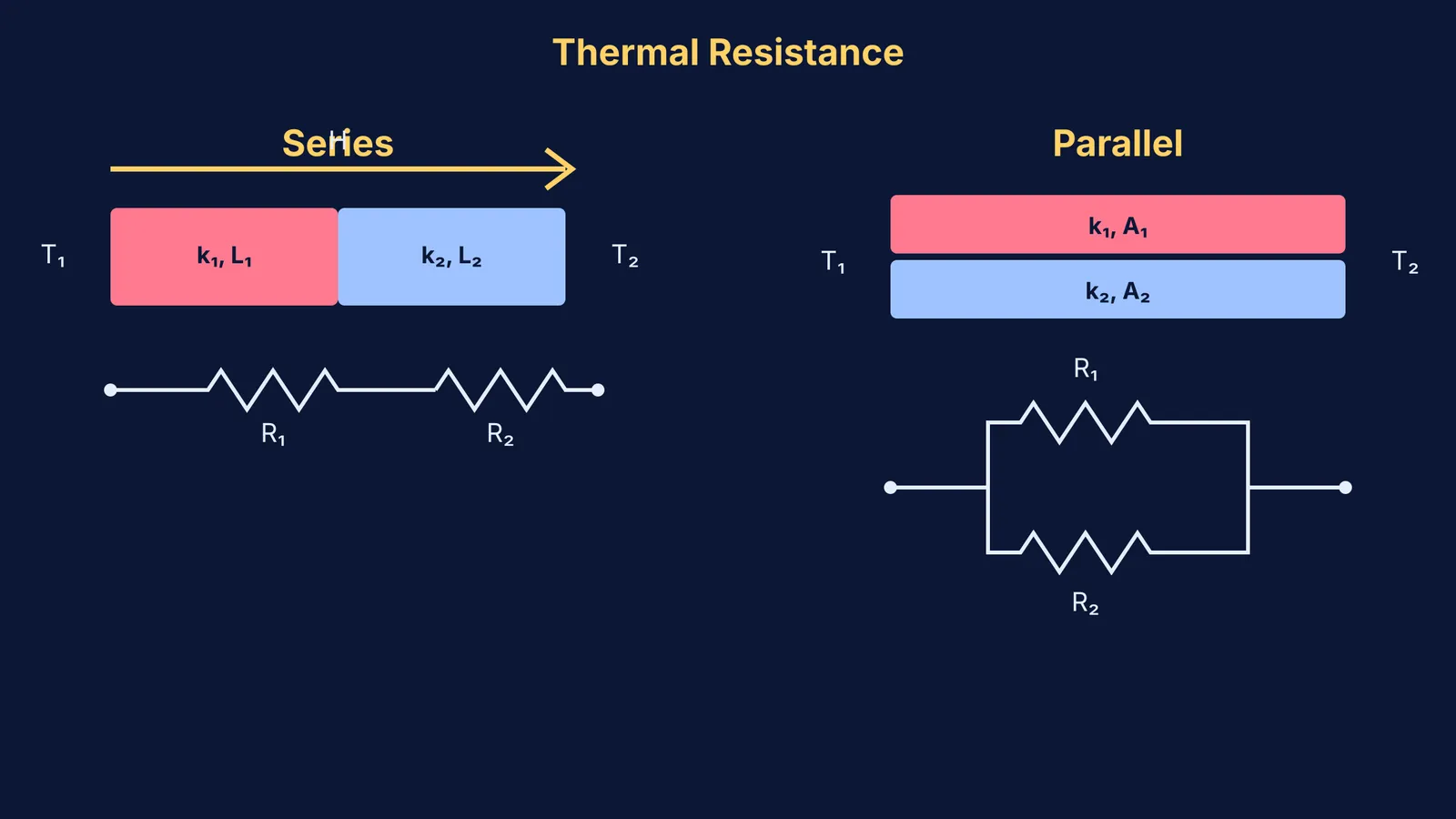
When heat must pass through multiple layers of different materials, the layers are in series as derived by HyperPhysics. Imagine two rods of lengths L₁ and L₂, with thermal conductivities k₁ and k₂, joined end-to-end. The same heat current H must flow through both of them, just as the same electrical current flows through resistors in series.
The total thermal resistance is simply the sum of the individual resistances: R_eq = R₁ + R₂
Substituting the formula for thermal resistance, we get: R_eq = (L₁ / k₁A) + (L₂ / k₂A)
If the rods are connected side-by-side between the same two temperatures, they are in parallel. When heat can flow through multiple paths simultaneously, the paths are in parallel. The total heat current splits between the two rods, just as electrical current splits in a parallel circuit.
For parallel rods, we add the reciprocals of their resistances: 1/R_eq = 1/R₁ + 1/R₂
If you find it hard to picture the heat flow taking different paths, the Fermi Simulation Lab lets you adjust the dimensions of the rods and watch how the energy distribution changes. This is similar to solving an infinite ladder of resistors, where finding the total parallel and series resistance is the main challenge.
How do you find the equivalent thermal conductivity?
Exams often ask you to find the equivalent thermal conductivity (k_eq) of a combination of rods. This means imagining a single rod that could replace the whole setup while keeping the same overall dimensions and total thermal resistance.
For rods in series Let's take two rods of equal cross-sectional area A, but different lengths L₁ and L₂. The equivalent rod will have a length of L₁ + L₂ and an area A.
Using the series resistance rule (R_eq = R₁ + R₂): (L₁ + L₂) / (k_eq × A) = (L₁ / k₁A) + (L₂ / k₂A)
The area A cancels out from both sides, leaving: (L₁ + L₂) / k_eq = (L₁ / k₁) + (L₂ / k₂)
If the two rods also have the same length (L₁ = L₂ = L), the formula simplifies to: 2L / k_eq = L/k₁ + L/k₂ k_eq = 2k₁k₂ / (k₁ + k₂)
For rods in parallel Now imagine two rods of equal length L, but different areas A₁ and A₂, joined side-by-side. The equivalent rod will have a length L and a total area of A₁ + A₂.
Using the parallel resistance rule (1/R_eq = 1/R₁ + 1/R₂): k_eq(A₁ + A₂) / L = k₁A₁ / L + k₂A₂ / L
The length L cancels out: k_eq(A₁ + A₂) = k₁A₁ + k₂A₂
If the two rods have the exact same area (A₁ = A₂ = A), the formula simplifies nicely: k_eq(2A) = k₁A + k₂A k_eq = (k₁ + k₂) / 2
Can we solve a worked example?
Let's put this into practice with a classic setup. You have a copper rod (k = 385 W/m·K) and a steel rod (k = 50.2 W/m·K) of identical lengths and areas, joined end-to-end in series. These conductivity values match those published by HyperPhysics. The free end of the copper rod is at 100 °C, and the free end of the steel rod is at 0 °C. What is the temperature at the junction?
Since they are in series, the heat current H is the same through both rods: H = (100 - T) / R_copper = (T - 0) / R_steel
Where R_copper = L / (385 × A) and R_steel = L / (50.2 × A).
Because L and A are the same, rearranging gives: 385(100 - T) = 50.2(T - 0) 38500 - 385T = 50.2T 435.2T = 38500 T = 88.5 °C
Because the steel rod offers more resistance to the heat flow, most of the temperature drop happens across it. If you get stuck on questions like this, the Fermi Problem Library breaks down composite rod problems step by step, helping you set up the circuit equations before you start solving.


