On this page
The AI tutor's answer looked neat and sure of itself, and it was wrong. This is normal, it will happen again, and how you react shapes how your child uses AI. The aim is not to ban the tool but to raise a child who treats every AI answer as a draft to check.
Can an AI tutor really give a wrong answer?
Yes, and often more than parents expect. In a field experiment with nearly 1,000 students at a high school in Turkey, published in PNAS in 2025, researchers gave students GPT-4 for maths practice (Bastani and colleagues, PNAS).
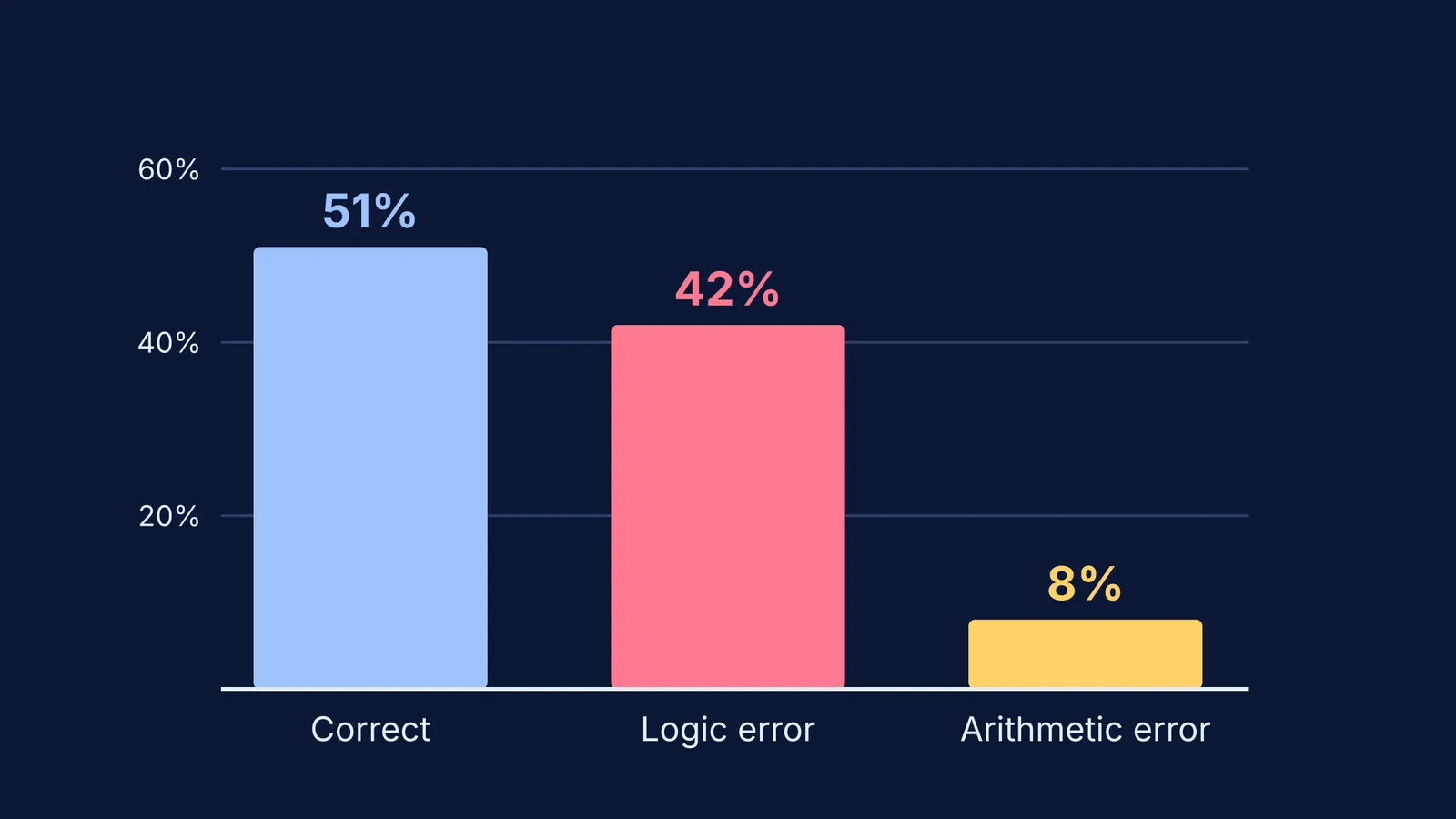
When the researchers asked the plain chatbot for the answer to each of the 57 practice problems ten times, it was correct only 51% of the time; it made logical errors 42% of the time and arithmetic errors 8% of the time (PNAS study).
The same study found that students who practised with the plain chatbot scored 17% lower on a later exam taken without it than students who never had it, and they did not notice that they had learned less (PNAS study). A version with prompts designed to protect learning largely removed that harm.
Why does this happen? A 2025 paper by Adam Tauman Kalai and colleagues argues that language models guess when uncertain, "like students facing hard exam questions", because training and evaluation reward guessing over admitting uncertainty (Kalai and colleagues, arXiv). So the tone of an answer tells your child nothing about whether it is right.
What should I tell my child when the AI got it wrong?
Keep it calm and short. Your child may feel foolish or decide AI is useless; neither helps. Try this:
"Good catch. You just did what scientists do: you didn't believe something only because it sounded sure."
"AI tools guess sometimes. That's not a reason to stop using it. It's a reason to check."
"Let's find where it went wrong. Open your textbook to the same topic."
"Which step doesn't match the book? Show me with your finger."
"Now you explain the right way to me, as if I'm the AI."
If your child didn't catch the mistake and lost marks, swap line 1 for: "Lots of people missed this. Next time we'll have a check that catches it."
How do I check an AI answer against the textbook?
Teach one routine and use it every time. Here it is with a Class 9 motion question.
The question: a car slows from 20 m/s to rest in 4 s. Find its acceleration. Suppose the AI replies "5 m/s²".
Find the matching page. Open the textbook chapter on motion and find the worked example closest to the question.
Compare the method, step by step. Write the formula from the book, a = (v − u)/t, and put in the numbers: (0 − 20)/4.
Check units and signs. The working gives −5 m/s². The AI dropped the minus sign without calling it a deceleration, and the sign is the point: the car is slowing down.
Explain it back. Your child says, in their own words, why the sign matters. If they can't, the doubt is not closed yet.
Watch for slips like this one: a dropped sign, a missing unit, a formula from the wrong chapter. For more checks of this kind, see our guide on using dimensions to check physics answers and our post on checking NCERT exercise answers with AI.
How do I make checking a habit, not a fight?
Habits stick when they are small, regular and owned by the child. A simple plan for the next two weeks:
Every AI answer gets one check. Textbook page, units, or a quick estimate. Your child picks which.
Keep a "caught it" list. A page in the notebook where your child writes each AI mistake they find. Praise the list, not just the marks.
Ask, don't tell. At dinner: "Did the AI get anything wrong today? How did you know?"
Try first, then ask AI. In the PNAS study, students who leaned on the plain chatbot as a crutch did worse later on their own (PNAS study), so your child should attempt the problem before opening the tool.
Supervise younger children. UNESCO's guidance sets an age limit of 13 for the use of AI tools in the classroom (UNESCO). Below that, sit with your child, and see our guide to safe AI study for Class 6 to 8.
Tools that show their working make checking easier than one final number does. The Fermi Problem Library has worked problems with a step-by-step solver that explains the reasoning rather than printing an answer, so your child can compare each step with the book.
Tonight, pick one AI answer from this week's homework and run the four-step check together.