On this page
Many parents worry that a five-year-old without daily paper practice will fall behind in Class 1. The evidence points the other way: at this age, children learn letters and numbers well through guided play, and a worksheet works best as an occasional extra.
Are worksheets bad for 5-year-olds?
Not bad, just overused. The trouble starts when daily tracing takes the place of the talking, building and sorting that five-year-olds actually learn from.
The American Academy of Pediatrics' 2018 clinical report The Power of Play notes that early childhood programmes are "pressured to add more didactic components and less playful learning", and says paediatricians can stress a balanced curriculum that includes playful learning. It says play builds the social-emotional, thinking, language and self-regulation skills behind executive function, "the process of learning, rather than the content".
What does India's curriculum say about worksheets at age 5?
NCERT's National Curriculum Framework for the Foundational Stage (2022) covers children aged 3 to 8. On textbooks it is direct: for ages 3 to 6, "there should not be any prescribed textbooks for the children", and "the learning environment, the TLMs and, where appropriate, simple worksheets are more than sufficient for meeting the curricular goals and pedagogical needs." TLMs are teaching-learning materials.
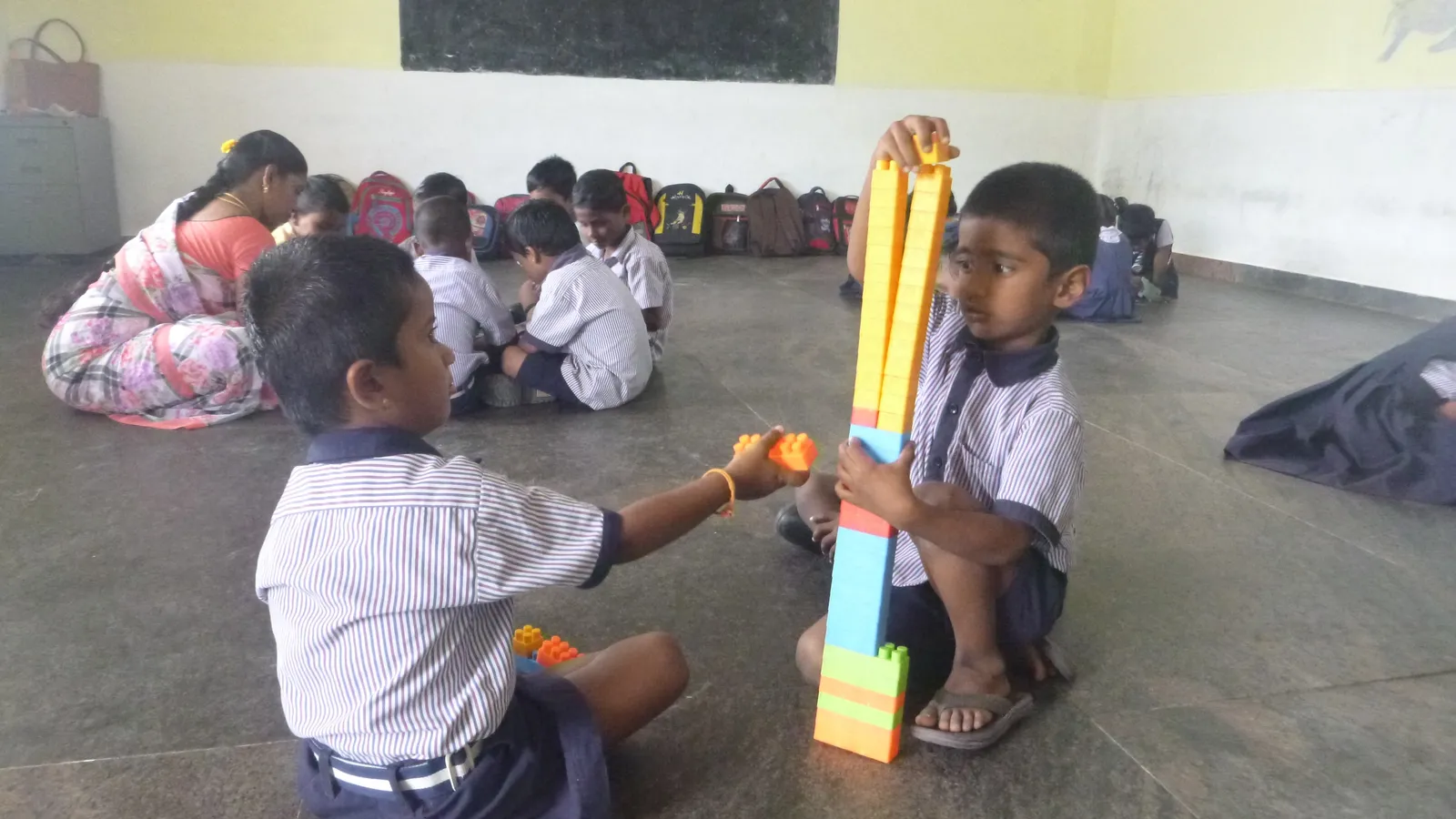
The framework puts play at the core of how lessons and time are organised. In guided play, it says, children lead the activity while adults actively facilitate it, and it calls guided play "most effective for enhancing skills related to all domains of development." It does not ban worksheets. It says children are more engaged when they use their hands and many senses, and that workbooks and worksheets become appropriate "as children grow". For a five-year-old, read that as sometimes, not every day.
It also warns that bringing in the script too early, while spoken language is still developing, "would be counterproductive for literacy development." Talking and listening come first.
Why does play teach letters and numbers better?
The strongest evidence comes from a 2022 systematic review and meta-analysis in Child Development by Kayleigh Skene and colleagues. They reviewed 39 studies and pooled 17 of them, covering 3,893 children aged 1 to 8. Guided play had a greater positive effect than direct instruction on early maths skills (effect size g = 0.24), shape knowledge (g = 0.63) and task switching (g = 0.40). For other key outcomes they found no difference, and they noted that studies defined and ran guided play in different ways.
So play is not magic, and the maths gain was modest. But the review found no key outcome where direct instruction came out ahead. And a worksheet cannot do what you can in a game: ask "how did you know?", notice a bead counted twice, and change the game on the spot.
Hands matter too. The framework suggests tearing paper, clay moulding and, for 4- and 5-year-olds, snipping with blunt scissors, and says paper folding "promotes fine motor coordination", the hand control a pencil needs later.
What can you do instead of worksheets at home?
Here is a five-day plan of 10-minute activities using things you already have.
Monday, letter hunt: pick one sound, say "mmm". Find three things that start with it (mango, mug, mirror), then shape the letter from a rope of atta dough.
Tuesday, rice tray: spread dry rice or sooji on a plate and let your child draw the letter with a finger. Shake to start again.
Wednesday, kitchen counting: "Bring me five spoons." Then ask, "Do we have more spoons or more plates?" Our guide to maths while cooking with kids has more ideas.
Thursday, sorting: sort buttons, peas or socks by colour or size, then count each pile. See these sorting games for young children.
Friday, story and rhyme: read a picture book in your home language, pause on rhyming words and ask, "What happens next?"
When is a worksheet fine?
A worksheet is fine when:
it is an occasional extra, not the main daily activity
it practises something your child has already done with real objects
it gives practice in a meaningful context, with adequate space and clear instructions, as the framework's guidance on maths worksheets asks
it is short, and your child can do most of it alone and wants to
you stop when they get tired or upset, without finishing "just one more row"
If school sends a worksheet home daily, you could tell the teacher: "We've read that the national framework for this stage focuses on play. Could we swap some sheets for an activity at home?" For what this year usually looks like, see what to expect from nursery to LKG.
If you are worried about your child's speech, grip or attention, talk to the class teacher and your paediatrician rather than adding practice.
The idea holds as children grow: for school science later, the Fermi Simulation Lab has interactive simulations for ideas that are easier to see than to read.
For now, put the tracing book away for a week and try the five-day plan.