

On this page
Raise your arm in a big circle, then try the same circle with your forearm while keeping your upper arm still. The first is easy; the second is impossible. That is the whole lesson on joints: the shape where two bones meet decides which way they can move.
What are ball and socket, hinge and pivot joints?
NCERT's Class 11 biology chapter defines joints as points of contact between bones, or between bones and cartilages, where the joint acts as a fulcrum for muscle force (NCERT, Locomotion and Movement). The same chapter says the human skeleton is made of 206 bones and a few cartilages.
A synovial joint has a fluid-filled cavity between the two bones, which allows considerable movement. NCERT's examples include the ball and socket joint between the humerus and pectoral girdle, the hinge joint of the knee, and the pivot joint between the atlas and axis (NCERT).
Which joints are ball and socket joints?
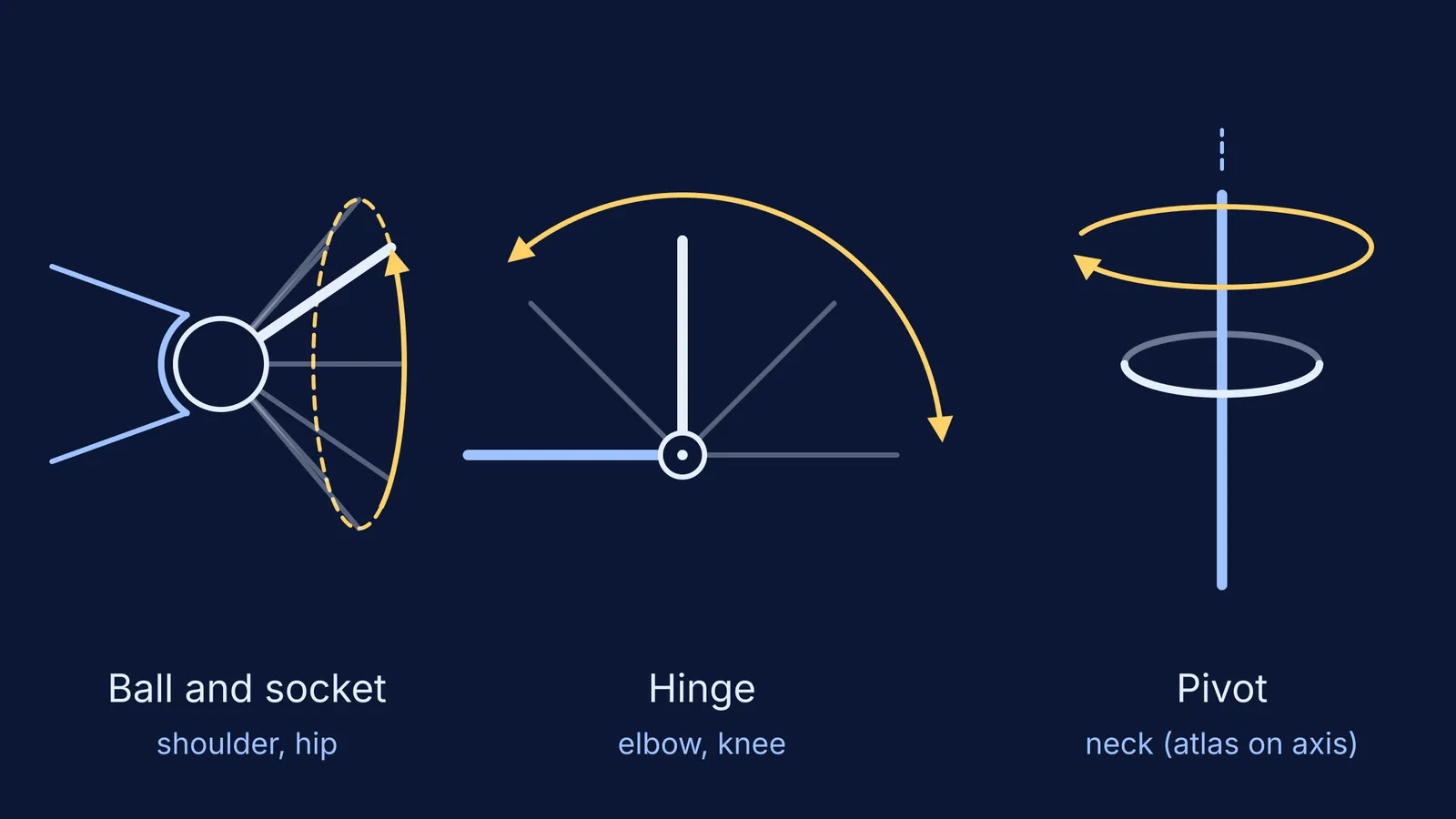
In a ball-and-socket joint, the rounded head of one bone (the ball) fits into a cup-shaped hollow in another bone (the socket), and it has the greatest range of motion of any joint type (OpenStax Anatomy and Physiology 2e, 9.4). The hip and the shoulder are the only ball-and-socket joints in the body, according to the same OpenStax section.
Movement allowed: forward, backward, sideways, and round in a circle. At the shoulder, the head of the humerus sits in the glenoid cavity of the scapula (NCERT); at the hip, the head of the femur sits in the acetabulum.
OpenStax says the shoulder has the largest range of motion of any joint, at the cost of stability, while the weight-bearing hip has a more limited range (OpenStax, 9.6).
Which joints are hinge joints?
A hinge joint allows only bending and straightening along a single axis, like a door on its hinges (OpenStax, 9.4). OpenStax calls the elbow a uniaxial hinge joint that permits flexion and extension of the forearm, and adds that the knee is the largest joint of the body (OpenStax, 9.6).
Movement allowed: bend and straighten, in one plane only. NCERT uses the knee as its hinge example.
Which joint is the pivot joint in the neck?
At a pivot joint, a rounded part of one bone sits inside a ring formed partly by another bone and partly by a ligament, and it rotates around a single axis (OpenStax, 9.4). The neck example is the joint between the first two vertebrae, the atlas and the axis.
Movement allowed: rotation. The atlas turns on top of the axis, moving your head left and right, as when you shake your head to say "no" (OpenStax, 9.6). Nodding "yes" is a different movement, so don't use it as your pivot example.
Which joints in your body do not move?
Not every joint moves. NCERT describes fibrous joints, such as the flat skull bones joined by sutures to form the cranium, which allow no movement, and cartilaginous joints between neighbouring vertebrae, which allow limited movement (NCERT). Some school books call the skull sutures fixed joints.
How can you test each joint type on your own body?
Try this five-minute test. Move slowly and gently, and stop if anything hurts.
Shoulder: hold your arm straight out and draw a big circle in the air. A full circle means many directions, so ball and socket.
Elbow: rest your upper arm on the desk. Bend and straighten your forearm, then try to swing it sideways. It only goes one way, so hinge.
Knee: sit on a chair and swing your lower leg forward and back. Same single plane, so hinge.
Neck: keep your shoulders still and turn your head to look left, then right. Turning around an upright axis means pivot.
Head: press gently on the top of your skull. Nothing shifts between the bones, so fixed joint.
In an exam, ask the same three questions. Can it go round in a circle? Ball and socket. Does it only open and close like a door? Hinge. Does it turn around an axis? Pivot.
Check your own syllabus, too. NCERT's 2024 Class 6 science textbook, Curiosity, has twelve chapters, and none of the chapter titles in its contents list is on body movements (NCERT, Curiosity prelims). The topic returns in the Class 11 biology chapter Locomotion and Movement.
Related reading: how a skeletal muscle is built, compact versus spongy bone and how X-rays show bones.
When a later topic builds on this one, such as the skeleton in Class 11, the Fermi Concept Library has every concept in biology with its own lesson and its place in the map, so you can see what joints connect to.


