On this page
A kitchen is full of numbers that matter: two cups of water for one cup of rice, a timer for the dal, four rotis for four people. For a child aged 5 to 11, those numbers are more interesting than a worksheet, because a wrong answer changes dinner.
Does doing maths at home actually help children?
The link is real but small, and that is worth knowing. A 2021 meta-analysis in Psychological Bulletin pooled 631 effect sizes from 64 studies and found an average correlation of r = .13 between children's home maths environment and their maths achievement (Daucourt et al., 2021). A 2025 meta-analysis of 72 samples from 20 countries, covering children aged 7 and under, found the same small positive relation, r = .13, and noted that the surveys behind it often ask about counting objects, weighing out ingredients and telling the time (James-Brabham et al., 2025).
These are correlations, not proof that cooking raises marks: kitchen maths adds to school, it does not replace it.
The skills it practises are the ones many Indian children are still building. In ASER 2024, a nationwide survey of rural households, 33.7% of Std III children could do a two-digit subtraction with borrowing, and 30.7% of Std V children could do a three-digit by one-digit division.
Which kitchen tasks practise which maths skills?
Ages 5 to 7, counting, comparing and measuring:
Counting: "Put six spoons of besan in the bowl. If I take one out, how many are left?"
Comparing: "Which glass holds more? How could we check without guessing?" Let them pour water from one into the other.
Measuring with any unit: "How many small katoris fill the big one?"
Ages 7 to 9, adding, subtracting and time:
Timing: "The rice needs 20 minutes. It is 7:45 now. When do we switch it off?"
Doubling and halving whole numbers: "The recipe says 3 tomatoes for 2 people. How many for 4?"
Ages 9 to 11, fractions, ratio and scaling:
Ratio: "One cup of rice takes two cups of water. How much water for three cups of rice?"
Fractions of a measure: "We need half of three-quarters of a teaspoon. How much is that?"
Scaling a whole recipe, as in the example below.
How do you double or scale a recipe with a child?
Take a poha recipe that serves 4: 2 cups poha, 1/2 teaspoon turmeric, 3/4 teaspoon salt and 1 1/2 tablespoons oil. Two guests arrive, so you now need 6 servings.
Estimate first: "Is 6 people double, or less than double?" (Less: double would be 8.)
Find the multiplier: 6 ÷ 4 = 1 1/2. "So we need everything once, plus half again."
Poha: 2 + 1 = 3 cups.
Turmeric: 1/2 + 1/4 = 3/4 teaspoon.
Salt: 3/4 + 3/8 = 9/8, a little over 1 teaspoon. Ask: "Can our spoons measure 9/8 exactly?" Rounding is a real cook's decision.
Oil: 1 1/2 + 3/4 = 2 1/4 tablespoons.
How do you teach fractions with a roti?
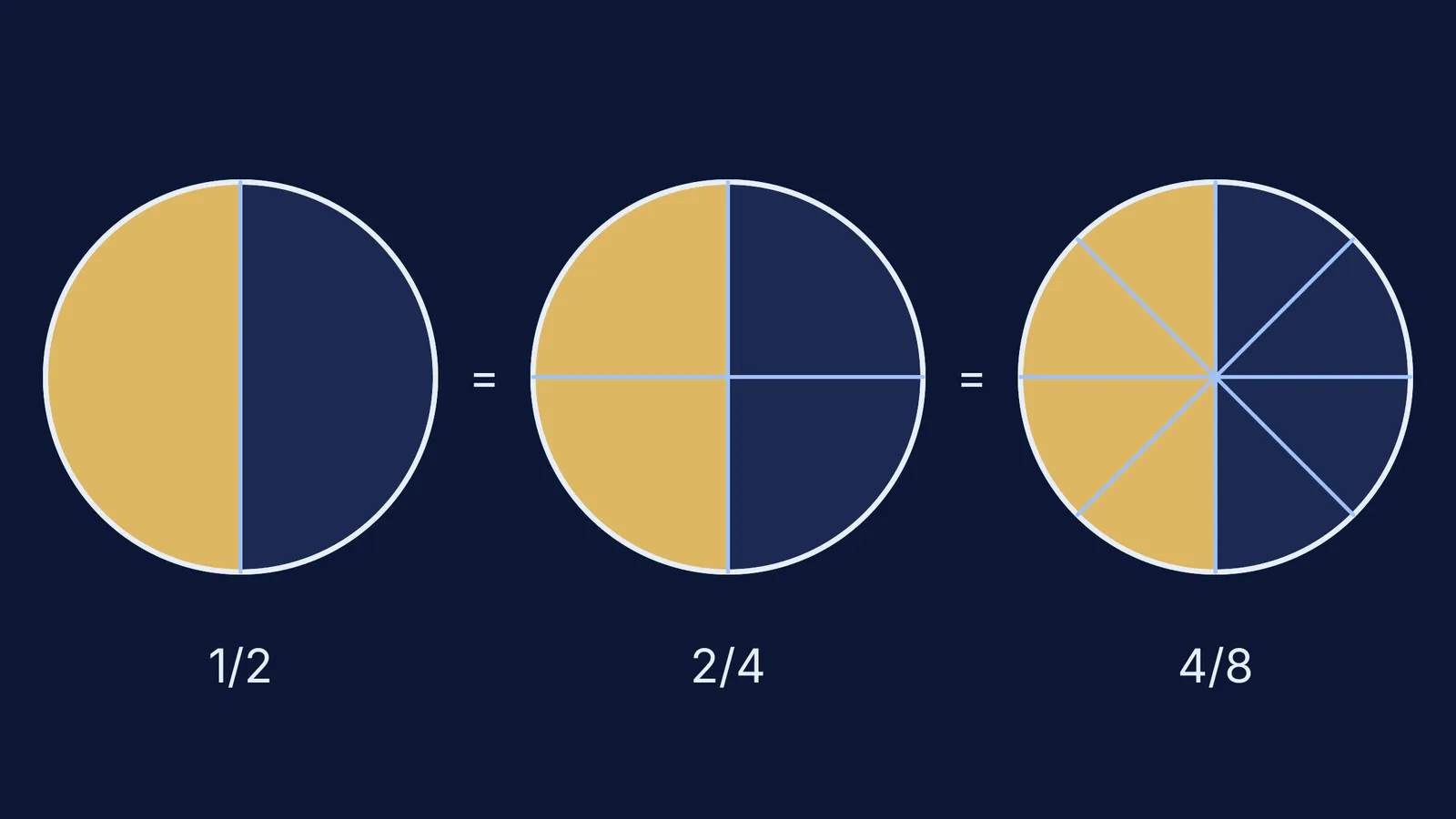
Start with fair sharing. Three rotis, four people: how much does each person get? Fold or cut each roti into quarters and share them out, and each person gets three quarters. That is 3 ÷ 4 = 3/4, seen on a plate. Then ask: "Is half a roti the same as two quarters? As four eighths?" Folding the roti answers it.
This is worth the time. A study of large, nationally representative data sets from the US and the UK found that primary school children's knowledge of fractions and of division predicted their algebra and overall maths achievement in high school, 5 or 6 years later, even after accounting for other maths knowledge, general ability, working memory and family income and education (Siegler et al., 2012).
If your child is in Class 6, our guide to fractions in the Class 6 textbook shows where the kitchen ideas reappear in school.
What should you say when they get it wrong?
Ask before you correct. Try: "How did you get that?", then "Let's check with the measuring cup", then "What would you change next time?" A mistake in the pot is easy to fix and to talk about.
Your own comfort with maths matters too. In a study of a maths app for families, children's maths improved within months, and the gains were largest where caregivers described themselves as anxious about maths (Berkowitz et al., 2015). If numbers make you tense, read our piece on parents' maths anxiety, and see everyday maths talk with young children for more phrases to use.
For older children who want to see where fractions and ratio lead next, the Fermi Concept Library gives every concept in mathematics its own lesson and its place in the map.
Tonight, pick one task from your child's age group and ask just two of the questions while you cook.