

On this page
The transition from Nursery to Lower Kindergarten (LKG) can feel like a major milestone for families. Under India’s National Education Policy (NEP) 2020, preschool is no longer just a soft on-ramp; it is formally integrated into a single "Foundational Stage" covering the first 5 years of education.
For parents, the shift means adapting to new expectations. While the learning remains play-based, LKG introduces more structure, shifting the focus from simple socialisation to emergent literacy and numeracy.
What changes from Nursery to LKG?
The National Curriculum Framework for Foundational Stage 2022 (NCF-FS) lays out clear developmental goals for these early years. In Nursery (typically ages 3 to 4 years), the primary focus is on "settling in"—developing basic gross motor skills, participating in parallel play, and getting used to time away from caregivers.
When a child enters LKG at age 4 years, the environment introduces more intentionality:
Literacy: Nursery children listen to stories and scribble. LKG students begin to recognise letter sounds, attempt "invented spelling," and hold longer conversations.
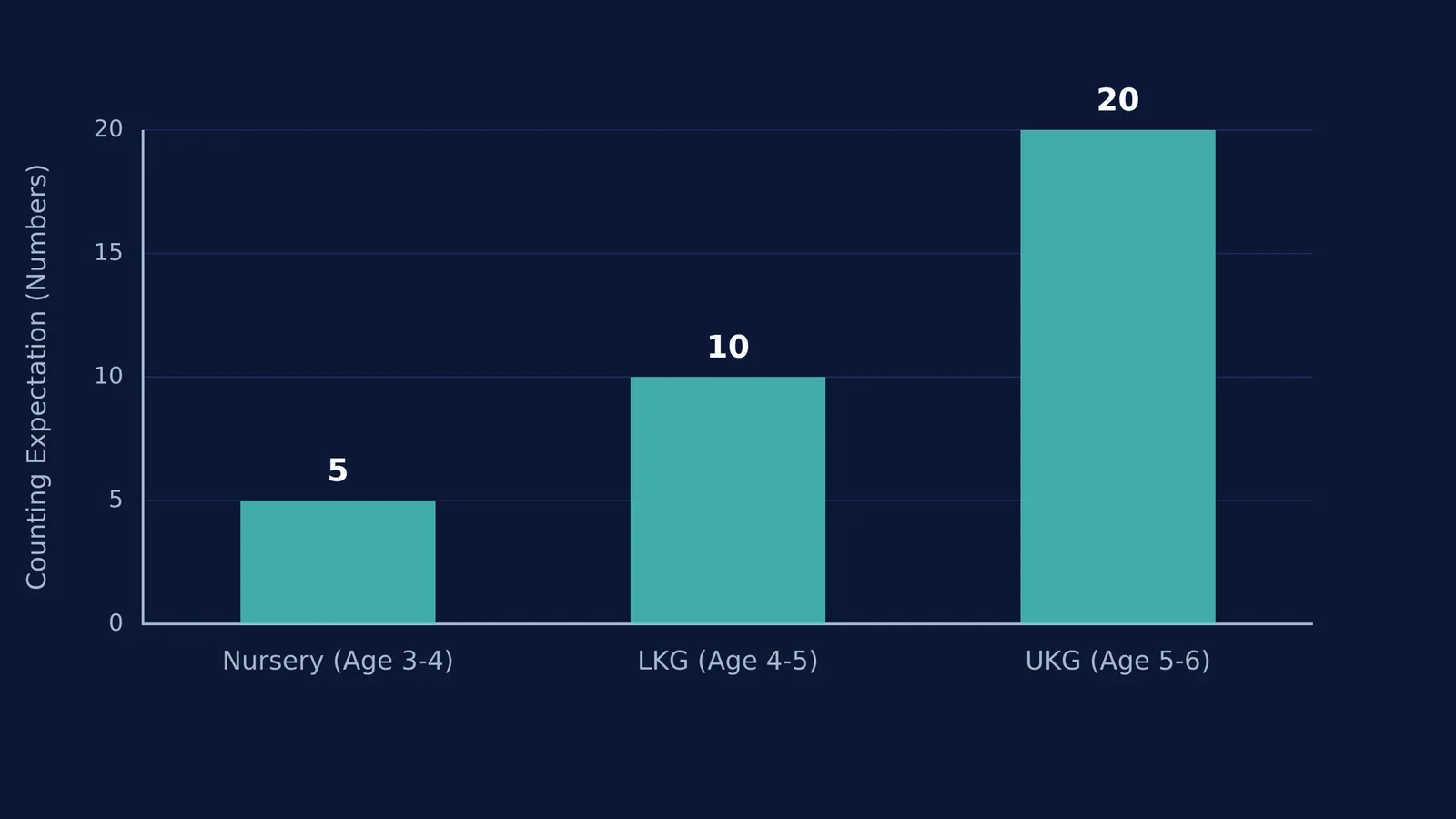
Numeracy: While a 3-year-old might sort objects by colour and count up to 5 objects, a 4-year-old in LKG learns to recognise patterns, sort by multiple attributes, and count objects up to 10.
Social skills: Parallel play evolves into cooperative play, where children must learn to share and understand another child’s perspective.
Is LKG all about writing and tests now?
Parents often worry that the formalisation of preschool means their 4-year-old will face exams. However, the NEP 2020 explicitly warns against traditional written tests for children aged 3 to 8 years (the entire Foundational Stage).
Instead, schools are shifting to Holistic Progress Cards. Rather than marks, teachers record observational notes on a child’s physical, socio-emotional, cognitive, and language development over time. The curriculum avoids formal textbooks in favour of worksheets, board games, and storytelling, ideally delivered in the child's home language to ensure better cognitive development.
What if my child does not seem ready for LKG?
Children develop at different rates, and variations are normal at 4 years old. Some might have strong motor skills but struggle with sharing, while others may speak clearly but find it hard to sit still.
If you are concerned about your child's transition, request a "readiness handover" conversation with their Nursery teacher. The NCF-FS 2022 emphasises documenting a child's developmental stage during this transition so the LKG teacher understands their specific needs. Focus on positive reinforcement, and give your child time to adjust to the new environment and routine. If they struggle with separation, practice short, predictable drop-offs.
How can you prepare your child gently at home?
You do not need to drill the alphabet at home. Instead, focus on building the underlying cognitive and physical skills that make formal learning easier.
Encourage independent self-care: A child who can open their own lunchbox, wash their hands, and manage their belongings feels more confident in a classroom. LKG requires more independence than Nursery, where teachers provide significant physical assistance.
Develop fine motor skills: Before a child can write letters, they need hand strength. Let them use child-safe scissors, peel stickers, build with small blocks, or help knead dough in the kitchen. These activities develop the pincer grip required for holding a pencil.
Start active learning early: Ask your child to explain their thinking rather than just giving them the answer. If they get stuck counting blocks, guide them to the next step rather than doing it for them; later in their schooling, platforms like the Fermi Problem Library will do exactly this for complex subjects by providing a step-by-step solver that explains the reasoning rather than printing an answer. In LKG, you build this foundation simply by asking, "What do you think happens next?"
Practise everyday maths talk: Talk about shapes, sizes, and quantities during daily routines. Asking a child to fetch "two more spoons" or pointing out the pattern on a shirt introduces maths talk with young children naturally, without adding pressure.
The leap to LKG is significant, but it is designed as a gradual progression. By focusing on independence and curiosity at home, you ensure your child arrives ready to learn.


