On this page
Give two animals the same antigen and one may respond strongly while the other barely responds. In the early 1960s Baruj Benacerraf showed that this difference is written in the genes. By 1970 his lab and others had placed those genes in the same stretch of DNA that decides whether a skin graft is accepted or rejected. That stretch is the major histocompatibility complex, or MHC.
Who was Baruj Benacerraf?
Benacerraf was born in Caracas, Venezuela, on 29 October 1920, according to his Nobel autobiography. He grew up in Paris from the age of five, moved to New York in 1940, and finished a science degree at Columbia University in 1942.
He writes that, in spite of an excellent record, he "was refused admission by the numerous medical schools" he applied to. A friend's father helped him get one of the last places at the Medical College of Virginia. Childhood asthma had made him curious about allergy, and hypersensitivity became his research interest.
He shared the 1980 Nobel Prize in Physiology or Medicine with Jean Dausset and George Snell "for their discoveries concerning genetically determined structures on the cell surface that regulate immunological reactions" (Nobel Prize press release). He died on 2 August 2011.
What did Benacerraf discover about immune response genes?
At New York University, Benacerraf's lab immunised guinea pigs with a simple synthetic antigen: a small chemical tag attached to a chain of the amino acid lysine (poly-L-lysine). In his autobiography he says the animals split into "two groups, responders and nonresponders."
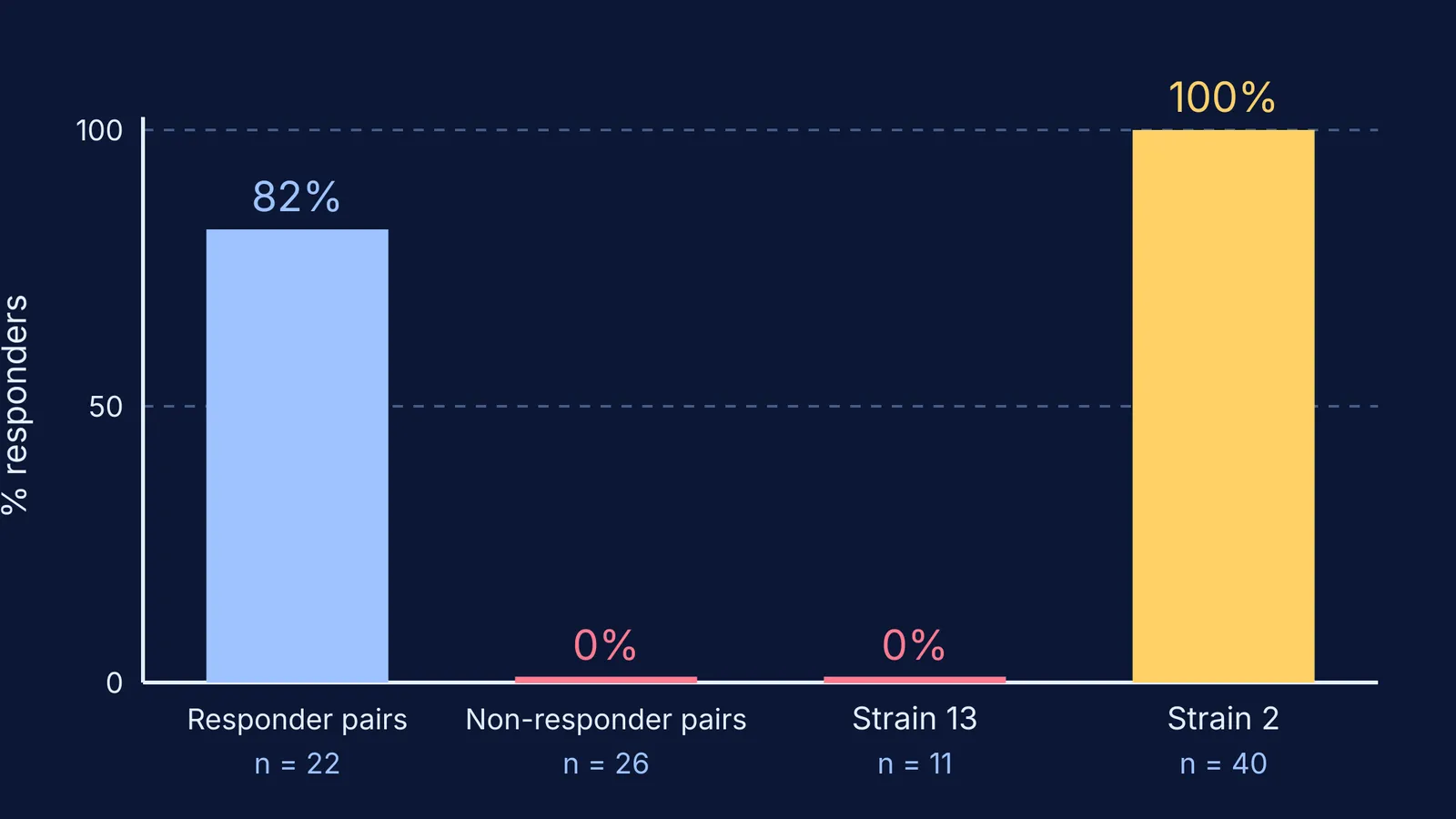
The 1963 breeding study by Levine, Ojeda and Benacerraf in the Journal of Experimental Medicine tested whether the split was inherited:
82% of the 22 offspring of responder parents were responders.
None of the 26 offspring of non-responder parents were responders.
All 40 guinea pigs of inbred strain 2 responded; none of 11 strain 13 animals did.
The authors concluded that the ability to respond is passed on as a single dominant Mendelian gene. These genes were "termed immune response (Ir) genes," his autobiography says.
How do immune response genes connect to the MHC?
George Snell had already shown in mice that genes on one region of one chromosome control whether transplanted tissue is accepted, and that region was named the major histocompatibility complex, according to the Nobel press release. Jean Dausset found the human version, the HLA genes.
Two results tied Ir genes to that region. In mice, McDevitt and Chinitz reported in Science in 1969 that responses to three synthetic polypeptides closely matched each strain's H-2 type, the mouse MHC. In 1970, Ellman, Green, Martin and Benacerraf showed in PNAS that the guinea pig poly-L-lysine gene is linked to the main histocompatibility locus, extending the pattern to a second species.
The Nobel press release summed it up this way: genes "intimately related" to the transplant antigen genes regulate how immune cells work together, and are "thereby important to the strength of an immunological reaction." Benacerraf's later Harvard work looked at how T cells recognise antigen alongside the body's own MHC molecules. Our explainer on how killer T cells recognise a virus only with self MHC picks up that part of the story, and humoral vs cell-mediated immunity covers why T cells reject grafts.
Can you work out the inheritance from his data?
Using the counts in the 1963 paper, let R be the responder allele and r the non-responder allele, with R dominant.
Non-responder × non-responder. Both parents must be rr. Every pup is rr, so the prediction is 0% responders. The data: 0 of 26. It fits.
Responder × responder. Each parent is RR or Rr. Only an Rr × Rr pair gives non-responders, one in four on average, so expect mostly responders. The data: 82% of 22, about 18 pups. It fits.
The inbred strains. Strain 2 behaves like RR (40 of 40 respond) and strain 13 like rr (0 of 11).
Your prediction. Cross strain 2 with strain 13. Every pup is Rr, so all should respond. Cross those pups back to strain 13 and you expect about half responders. This step is our prediction from Mendel's rules, not data from the 1963 paper.
If the monohybrid logic in step 2 felt shaky, the Fermi Problem Library has worked problems with a step-by-step solver that explains the reasoning rather than printing an answer.
How should you remember this for biology exams?
Guinea pigs, poly-L-lysine, responders vs non-responders, 1963.
One dominant Ir gene controls the response.
Ir genes sit in the MHC, which also controls graft rejection.
1980 Nobel Prize with Snell and Dausset.
If antigens are still fuzzy, start with how antibodies recognise specific antigens, then look up MHC and dominance in the Fermi Concept Library, where each concept has its own lesson and its place in the map.