

On this page
Benjamin List was a postdoctoral researcher at the Scripps Research Institute in California when he asked a simple question: does an amino acid have to be part of a large enzyme to catalyse a reaction? His answer, published in February 2000, was no. Proline, a small amino acid, could do the job on its own, and could make one mirror-image form of a product far more than the other.
What did Benjamin List discover in 2000?
A catalyst speeds up a chemical reaction without being used up in it, as the Nobel Committee's popular science background explains. The same document says that, in principle, every catalyst found before 2000 was either a metal or an enzyme.
List was working on catalytic antibodies in Carlos F. Barbas III's group. He noticed that many enzymes need no metal: one or a few amino acids inside the protein do the chemistry. Could a single amino acid work alone? He tested proline on an aldol reaction, in which carbon atoms from two molecules bond, and according to the Nobel background it worked straight away.
The paper, “Proline-Catalyzed Direct Asymmetric Aldol Reactions” by List, Richard A. Lerner and Barbas, appeared in the Journal of the American Chemical Society, volume 122, pages 2395 to 2396. The popular background quotes how List described the new concept when he published it: “The design and screening of these catalysts is one of our future aims”.
How does proline catalyse the aldol reaction?
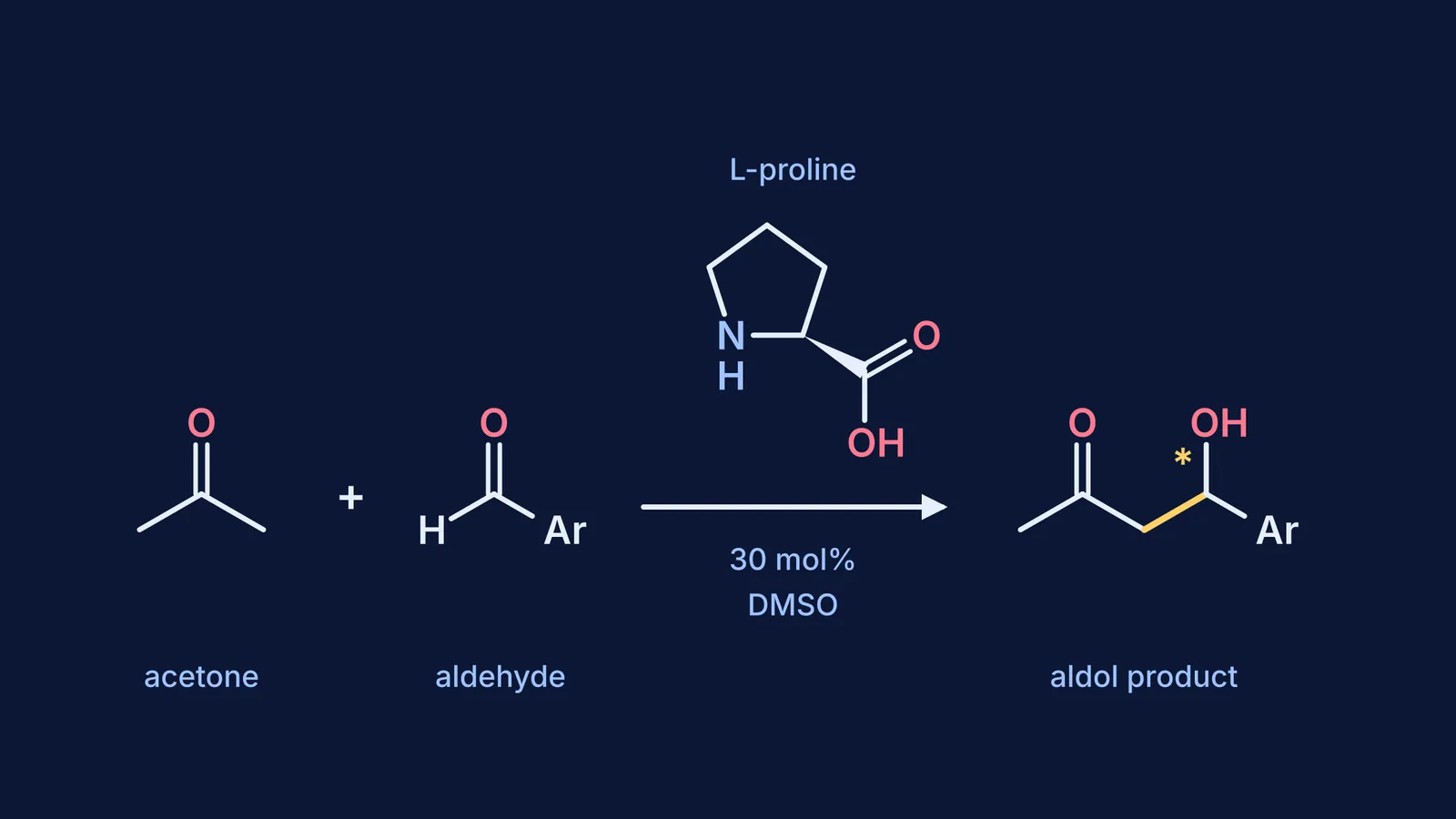
The Nobel Committee's scientific background shows List's reaction: acetone joined to a series of aldehydes, with L-proline (30 mol%) as the catalyst and DMSO as the solvent. In plain terms:
Proline's nitrogen reacts with acetone to form an enamine, which has a raised HOMO and so is a better nucleophile.
The enamine's carbon attacks the carbonyl carbon of the aldehyde. This makes the new carbon–carbon bond, shown in yellow in the diagram above.
Proline's carboxylic acid group helps stabilise the transition state through hydrogen bonding. This steers the attack, so one mirror image forms far more often.
The product is released and proline is free for the next cycle, which is what makes it a catalyst rather than an ingredient.
The researchers suggested that proline works as a “micro-aldolase”, a small mimic of an enzyme. Across six examples in equation 2 of that background, yields were 54 to 97% and the enantiomeric ratio ran from 80:20 up to 98:2.
If the aldol steps are fuzzy, start with our step-by-step aldol condensation mechanism.
Why does a catalyst without metals matter?
The 2021 Nobel press release says organic catalysts are built on a framework of carbon atoms, often with oxygen, nitrogen, sulphur or phosphorus, so they are “both environmentally friendly and cheap to produce”. The popular background adds that some metal catalysts are very sensitive to oxygen and water, which is hard to manage in large factories, and that many are heavy metals that can harm the environment.
Controlling mirror images matters most for medicines: the popular background recalls the 1960s thalidomide disaster, when one mirror image of the drug harmed developing embryos. It also gives an example of efficiency: the first synthesis of strychnine, in 1952, took 29 reactions and only 0.0009% of the starting material became strychnine. In 2011, an organocatalytic cascade built it in 12 steps and was 7,000 times more efficient.
List shared the 2021 prize with David MacMillan, who independently developed a different metal-free catalyst the same year and coined the word “organocatalysis”. For the earlier, metal-based route to the same goal, read our profile of Ryoji Noyori and asymmetric hydrogenation.
How do you turn an enantiomeric ratio into ee?
Papers often report an enantiomeric ratio (er); your textbook uses enantiomeric excess (ee). The conversion is: ee = (major − minor) ÷ (major + minor) × 100. Using the figures in the Nobel scientific background:
List's weakest result, er 80:20, gives (80 − 20) ÷ 100 × 100 = 60% ee.
His best, er 98:2, gives 96% ee.
A 50:50 (racemic) mixture gives 0% ee.
Try it yourself: Hajos and Parrish's proline reaction (Scheme 1 of the background) gave er 97.4:2.6. (Answer: 94.8% ee.)
To connect ee to what a polarimeter reads, see our guide to enantiomeric excess and specific rotation.
What can you learn from how List worked?
List's question is a habit you can copy in any subject:
Ask which small part of a system does the real work.
Look again at old results that nobody followed up.
Run the cheap, simple test before the complicated one.
If the jump from enzyme to enamine is still unclear, the Fermi Concept Library gives every concept in chemistry its own lesson and its place in the map. For ee and yield numericals, the Fermi Problem Library has worked problems with a step-by-step solver that explains the reasoning rather than printing an answer.
Next time you write out an aldol mechanism, try swapping the base for proline and see what changes.


