

On this page
Most students can write the aldol product from memory. In a mechanism question, though, the marks go to the arrows: which proton leaves, which carbon attacks, where the new hydrogen comes from, and why heat changes the product. Below is each step for ethanal, then a ketone to try yourself.
What is aldol condensation?
The NCERT Class 12 chapter on aldehydes, ketones and carboxylic acids defines it like this: aldehydes and ketones with at least one α-hydrogen react with dilute alkali as a catalyst to form β-hydroxy aldehydes (aldols) or β-hydroxy ketones (ketols). The same chapter explains that the name "aldol" combines the two groups in the product, aldehyde and alcohol. When the aldol or ketol loses water to give an α,β-unsaturated carbonyl compound, the reaction is called aldol condensation.
The α-hydrogen condition matters because the whole reaction starts by removing that hydrogen. NCERT puts its acidity down to the electron-withdrawing pull of the carbonyl group and resonance stabilisation of the conjugate base. If that idea feels shaky, read our explainer on why α-hydrogens in carbonyl compounds are acidic first.
What are the steps of the aldol condensation mechanism?
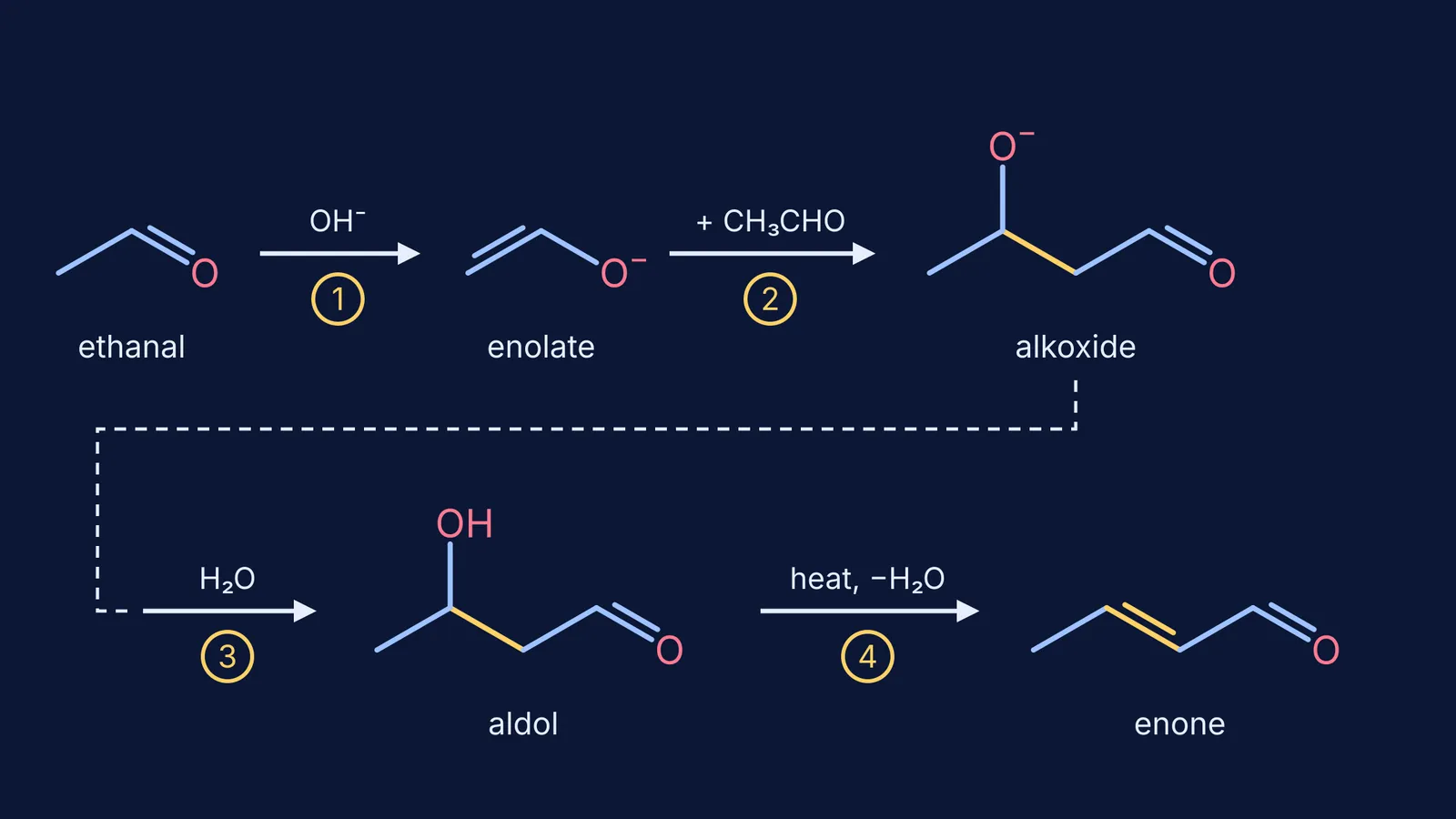
Take NCERT's example: two molecules of ethanal (CH₃CHO) with dilute NaOH. The four steps below follow the mechanism set out in the LibreTexts organic chemistry text on the aldol reaction/23%3A_Carbonyl_Condensation_Reactions/23.01%3A_Carbonyl_Condensations_-_The_Aldol_Reaction).
Enolate formation. Hydroxide removes an α-hydrogen from the CH₃ group of one ethanal molecule. The result is the enolate ion, ⁻CH₂–CHO, with its negative charge shared between the α-carbon and the oxygen. Water is the by-product.
Nucleophilic attack. The α-carbon of the enolate attacks the carbonyl carbon of a second ethanal molecule. The C=O π electrons move onto oxygen, giving a tetrahedral alkoxide, CH₃–CH(O⁻)–CH₂–CHO, and the new carbon–carbon bond.
Protonation. The alkoxide takes a proton from water, giving the neutral aldol, 3-hydroxybutanal, CH₃–CH(OH)–CH₂–CHO, and regenerating hydroxide. That is why the base counts as a catalyst.
Dehydration on heating. Base removes another α-hydrogen (on C-2, between the CHO and the CH(OH) carbon), and the resulting enolate pushes out OH⁻ from the β-carbon. The product is but-2-enal, CH₃–CH=CH–CHO, an α,β-unsaturated aldehyde.
Why does heating turn the aldol into an enone?
Steps 1 to 3 are reversible. The LibreTexts aldol section/23%3A_Carbonyl_Condensation_Reactions/23.01%3A_Carbonyl_Condensations_-_The_Aldol_Reaction) notes that the equilibrium favours products for unhindered aldehydes but favours the starting materials for ketones and hindered aldehydes.
Heat changes the picture. According to the LibreTexts page on dehydrating aldol products/23%3A_Carbonyl_Condensation_Reactions/23.03%3A_Dehydration_of_Aldol_Products_-_Synthesis_of_Enones), base at room temperature gives the aldol, while heating quickly converts it to the condensation product by an E1cB elimination. The same page explains that the conjugated C=C–C=O product is more stable than a non-conjugated one, and that removing water drives the equilibrium towards products (Le Chatelier's principle), so yields are good even when the aldol step itself is unfavourable.
One more number explains why only a little enolate is present at any moment. The LibreTexts section on α-hydrogen acidity/22%3A_Carbonyl_Alpha-Substitution_Reactions/22.05%3A_Acidity_of_Alpha_Hydrogen_Atoms-_Enolate_Ion_Formation) gives a pKa of about 16 to 18 for aldehyde α-hydrogens and 19 to 21 for ketones, against about 50 for an alkane, and notes that hydroxide or alkoxide bases form the enolate only in very low concentration.
Worked example: try propanone yourself
Cover the answer and run the four steps on propanone (CH₃COCH₃) with Ba(OH)₂, the example in the NCERT chapter.
Step 1: remove an α-hydrogen from a CH₃ group to get ⁻CH₂COCH₃.
Step 2: that carbon attacks the C=O carbon of a second propanone, giving (CH₃)₂C(O⁻)–CH₂COCH₃.
Step 3: protonate the oxygen to get the ketol, 4-hydroxy-4-methylpentan-2-one.
Step 4: heat removes water to give 4-methylpent-3-en-2-one, (CH₃)₂C=CH–COCH₃.
Check your numbering: the chain is five carbons long with the C=O at C-2, so the OH sits on C-4 and the new double bond runs from C-3 to C-4.
The same chapter shows what happens with two different carbonyl compounds that both have α-hydrogens. Ethanal and propanal together give a mixture of four products, two self-aldol and two cross-aldol. When a question gives you a mixture, list every enolate that can form and every carbonyl it can attack before you draw anything. The ring-forming version, where both partners are in one molecule, is covered in our post on intramolecular aldol reactions and ring size.
Which mistakes cost marks in aldol questions?
Starting the reaction with a compound that has no α-hydrogen, such as methanal or benzaldehyde, on its own. On heating with concentrated alkali these undergo the Cannizzaro reaction instead, as the NCERT chapter shows.
Drawing the enolate oxygen, not the α-carbon, as the atom that attacks.
Putting the double bond in the wrong place. It is always between the α- and β-carbons, conjugated with C=O.
Writing "aldol" for a ketone product. NCERT calls it a ketol, though the reaction keeps the name aldol condensation.
If you get stuck at a particular arrow on a past-paper question, the Fermi Problem Library has worked problems with a step-by-step solver that explains the reasoning rather than printing an answer. To revise enolates and carbonyl reactivity from the start, the Fermi Concept Library gives each chemistry concept its own lesson.


