

On this page
When a molecule has two carbonyl groups, treating it with a base can cause it to react with itself. This intramolecular aldol condensation is a powerful way to build cyclic compounds. But because the molecule often has multiple alpha-carbons, it can theoretically form rings of different sizes.
The rule of thumb is simple: the molecule will always form a 5- or 6-membered ring if it can. Here is why the geometry of the carbon chain dictates the product, and how to spot which enolate will attack which carbonyl.
Which ring size forms in an intramolecular aldol condensation?
The aldol addition step is reversible. If a highly strained ring forms, it will quickly undergo a retro-aldol reaction to return to the open-chain form. The reaction equilibrates until it finds a stable structure, and the final dehydration step "locks" that stable ring in place.
The stability of a ring comes down to its strain energy. Cyclohexane, a 6-membered ring, can adopt a chair conformation that makes it essentially strain-free, with exactly 0 kcal/mol of ring strain 1). Cyclopentane, a 5-membered ring, cannot perfectly stagger all its bonds and carries about 6.2 kcal/mol of torsional strain 1).
While a 5-membered ring is slightly more strained than a 6-membered one, both are vastly more stable than 3- or 4-membered rings, which suffer from severe angle strain.
If you struggle to picture these 3D conformations, the Fermi Concept Library contains every concept in chemistry, each with its own lesson and its place in the map. The AI tutor teaches rather than answers, drawing the figure and running the simulation to help you see the strain in a small ring before you try solving problems.
Does a 1,4-diketone form a 5-membered ring?
Consider 2,5-hexanedione. When a base is added, it can remove a proton from either the terminal alpha-carbon (C1) or the internal alpha-carbon (C3).
Path A: If the enolate forms at C3 and attacks the carbonyl at C5, the resulting ring contains C3, C4 and C5. This is a 3-membered ring.
Path B: If the enolate forms at C1 and attacks the carbonyl at C5, the ring contains C1, C2, C3, C4 and C5. This is a 5-membered ring.
Because a 3-membered ring is highly strained, the equilibrium shifts entirely to Path B. The molecule dehydrates to form 3-methylcyclopent-2-en-1-one. This logic applies to any 1,4-diketone.
*(If you are revising for JEE, you will also see this selectivity in nucleophilic addition and named reactions across organic chemistry.)*
Does a 1,5-diketone form a 6-membered ring?
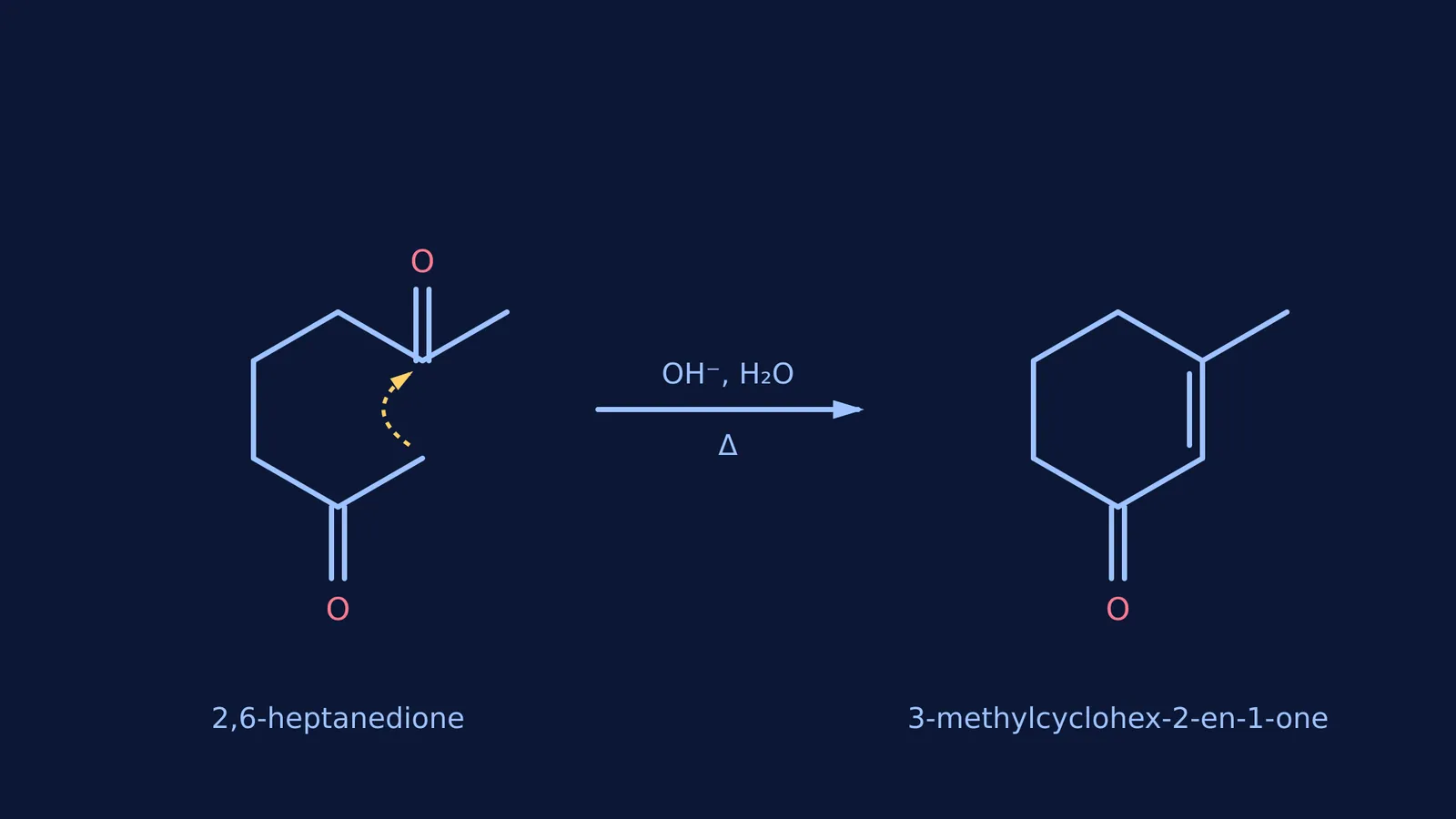
Now look at 2,6-heptanedione. The two potential enolate sites are again at the end of the chain (C1) or inside it (C3).
Path A: If the enolate forms at C3 and attacks the carbonyl at C6, the ring contains C3, C4, C5 and C6. This creates a 4-membered ring.
Path B: If the enolate forms at C1 and attacks the carbonyl at C6, the ring contains C1 to C6. This forms a perfect 6-membered ring.
The 6-membered ring has zero angle strain. The reaction completely favours Path B, yielding 3-methylcyclohex-2-en-1-one. (The aldol reaction itself was co-discovered by Alexander Borodin, a composer and chemist, and this intramolecular variant is one of its most elegant applications).
How do you predict the major product?
In an exam, you do not need to draw every possible mechanism. Use this plan to find the major product:
Number the chain: Number the longest carbon chain from one end to the other, making sure the carbonyls get the lowest possible numbers.
Find the alpha-carbons: Identify every carbon sitting next to a carbonyl group. These are your potential nucleophiles.
Count the ring sizes: For each alpha-carbon, count the number of atoms from that carbon to the *other* carbonyl carbon (inclusive). This is your potential ring size.
Pick the winner: Choose the pathway that yields a 5- or 6-membered ring. If both are possible (e.g. a very long chain), the 6-membered ring is usually the thermodynamic major product.
Draw the dehydration: Draw the ring, place a double bond between the attacking alpha-carbon and the attacked carbonyl carbon, and add any remaining side chains.
Just like the Cannizzaro reaction, the intramolecular aldol condensation looks complex but follows a strict set of rules. Once you know to look for the strain-free ring, the product draws itself.


