

On this page
Carbon–hydrogen bonds are famously stable. In a typical alkane, like ethane, a C–H bond has a pKa of about 50 (LibreTexts/Aldehydes_and_Ketones/Reactivity_of_Aldehydes_and_Ketones/Acidity_of_Alpha_Hydrogens)), meaning it is almost impossible to remove the hydrogen as a proton. But move that hydrogen next to a carbonyl group (C=O), and everything changes.
The alpha hydrogen of an aldehyde or ketone is remarkably acidic, with a pKa between 16 and 20. This acidity is not just a trivia fact; it is the engine behind a whole class of organic reactions taught in Class 12 chemistry, from the aldol condensation to the haloform reaction (NCERT).
Why is the alpha hydrogen acidic?
The carbon atom immediately attached to the carbonyl group is called the alpha carbon, and any hydrogens attached to it are alpha hydrogens. Two effects work together to make these hydrogens unexpectedly acidic:
The inductive effect: Oxygen is highly electronegative, pulling electron density away from the carbonyl carbon. This carbon, now slightly positive, pulls electrons away from the neighbouring alpha carbon, which in turn draws them away from the alpha hydrogen. This electron-withdrawing effect weakens the C–H bond.
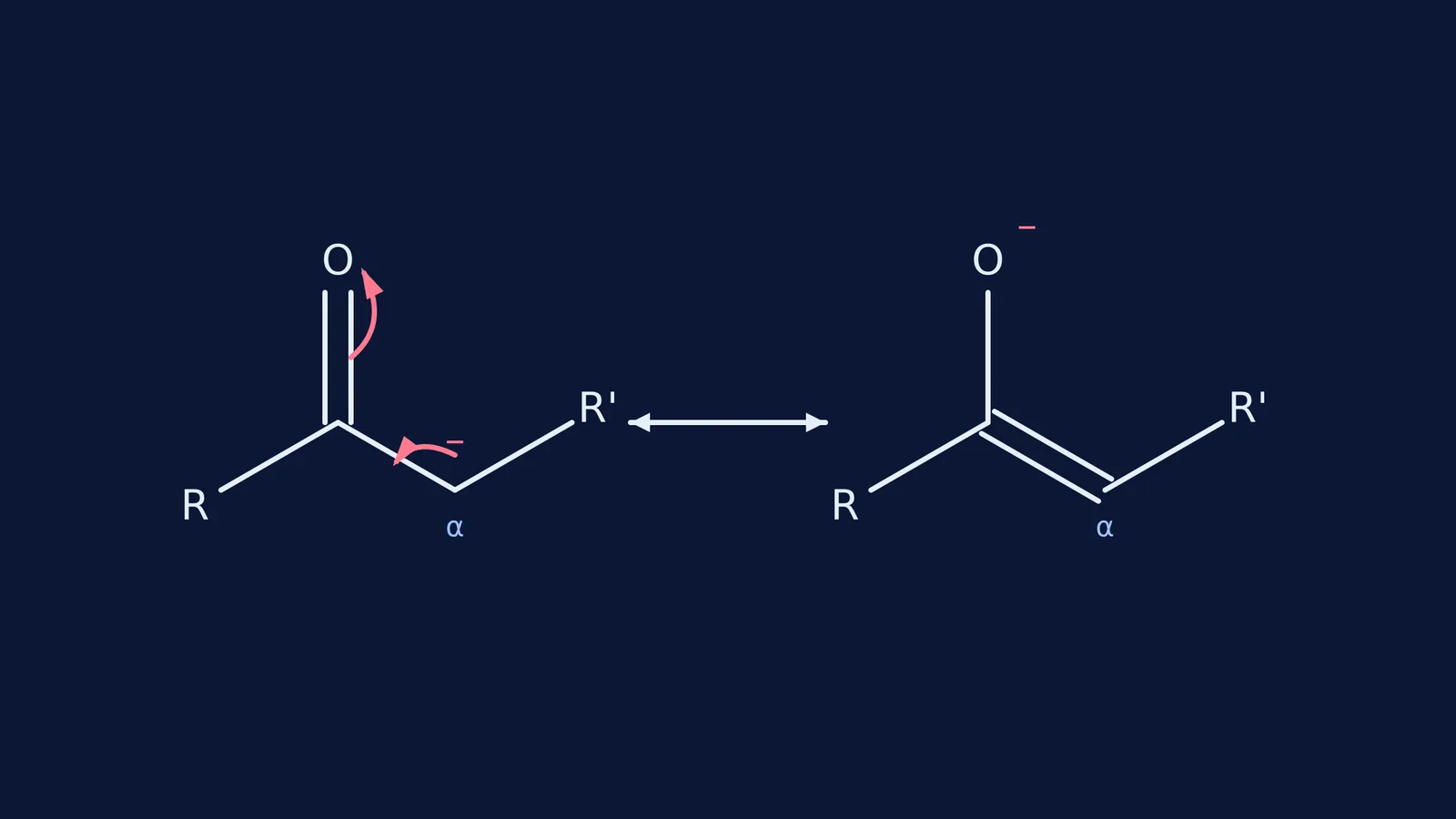
Resonance stabilisation: This is the more powerful factor. When a base removes the alpha hydrogen, it leaves behind a negative charge on the carbon, forming a carbanion. However, this charge does not stay stuck on the carbon. It delocalises onto the electronegative oxygen atom through resonance.
The resulting resonance-stabilised structure is called an enolate ion. Because oxygen can hold a negative charge much more comfortably than carbon, the enolate ion is surprisingly stable. This stability of the conjugate base is what makes the original alpha hydrogen acidic.
When learning about the delocalisation of electrons in the enolate ion, picturing the structure matters. The Fermi Concept Library has every concept in chemistry, each with its own lesson and its place in the map, helping you visualise how these resonance shifts work.
Which reactions rely on alpha hydrogen acidity?
Because aldehydes and ketones can form enolate ions, they act as nucleophiles in several staple organic reactions.
The most prominent is the aldol condensation. When an aldehyde or ketone with at least one alpha hydrogen is treated with a dilute alkali, the base removes the acidic alpha hydrogen. This creates an enolate ion that attacks another molecule of the unreacted carbonyl compound to form a β-hydroxy aldehyde or ketone.
Ketones with a methyl group attached to the carbonyl (three alpha hydrogens) react with halogens in the presence of a base. The acidic alpha hydrogens are successively replaced by halogen atoms until the bond breaks to form a haloform, such as iodoform.
The principle applies beyond just aldehydes and ketones. The Hell-Volhard-Zelinsky reaction: alpha-halogenation of acids relies on the alpha hydrogens of carboxylic acids. This acidity also allows molecules to flip between two structures, a process explained in Keto-enol tautomerism: alpha hydrogens and which form wins.
If a molecule lacks an alpha hydrogen entirely, such as formaldehyde or benzaldehyde, it cannot form an enolate. Instead, when heated with a strong base, it undergoes a disproportionation reaction, which you can read about in Cannizzaro reaction: which aldehydes undergo it and what forms.
How do you spot alpha-hydrogen reactions in exams?
In JEE and NEET, organic chemistry questions often test whether you can identify the right reaction conditions for carbonyls. Use this three-step framework:
Locate the carbonyl group and identify the adjacent alpha carbons.
Count the alpha hydrogens. If there are none, rule out aldol and haloform reactions entirely.
Check the reagent. Dilute base with an alpha hydrogen leads to an aldol condensation. A halogen and base with a methyl ketone leads to a haloform reaction. A concentrated base with no alpha hydrogen leads to a Cannizzaro reaction.
If you get stuck predicting the products of these reactions, the Fermi Problem Library has worked problems with a step-by-step solver that explains the reasoning rather than printing an answer. Writing out the mechanism yourself, starting with the base removing that acidic proton, is the most reliable way to find the final product without memorising it.


