

On this page
If a JEE question gives a polarimeter reading and asks for the percentage of each enantiomer, you need two ideas: how a measured rotation becomes a specific rotation, and how a specific rotation becomes enantiomeric excess. If chirality and R/S still feel shaky, read our step-by-step guide to stereoisomerism, chirality and R/S first.
What is the difference between observed and specific rotation?
The observed rotation, α, is the angle your polarimeter shows. It changes with concentration and tube length, because it depends on how many chiral molecules the light meets, as the Roberts and Caserio chapter on specific rotation/19%3A_More_on_Stereochemistry/19.02%3A_Specific_Rotation) explains.
Specific rotation removes those two effects: [α] = 100α ÷ (l × c), where l is the path length in decimetres and c is the concentration in grams per 100 mL. The same chapter says the wavelength (usually the sodium D line, 589.3 nm) should be stated, because rotation also changes with temperature and solvent.
Two enantiomers rotate plane-polarised light in opposite directions, one (+) and one (−) (LibreTexts, Optical Rotation/I%3A__Chemical_Structure_and_Properties/05%3A_Stereochemistry/5.07%3A_Optical_Rotation)). An equal mixture of the two is called a racemic mixture, or racemate, and it does not rotate light at all because the two effects cancel.
How do you calculate enantiomeric excess and optical purity?
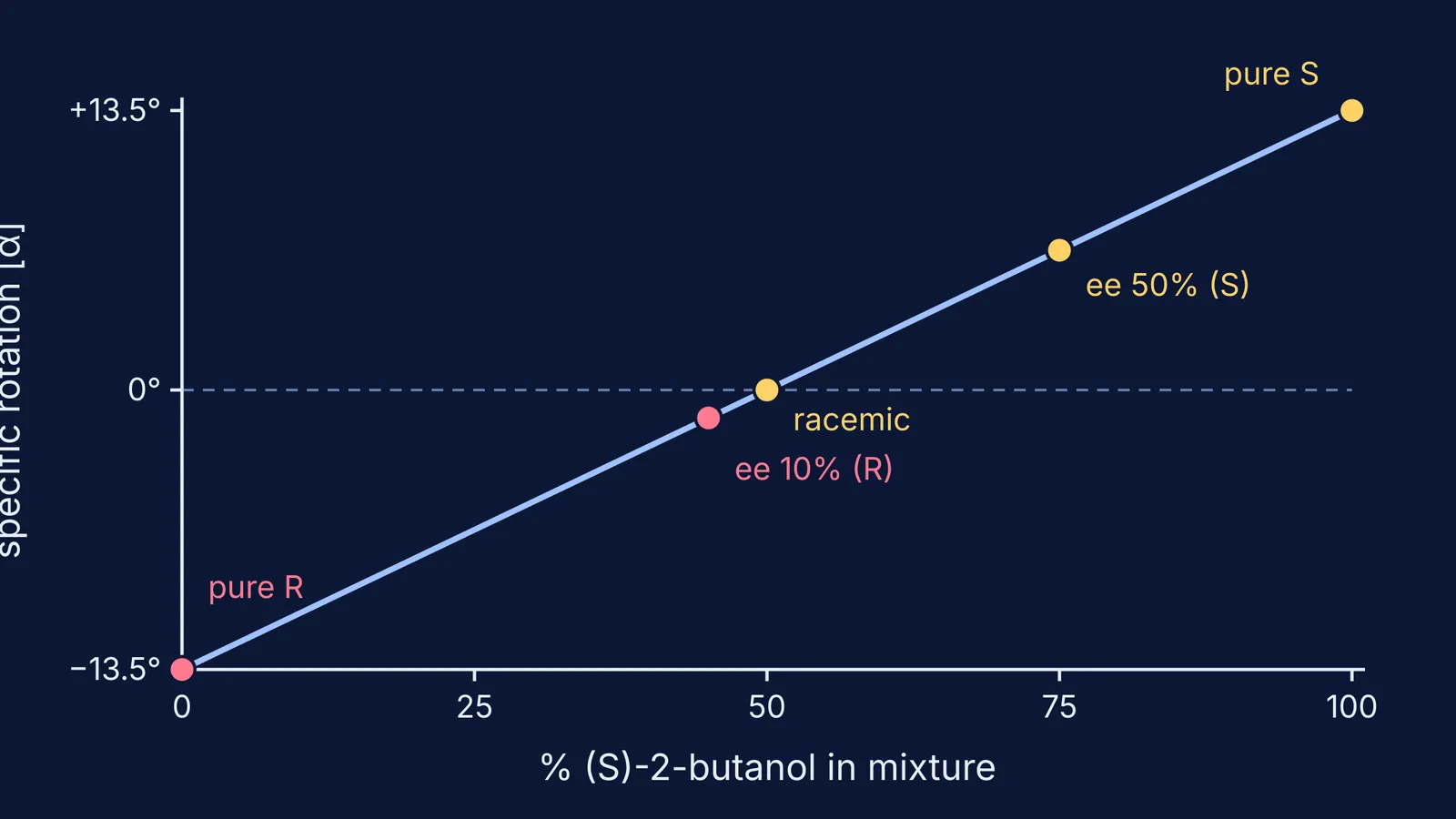
Enantiomeric excess (ee) is the difference between the relative amounts of the two enantiomers, and the rotation of a mixture equals ee times the specific rotation of the major enantiomer (LibreTexts, Enantiomeric Excess/06%3A_Isomers_and_Stereochemistry/5.10%3A_Enantiomeric_Excess)).
Roberts and Caserio define optical purity (or enantiomeric purity) as the fractional excess of one enantiomer over the other: (n₁ − n₂) ÷ (n₁ + n₂) = α(obs) ÷ α(pure) (LibreTexts, Enantiomeric Purity/19%3A_More_on_Stereochemistry/19.04%3A_Enantiomeric_Purity)). That fraction is ee written as a decimal, which is why exam problems treat the two as equal.
So the three formulas you need are:
ee (%) = % major enantiomer − % minor enantiomer
ee (%) = optical purity (%) = [α] of sample ÷ [α] of pure enantiomer × 100
% major = (100 + ee) ÷ 2, and % minor = (100 − ee) ÷ 2
The third line is algebra: the two percentages add to 100 and differ by ee. LibreTexts' own examples check it: a 75:25 mixture has 50% ee, and a mixture that is 95% one enantiomer has 90% ee (LibreTexts, Enantiomeric Excess/06%3A_Isomers_and_Stereochemistry/5.10%3A_Enantiomeric_Excess)).
Worked JEE-style examples: what percentage of each enantiomer?
A Portland State University organic chemistry quiz gives pure (R)-2-butanol a specific rotation of −13.5°, so pure (S)-2-butanol is +13.5° (PSU Chem 334 quiz). All four examples use 2-butanol; the numbers in examples 2 to 4 are ours, built on that value.
Example 1, from specific rotation to percentages: a 2-butanol sample has [α] = −1.35°. Find its composition.
Optical purity = 1.35 ÷ 13.5 × 100 = 10%, so ee = 10%.
The sign is negative, so (R) is in excess.
% (R) = (100 + 10) ÷ 2 = 55%, and % (S) = 45%, the quiz's own answer.
Example 2, from a raw polarimeter reading: pure (R)-2-butanol at 3.0 g per 100 mL in a 2 dm tube reads α = −0.81°. A second sample under the same conditions reads −0.405°. Find its composition.
Check the pure sample: [α] = 100 × (−0.81) ÷ (2 × 3.0) = −13.5°.
Second sample: [α] = 100 × (−0.405) ÷ (2 × 3.0) = −6.75°.
ee = 6.75 ÷ 13.5 × 100 = 50%, with (R) in excess.
% (R) = 75%, and % (S) = 25%.
Example 3, working backwards: a reaction gives 80% (S)-2-butanol and 20% (R). What specific rotation should the product show?
ee = 80 − 20 = 60%, with (S) in excess.
[α] = 0.60 × (+13.5°) = +8.1°.
Example 4, the racemic trap: a 2-butanol sample shows zero rotation. Is 2-butanol achiral? No. A 50:50 mixture of (R) and (S) has ee = 0 and rotates light by 0°, even though every molecule in it is chiral. To check whether a molecule is chiral at all, use our guide on counting stereoisomers from the number of chiral centres.
Which mistakes cost marks in these questions?
Comparing a raw reading α with the specific rotation of the pure compound. Convert to [α] first.
Mixing units for c. The formula above takes grams per 100 mL; for g/mL, use [α] = α ÷ (l × c) instead.
Reporting the major percentage as ee. As the LibreTexts enantiomeric excess page/06%3A_Isomers_and_Stereochemistry/5.10%3A_Enantiomeric_Excess) shows, a 75:25 sample has 50% ee, not 75%.
Treating zero rotation as proof that the compound is achiral.
How should you practise this?
Do one problem of each of the four types above in one sitting. On your second round, cover the formulas and rebuild them from 'the percentages add to 100 and differ by ee'.
If a step goes wrong and you cannot see why, the Fermi Problem Library has worked problems with a step-by-step solver that explains the reasoning rather than printing an answer. If the gap is chirality itself, the Fermi Concept Library gives each chemistry concept its own lesson and its place in the map.


