On this page
When a new virus enters your body, your immune system faces a massive search problem. It must find the exact weapon to neutralise the invader without harming your own cells. It solves this using one of the most precise recognition systems in nature.
How do antibodies recognise specific antigens?
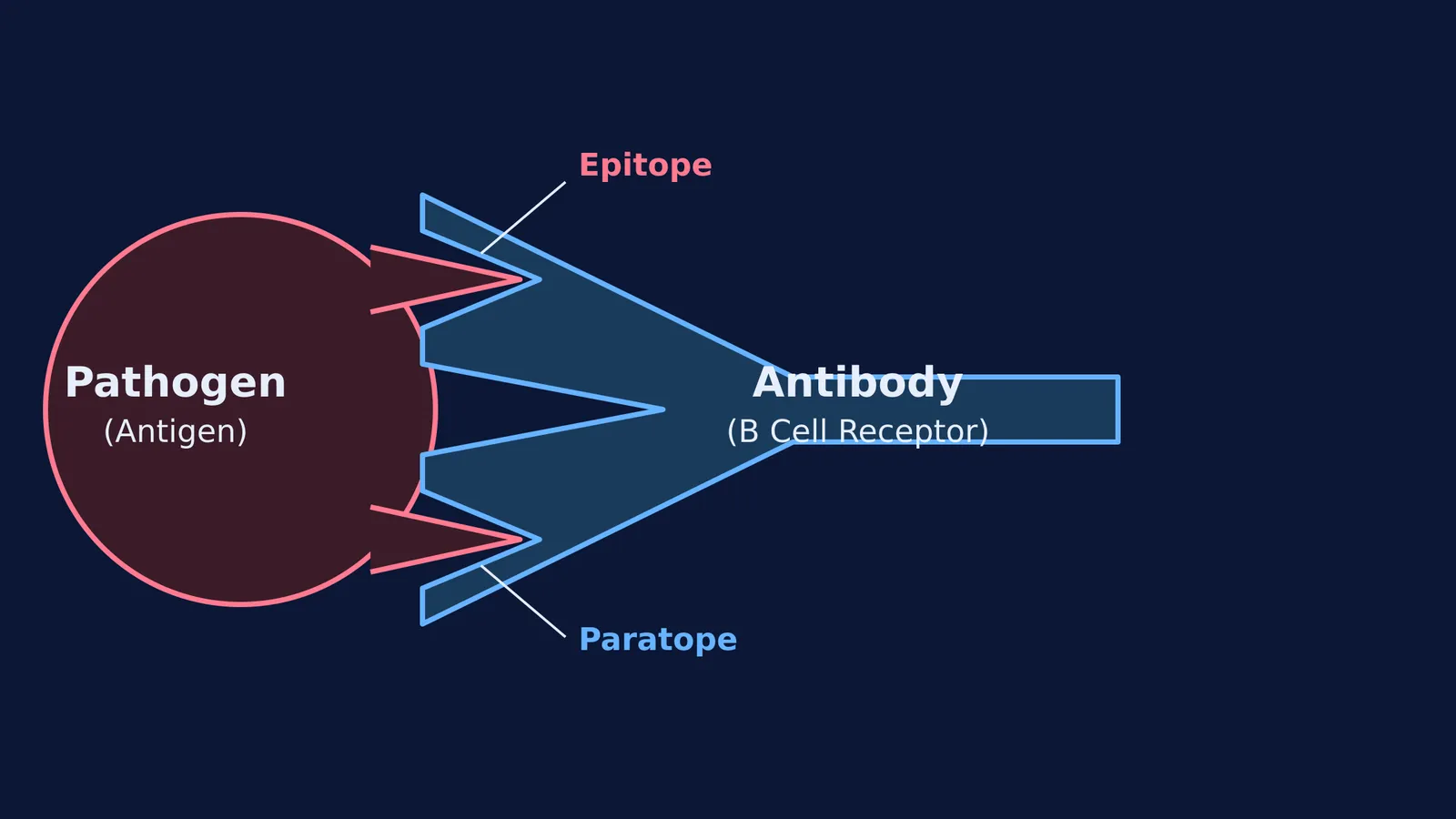
Antibodies identify threats using a mechanism often compared to a lock and key. The surface of any pathogen—whether a virus, bacterium or toxin—is covered in unique molecular shapes called antigens. The specific part of the antigen that the immune system "reads" is known as the epitope.
To neutralise the threat, your body produces antibodies (Y-shaped proteins) that have a complementary binding site at their tips, called a paratope. For an antibody to bind, its paratope must fit the antigen's epitope perfectly.
This fit relies on two things:
Geometric shape: The physical contours must match. A rounded epitope requires a cup-shaped paratope.
Chemical bonds: Once the shapes align, weak chemical interactions (such as hydrogen bonds and electrostatic forces) act like molecular Velcro to hold them tightly together.
If you struggle to remember which is which, antigen, antibody and antibiotic definitions often trip up biology students, but remembering that the antibody *paratope* grips the antigen *epitope* is the key to immunology.
How many different antibody shapes can we make?
Because there are countless potential threats in the world, the immune system needs an enormous library of "keys" ready to deploy. According to a 2009 study in the *Proceedings of the National Academy of Sciences* (*PNAS*), the human immune system can generate up to 100 billion (10¹¹) unique antibody molecules.
It does this not by having 100 billion separate genes, but by shuffling a smaller set of genetic instructions and intentionally introducing small mutations—much like shuffling a deck of cards to create nearly infinite unique hands.
How do vaccines train antibodies?
A vaccine introduces a harmless piece of a pathogen (the antigen) into your body. This acts as a wanted poster.
Your immune system begins scanning its vast library of B cells until it finds the one whose antibody shape happens to fit this new antigen. Once the match is found, that specific B cell is selected to multiply, creating an army of clones that pump out millions of identical, perfectly shaped antibodies.
This search and mass-production process takes time. The US Centers for Disease Control and Prevention (CDC) notes that it takes about two weeks after vaccination for the body to develop protective levels of antibodies.
Why are vaccines germ-specific?
Because the lock-and-key fit is so precise, a vaccine for one disease rarely protects against another.
If you receive a measles vaccine, your body builds an army of antibodies with paratopes shaped exactly for the measles virus. If you are later exposed to the polio virus, those measles antibodies will simply bounce off the polio antigens, because the shapes do not match. The immune system has to start the two-week search process all over again. (This specificity is similar to how enzymes work, which you can see when studying competitive and noncompetitive inhibition).
How to test binding shapes yourself?
When you are studying humoral vs cell-mediated immunity for an exam, reading about binding is less effective than predicting it. You can test your understanding by building and matching the shapes yourself.
Draw the epitope: Sketch a pathogen and give it a highly specific geometric spike (for example, a jagged zigzag).
Design the paratope: Draw three different antibody tips. Make one a smooth curve, one a square pocket, and one a zigzag pocket.
Predict the bond: Trace how the shapes would slide together. Only the zigzag pocket will allow the surfaces to touch closely enough for chemical bonds to form.
Test it dynamically: To see how these physical constraints work in motion, you can manipulate binding rules and test which shapes connect in the Fermi Simulation Lab.
If you are unsure why a particular antibody structure fails to bind, you can sketch your hypothesis and ask Fermi's AI tutor to check your understanding of the binding geometry. Working out the mechanics of the fit yourself ensures you will never forget why immunity is so specific.