

On this page
What is the difference between an antigen, antibody and antibiotic?
All three words share the Greek prefix "anti", yet each operates in a completely distinct biological realm. Understanding their differences begins with separating the trigger, the defender, and the drug.
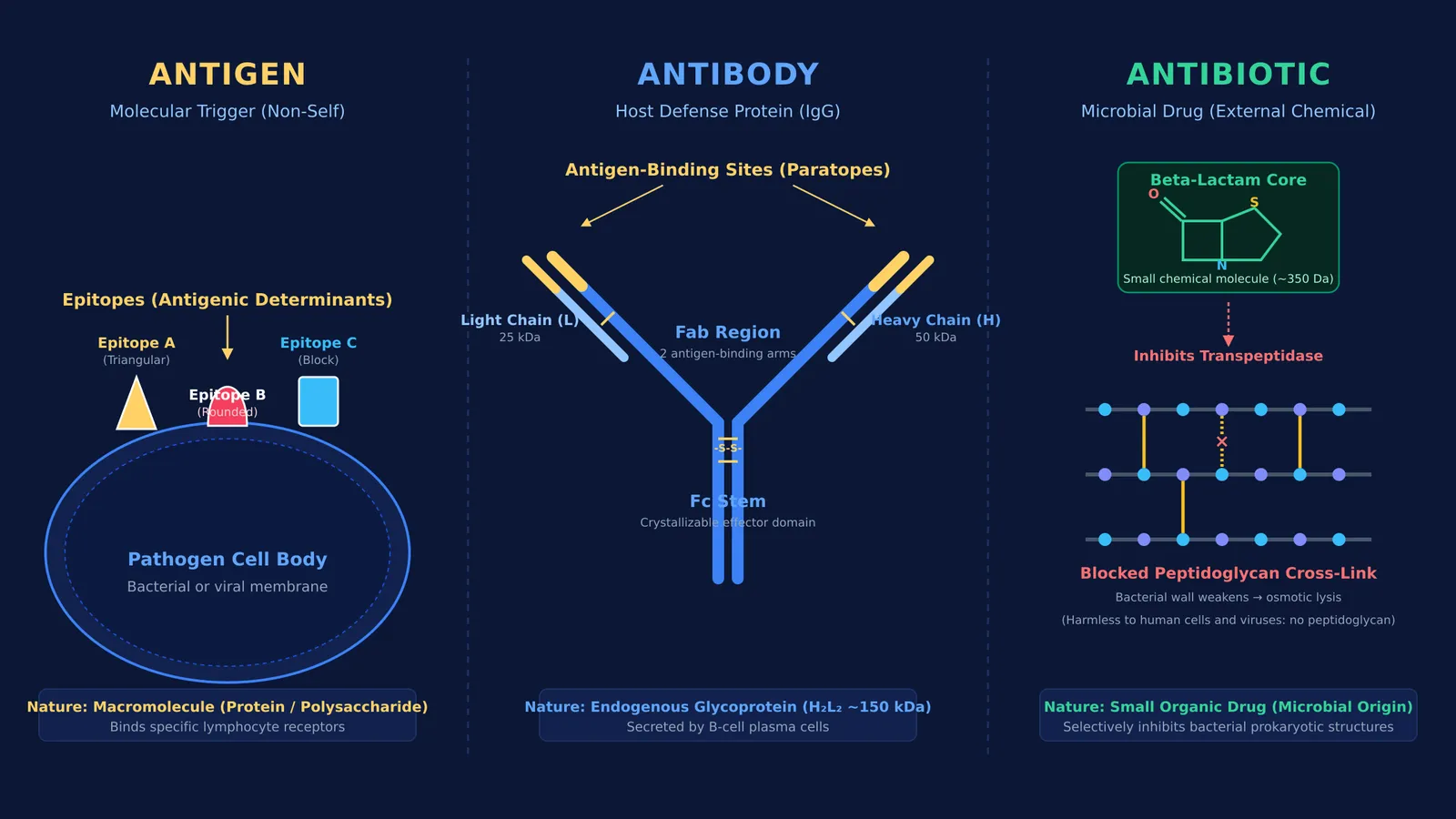
An antigen is a molecular trigger. Short for "antibody generator", an antigen is any substance—typically a surface protein or polysaccharide on a virus, bacterium, or foreign cell—that the host immune system recognizes as non-self. The specific chemical motif recognized by immune receptors is called an epitope. Antigens do not fight infection; they alert the host to an intruder.
An antibody is the host's defense protein. Synthesized by specialized white blood cells called plasma cells, antibodies are immunoglobulins. In 1959, Rodney Porter demonstrated in the Biochemical Journal that papain cleaves an antibody into two identical antigen-binding (Fab) fragments and one crystallizable (Fc) fragment. Antibodies circulate in blood and lymph, latching onto complementary epitopes. For the early history of targeted immune theories, see Paul Ehrlich and the magic bullet.
An antibiotic is neither a human protein nor an immune component. Selman Waksman, who coined the term in the early 1940s, formally defined it in 1947 in Mycologia as a chemical substance produced by microorganisms that suppresses or destroys competing bacteria. Alexander Fleming's 1928 discovery of penicillin, reprinted in Clinical Infectious Diseases, showed that mould culture filtrates produced a substance capable of inhibiting staphylococci. An antibiotic is an external medicine, not an endogenous protein.
How does an antigen trigger an antibody response?
The interaction between an antigen and an antibody drives adaptive humoral immunity. When a pathogen enters bodily fluids, antigen-presenting cells display its fragments to lymphocytes.
Naive B cells display surface receptors matching specific epitopes. Upon encountering their target antigen and receiving helper T cell signals, selected B cells proliferate into memory cells and antibody-secreting plasma cells. In 1970, Gerald Edelman showed in Scientific American that each immunoglobulin monomer consists of two heavy chains and two light chains (an H₂L₂ arrangement) joined by disulfide bonds, creating two variable antigen-binding clefts.
Secreted antibodies neutralize pathogens through three mechanisms:
Neutralization: Coating viral surface spikes or bacterial toxins to block cellular entry.
Opsonization: Tagging pathogens via the Fc stem so phagocytic macrophages ingest them.
Agglutination: Cross-linking multiple cells into clumps for efficient clearance.
This lock-and-key specificity makes antibodies indispensable in diagnostics like ELISA, detailed in our review of transgenic animals and ELISA in molecular diagnosis.
Why do antibiotics kill bacteria but leave viruses untouched?
A common misunderstanding—expecting antibiotics to cure viral colds or influenza—stems from confusing antibodies with antibiotics. Antibiotics act via selective toxicity, disrupting biochemical targets exclusive to prokaryotic bacteria:
Cell wall inhibition: Beta-lactams like penicillin inhibit transpeptidase enzymes, halting peptidoglycan cross-linking so bacterial cells rupture under osmotic pressure.
Protein synthesis inhibition: Macrolides and tetracyclines bind selectively to bacterial 70S ribosomes without disrupting host 80S ribosomes.
DNA replication disruption: Fluoroquinolones inhibit bacterial DNA gyrase.
Viruses possess none of these structures. A virus consists solely of nucleic acid enclosed in a protein capsid. It lacks a peptidoglycan cell wall, 70S ribosomes, and independent metabolic pathways, replicating entirely within host cellular machinery. Consequently, antibiotics cannot bind or harm viral particles.
Taking antibiotics for viral illnesses exposes harmless resident bacteria to unnecessary drug pressure. A global analysis led by Christopher Murray in The Lancet02724-0) estimated that bacterial antimicrobial resistance was associated with 4.95 million deaths in 2019, including 1.27 million deaths directly attributable to resistant pathogens. For the discovery of streptomycin from soil microbes, read Selman Waksman, Albert Schatz and streptomycin.
How do exam questions trap you with 'anti-' terms?
In competitive exams like NEET-UG, questions often test whether you can separate the origins and targets of these three terms. You can resolve them quickly with a three-point checklist:
Source: Antigens originate on foreign invaders (or allergens); antibodies are made inside you by B-cell plasma cells; antibiotics are produced by microbes or synthesized in pharmaceutical labs.
Structure: Antigens are macromolecules (proteins, polysaccharides); antibodies are large Y-shaped glycoprotein assemblies (H₂L₂); antibiotics are small organic molecules.
Target: Antigens stimulate lymphocyte receptors; antibodies bind specific epitopes to mark or neutralize them; antibiotics inhibit bacterial enzymes and ribosomes.
Watch for these standard traps:
Vaccines: Vaccines introduce antigens (attenuated pathogens or mRNA) to train memory cells, not pre-made antibodies or antibiotics.
Antivenom: Snake antivenom provides pre-formed antibodies for immediate passive immunity; it is not an antibiotic.
Secretory products: Plasma cells secrete antibodies into blood; they never synthesize antibiotics.
To build clarity around how immune cells and antimicrobial compounds function, the Fermi Concept Library covers every concept in biology, chemistry and physics, each with its own lesson and its place in the map. When working through challenging problems on pathogen defense and microbiology, the Fermi Problem Library provides worked problems with a step-by-step solver that explains the reasoning rather than printing an answer.


