

On this page
When you study enzyme kinetics for exams like NEET-UG or biology coursework, it is easy to get lost in the formulas for Vmax and Km. The simplest way to tell the two main types of inhibition apart is to ask one physical question: if you flood the system with more substrate, does the enzyme go back to working at its maximum speed?
If it does, the inhibitor is competing for the same spot. If it does not, the inhibitor has broken the machine from the outside. Here is how both work, why their rate curves look different, and how you can picture them in a simulation.
What is competitive inhibition?
In competitive inhibition, the inhibitor molecule looks enough like the real substrate that it can fit into the enzyme's active site. Because the active site is blocked, the actual substrate cannot get in.
The two molecules are playing musical chairs with the same seat. This means the inhibition can be overcome by simply adding more substrate. If you flood the environment with vastly more substrate molecules than inhibitor molecules, the substrate will win almost every time.
Because the enzyme can still reach its normal maximum speed if you push hard enough, the Vmax remains unchanged. However, because the inhibitor is in the way, it takes a much higher concentration of substrate to reach half of that maximum speed. In kinetic terms, the enzyme's affinity appears to drop, meaning the Km increases.
What is noncompetitive inhibition?
In noncompetitive inhibition, the inhibitor does not try to take the active site. Instead, it binds to a completely different location on the enzyme, known as an allosteric site.
When the inhibitor binds there, it causes the entire enzyme to change shape. The active site might still exist, and the substrate might even still bind to it, but the enzyme can no longer perform the chemical reaction efficiently. Because the inhibitor and the substrate are not fighting for the same spot, adding more substrate does not help at all. The broken enzymes stay broken.
As a result, the total number of working enzymes is effectively reduced. This means the Vmax decreases. However, because the inhibitor does not stop the substrate from finding the active site of the enzymes that *are* working, the affinity of those working enzymes stays exactly the same, meaning the Km remains unchanged.
Can you overcome competitive vs non competitive inhibition with more substrate?
Yes for competitive, no for noncompetitive. This is the fundamental difference that dictates their curves on a Michaelis-Menten graph.
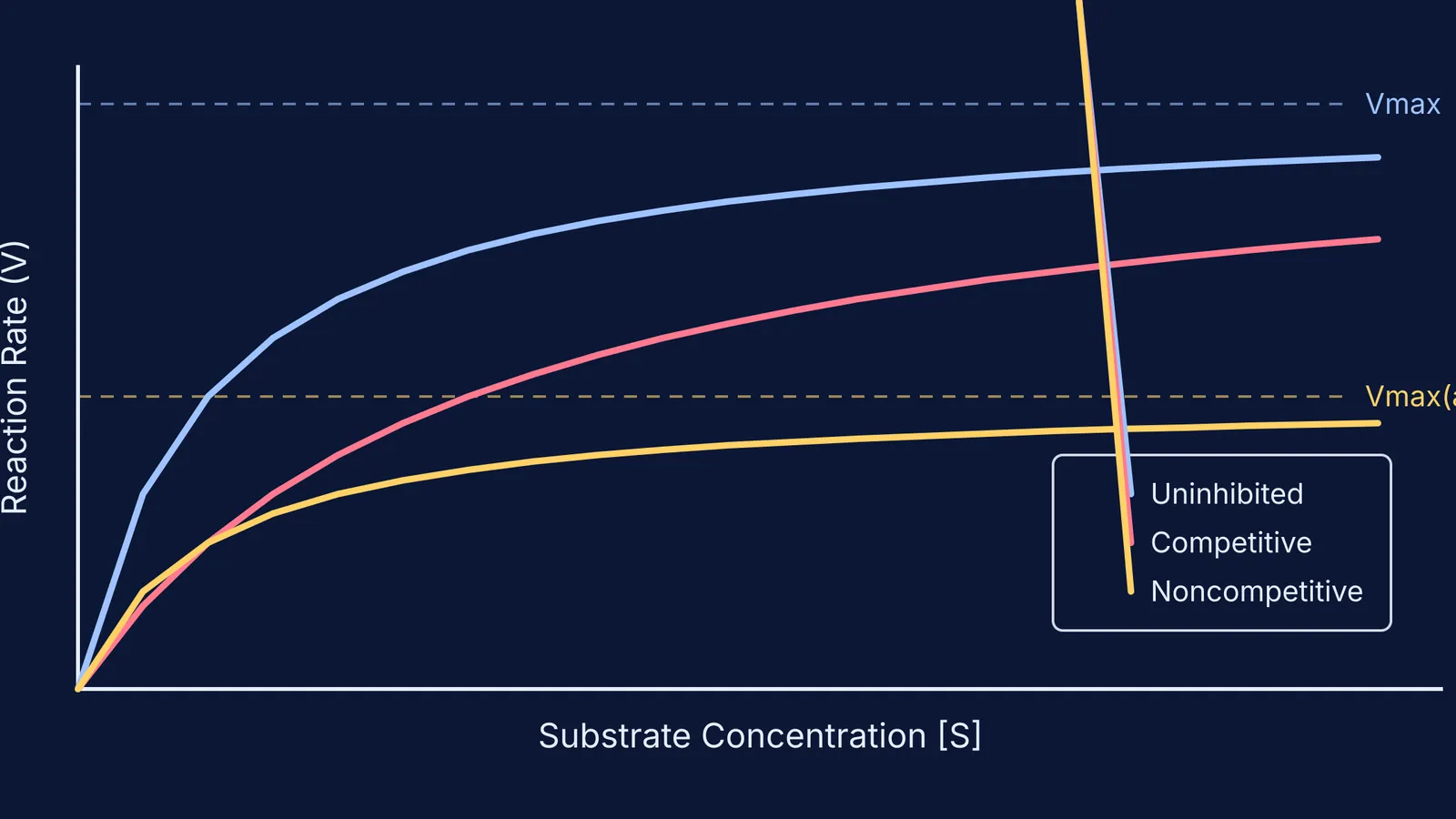
If you plot the reaction rate (velocity) against the substrate concentration, an uninhibited enzyme forms a curve that rises steeply and then levels off at a ceiling (Vmax).
With a competitive inhibitor, the curve rises much more slowly at first (because of the higher Km). But if you keep following the x-axis to the right, adding more and more substrate, the curve will eventually climb up to hit the exact same Vmax ceiling as the uninhibited enzyme.
With a noncompetitive inhibitor, the curve rises at a normal proportion at first, but it hits a completely new, lower ceiling. No matter how far right you go on the x-axis, it will never reach the original Vmax.
How does a competitive vs non competitive inhibition simulation work?
To see this mathematically, you can build a competitive vs non competitive inhibition simulation using the Michaelis-Menten equation. By changing the variables, you can plot the exact curves shown in the diagram above.
For a standard enzyme, the rate V is calculated as: V = (Vmax × [S]) / (Km + [S])
To simulate competitive inhibition, you multiply Km by a factor (often written as α) that represents the inhibitor concentration, leaving Vmax alone. To simulate noncompetitive inhibition, you divide Vmax by that same factor, leaving Km alone. If you graph these functions, you will immediately see the competitive curve stretch out to the right while the noncompetitive curve flattens downward.
If you want to run this yourself without writing code, try the Simulation Lab to see the curves shift in real time as you adjust substrate and inhibitor concentrations.
To see how this applies to specific enzymes you need to know for your exams, check our guide to enzymes for NEET biology, or read the history of how these kinetics were discovered in our profile on Michaelis and Menten.


