On this page
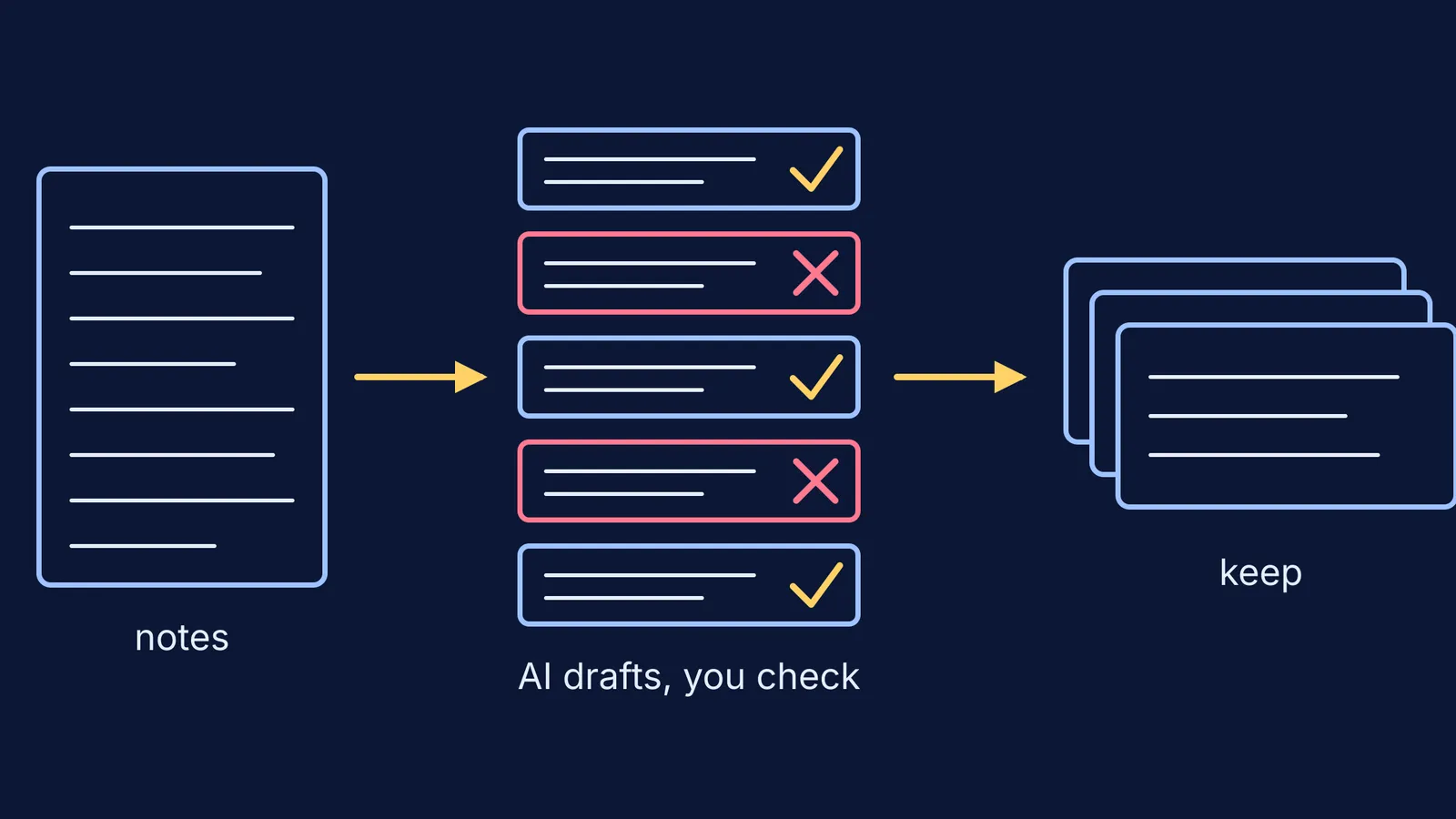
Rereading your notes feels like work, but it mostly tells you whether the page looks familiar. Answering from memory is harder, and that is the point. AI can turn a page of your notes into a stack of question cards in a minute. The useful part comes next: you read every card, delete the vague and the wrong ones, and revise only from what survives.
Why turn notes into questions at all?
In a 2006 study by Henry Roediger and Jeffrey Karpicke, students read prose passages and then either reread them or took recall tests (Psychological Science, 2006). On a test 5 minutes later, rereading won. On tests 2 days and 1 week later, the students who had practised recalling remembered substantially more, even though rereading had made the other group feel more confident.
A later experiment found that retrieval practice produced more learning than building concept maps, including on questions that asked students to make inferences (Karpicke and Blunt, Science, 2011).
A review of 10 common study techniques rated practice testing and distributed practice as “high utility”, and highlighting and rereading as “low utility” (Dunlosky and colleagues, 2013).
So the cards are worth making. But a wrong card can do harm: each time you answer it, you practise the mistake.
How do you make active recall questions from notes with AI?
Work one topic at a time, not a whole chapter. Before you start, check the notes themselves; our guide on asking AI to check your notes for mistakes shows how. Then paste one page and use a prompt like this:
“Here are my notes on projectile motion for Class 11 physics. Write eight question-and-answer cards using only what is in these notes. Each question must have one short, checkable answer. Include at least two questions that make me apply an idea, not just repeat a line. Do not add facts that are not in my notes. After the cards, list anything in my notes you think is unclear or wrong.”
The last line asks the AI to point out problems instead of quietly smoothing them over.
Which AI-made cards should you delete?
For each card, ask: could I mark my answer right or wrong without arguing with myself? If not, fix or delete it. Watch for six problems:
Vague: “What is important about projectile motion?” There is no single answer to check.
Wrong: the answer contradicts your textbook. Check against NCERT, not against the AI.
Giveaway: the question contains its own answer.
Too big: “List all the formulas of this chapter.” Split it into one card per formula.
Outside your notes: a fact you never studied, sometimes made up. Delete it unless you can find it in your book.
Duplicate: two cards asking the same thing in different words. Keep the clearer one.
What does this look like on a real page of notes?
Say your notes on projectile motion (no air resistance, level ground) include the range formula R = u² sin 2θ / g and the line “horizontal velocity stays constant”. The AI drafts five cards:
Card 1. Q: Why does horizontal velocity stay constant? A: Gravity acts only vertically, so nothing changes the horizontal velocity. Keep.
Card 2. Q: What is the velocity at the highest point? A: Zero. Wrong. Only the vertical part is zero; the ball still moves sideways at u cos θ. Rewrite the answer and keep it, because this is a common exam trap.
Card 3. Q: What is the key idea of projectiles? Vague. Delete.
Card 4. Q: Two balls are thrown at the same speed, at 30° and 60°. Which lands farther away? A: Neither; sin 60° equals sin 120°, so the ranges are equal. Keep. This is an apply card.
Card 5. Q: At what angle is the range greatest? A: 45°, since sin 2θ is largest at 90°. Keep.
Five drafts became four trustworthy cards, and fixing Card 2 made you think about the mistake. That editing is revision too.
How should you revise with the cards?
Cover the answer, say or write your reply, then check. Sort the cards into “got it” and “missed it”, and bring back the missed pile the next day. Spread the rounds out over days and weeks; what Harry Bahrick learned about long-term memory explains why spacing helps. Once a week, mix in old cards from earlier chapters, as in a weekly cumulative quiz with AI.
When a card keeps landing in the “missed it” pile, the problem is often the idea behind it, not your memory. Fermi’s AI tutor works out what you already know, builds a plan for the session and checks your understanding as it goes, so a card you keep missing becomes a lesson instead of another round of guessing.
Start tonight with one page of notes and eight cards. Delete the ones you cannot trust, and keep the rest for tomorrow.