

On this page
By mid-session, students preparing for board and competitive exams hit an invisible wall. They can solve numericals from the current week's chapter, but older topics covered earlier in the term have evaporated. Rereading entire textbooks feels overwhelming, so earlier chapters are postponed until exam season—when it is far too late to relearn the syllabus.
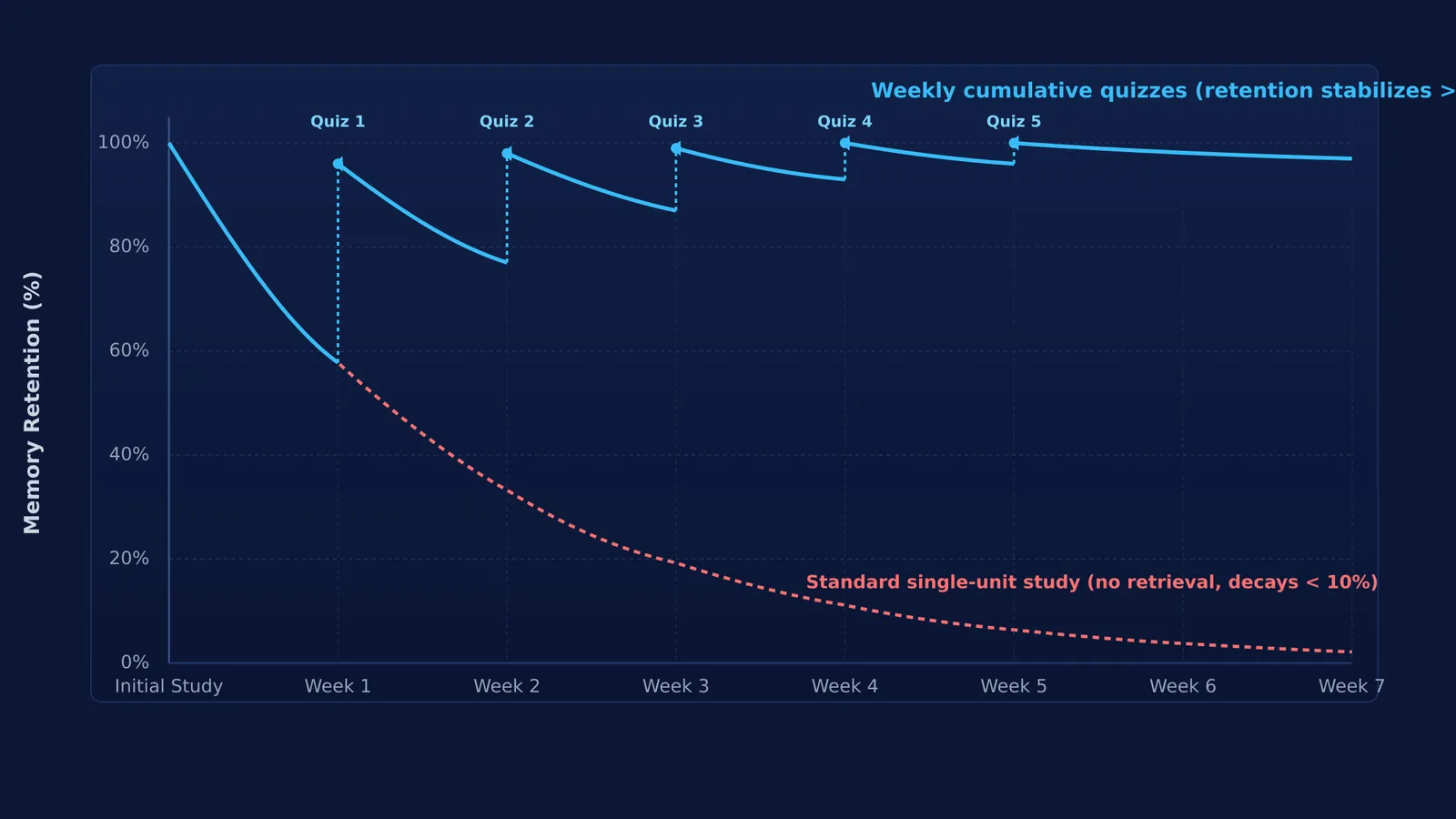
A weekly cumulative quiz solves this. By retrieving a focused blend of recent and older concepts every weekend, you protect earlier chapters from decaying. Using an AI prompt automates the test generation, giving you a targeted diagnostic session in a single sitting.
Why do students forget earlier chapters by exam season?
The human brain sheds unused memories systematically. As mapped by Ebbinghaus's forgetting curve, newly learned material fades rapidly without active reinforcement. Standard schooling worsens this through "blocked practice," where students study one chapter in isolation, write a unit test, and move on.
Blocked practice creates a false sense of mastery. Solving routine problems from a single subtopic requires no effort to identify the appropriate method. In a landmark study in *Psychological Science*, Roediger and Karpicke (2006) demonstrated that after one week of delay, students who relied on repeated reading recalled only 40% of the material, whereas students using retrieval practice retained 61%. A structured spaced revision schedule halts this rapid loss by prompting recall before neural traces fade.
What does cognitive science say about cumulative quizzing?
Cumulative quizzes require students to retrieve older material alongside current lessons. Cognitive psychologists have repeatedly demonstrated that cumulative testing produces durable memory.
In a controlled classroom trial in *Teaching of Psychology*, Lawrence (2013) found that students taking cumulative exams averaged 80% on the comprehensive final exam, compared to 77% for peers taking non-cumulative unit exams, with lower-scoring students showing the greatest retention gains.
This retention advantage endures over time. A study in *Teaching of Psychology* by Khanna, Badura-Brack, and Finken (2013) showed that students evaluated through cumulative tests retained significantly more course knowledge across follow-up assessments conducted up to 18 months after course completion.
Furthermore, mixing different topics—known as interleaving—trains problem discrimination. In the *Journal of Educational Psychology*, Rohrer, Dedrick, and Stershic (2015) found that on a 30-day delayed test, seventh-grade mathematics students completing interleaved practice scored 76% higher than those using blocked practice, achieving 74% compared to 42%.
How do you structure a ten-question cumulative quiz?
A ten-question quiz provides diagnostic precision without mental exhaustion. To reinforce current lessons while safeguarding older chapters, use a 4-3-3 distribution.
Questions 1–4 (Current chapter): Check core definitions and standard numerical setups from the week's lessons.
Questions 5–7 (Medium-range chapters): Revisit topics finished earlier in the term to interrupt mid-term memory decay.
Questions 8–10 (Foundational chapters): Test early chapters studied at the start of the academic year to ensure core models remain intact.
Completing ten questions takes a brief sitting. Any incorrect response flags an isolated concept gap that can be resolved immediately, preventing pre-exam panic.
How can an AI tutor build and grade your weekly quiz?
Assembling an interleaved quiz by hand takes too much time and tempts you to choose questions you already know. Delegating test generation to AI preserves the element of surprise. When you make an AI chatbot quiz you, set strict rules so it acts as an examiner rather than giving answers away.
Use this prompt template at the end of each study week:
> "Act as a strict STEM tutor. Generate a 10-question physics quiz: 4 questions on Current Electricity (current topic), 3 on Electrostatic Potential (completed recently), and 3 on Electric Charges and Fields (foundational topic from earlier in the year). Present question 1 only. Wait for my response. After I answer, verify if it is correct, explain any mistake in two sentences, and then show the next question."
When assessing errors, standard chatbots often print generic solutions. On Fermi's AI tutor, the tutor holds a line of reasoning across the session, notices where you get stuck, and decides whether to explain, ask, or show. If a quiz uncovers an older topic you have forgotten, you can review the Fermi Concept Library, where every concept in physics, chemistry, biology, mathematics, and computing has its own lesson and place in the map. For persistent numerical mistakes, the Fermi Problem Library offers worked problems with a step-by-step solver that explains the reasoning.
Schedule your ten questions every Sunday morning. With continuous retrieval, you keep all chapters accessible all year long.


