On this page
You have probably seen the graph: a line plunging downward, with a caption saying you forget most of what you learn within a day unless you revise. It is credited to Hermann Ebbinghaus, a psychologist who tested his own memory in the 1880s. The curve is real. Much of what is said about it is not what he measured.
What did Ebbinghaus actually do?
Ebbinghaus was his own and only subject. According to Murre and Dros's 2015 paper in PLOS ONE, he completed his forgetting experiment in 1880 and reported it in 1885, after seven months of experimenting, often with up to three sessions a day.
He learned rows of 13 nonsense syllables until he could recite them without error, then relearned them after a delay: about 20 minutes, 1 hour, about 9 hours, 1 day, 2 days, 6 days or 31 days. Nonsense syllables let him avoid the meanings and associations that real words carry.
The key is how he measured memory. He did not count how many syllables he could recall. He used savings: how much less time it took to relearn a list than to learn it the first time. Murre and Dros define it: "Savings is defined as the relative amount of time saved on the second learning trial as a result of having had the first." If relearning takes as long as learning did, savings is zero.
What did the forgetting curve show?
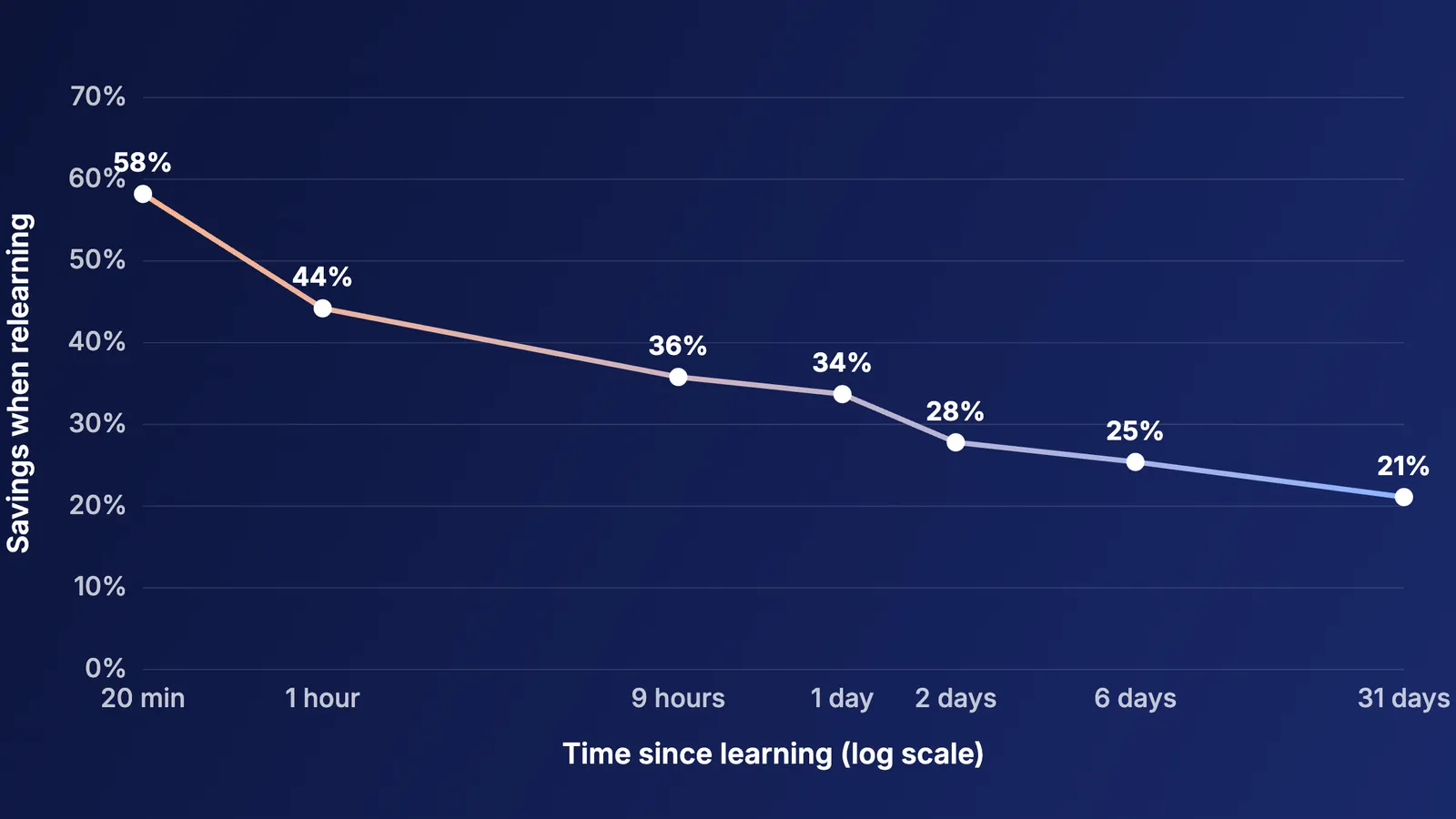
His savings, as tabulated from his 1885 book in Murre and Dros's paper, were roughly:
58% after about 20 minutes
44% after 1 hour
36% after about 9 hours
34% after 1 day
28% after 2 days
25% after 6 days
21% after 31 days
In his words, from the English translation of his book Memory: "After 24 hours about one third was always remembered; after 6 days about one fourth, and after a whole month fully one fifth of the first work persisted in effect."
Two features matter. Forgetting is fastest at the start and then slows. And it levels off: a month later, a fifth of the original effort was still saved.
Did the forgetting curve replicate?
Yes. In 2015, Murre and Dros repeated the experiment with a single subject, Dros, who spent 70 hours learning and relearning lists. The results were similar to Ebbinghaus's: savings fell from about 47% at 20 minutes to about 32% at one day and 4% at 31 days.
They also concluded that the curve "is not completely smooth but most probably shows a jump upwards starting at the 24 hour data point," which some researchers have linked to sleep. Our post on sleep before an exam covers that research.
Where does the "80% forgotten" claim go wrong?
Popular versions often say you forget 70% or 80% of what you learned within a day. Three problems:
Savings is not recall. Murre and Dros note that savings and recall can give different results. A savings score of 34% means relearning took about a third less time. It does not mean 34% of the facts were still in your head, or that 66% were gone.
Nonsense syllables are not physics. Ebbinghaus chose material with no meaning on purpose. Concepts you understand and link to what you already know are a different case, so don't read his numbers as a forecast for your NCERT chapter.
One person. The original and the replication each used a single subject. The shape has replicated; exact percentages for you will vary.
What carries over is the shape: fast early forgetting, slower later forgetting, and the fact that relearning is quicker than learning from scratch.
How to use the curve in your revision
Review a new topic within a day or two, while the drop is steepest. A 15-minute self-test the next evening is enough.
Space later reviews further apart: about a week, then a few weeks.
Test before you reread. Write what you remember first, then check the gaps. See why rereading feels like learning.
Count on relearning being fast. A chapter you studied in Class 11 is not lost; a focused session will bring it back faster than the first time.
For a full schedule, see how to plan revision using the spacing effect.
Where Fermi fits
Spacing works best when you know what has faded. Fermi's AI tutor works out what you already know and builds a plan for the session, so revision starts where your gaps are. For a concept that has faded completely, the Fermi Concept Library has a lesson for each one.
Pick a topic you studied last week and test yourself before you reread it.