

On this page
When we take notes in class or while watching a lecture, we are usually racing to keep up. We try to capture the main ideas, but in the rush, we often omit the subtle details that matter most. Reading those notes later often creates a false sense of security.
You glance over a page you wrote last week on rotational motion or cell division, see your familiar handwriting, and feel you know the material. But what if you copied a formula incorrectly, or completely missed a crucial constraint?
Finding those hidden mistakes early saves marks later. Instead of waiting for a mock test to reveal your blind spots, you can take a photo of your handwritten page, paste it into an AI tool, and ask it to find the errors.
Why is checking notes for errors effective?
We naturally want to avoid making mistakes, but avoiding them during study sessions is a missed opportunity. A 2017 review by psychologist Janet Metcalfe at Columbia University found that errorful learning followed by corrective feedback is highly beneficial for students. The review noted that errors committed with high confidence are actually corrected more readily than low-confidence errors, provided the student receives feedback that analyses their reasoning.
When you ask an AI to hunt for mistakes in a page of notes you thought was perfect, you are exposing your high-confidence errors. The AI provides immediate corrective feedback, breaking down exactly where your logic went wrong. This process turns a passive review session into an active investigation of your own memory.
How can I ask AI to check my notes for mistakes?
To get the most out of this technique, you need to use a specific script. If you just upload an image and ask, "Are these notes good?", the AI might give you vague praise, summarise the page, or rewrite the notes entirely. You want it to act as a strict inspector, not a co-author.
Here is a script you can use to set the right boundaries:
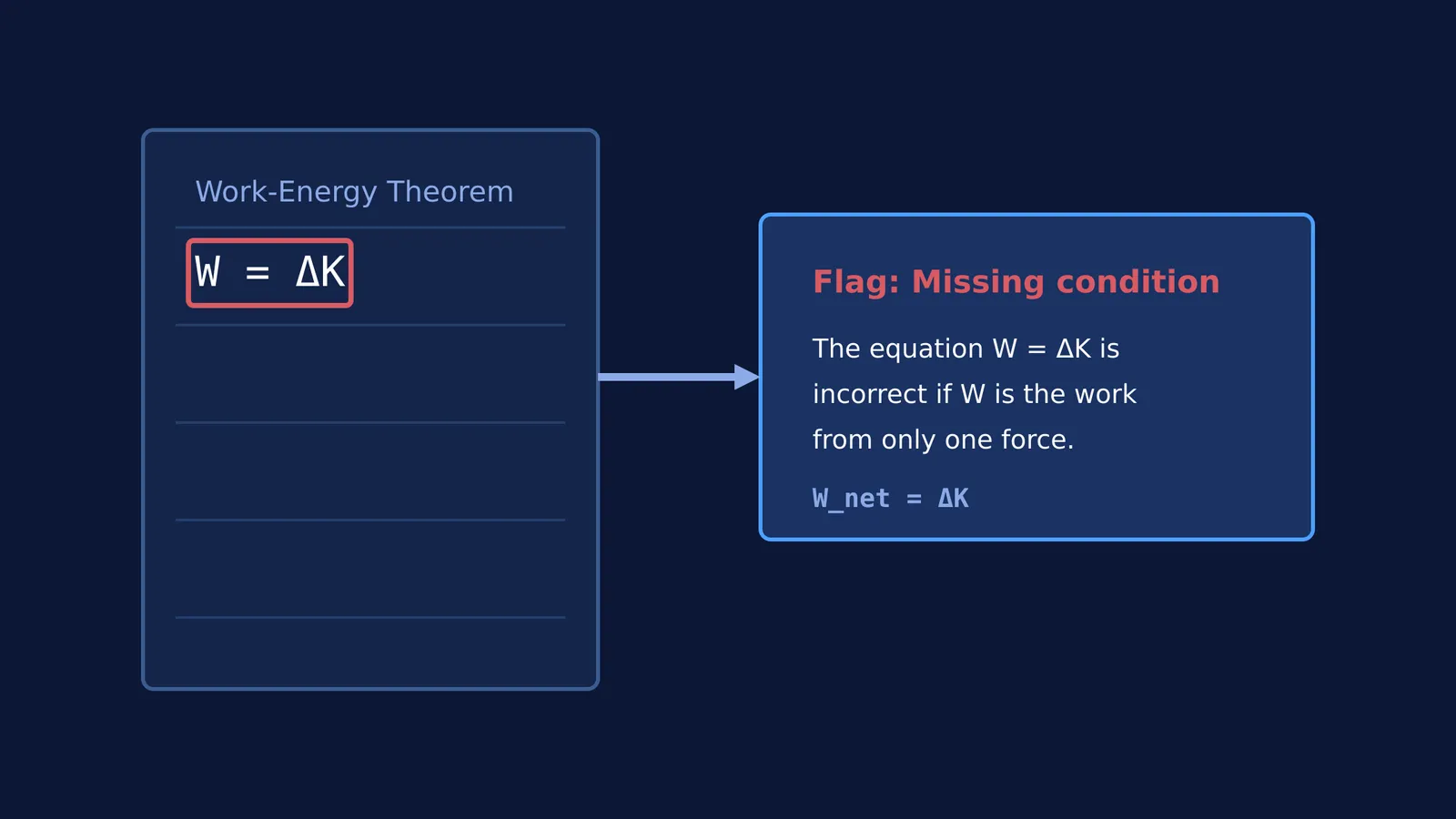
Upload a clear photo of your handwritten page—or paste your typed notes—along with this prompt. The AI will return a bulleted list of potential issues. For example, in physics, it might flag that you wrote down the work-energy theorem but forgot to specify that it only applies to net work.
How should I confirm the AI's flags?
Do not take the AI's corrections as absolute truth. An AI can hallucinate errors, misread your handwriting, or apply conventions from a different syllabus. The real learning happens when you verify its claims.
Take the first flagged error on the AI's list.
Open your standard textbook, such as the NCERT biology book or your primary physics text.
Look up the specific concept. If the AI says you missed the "ideal gas" condition for an equation, read the derivation in the textbook to confirm it.
Correct your physical notes in a different colour ink.
It is tempting to simply glance at the AI's list and tell yourself you will remember the correction. But passive reading is exactly what caused the mistake to survive in the first place. You must interact with the text. If the AI flags that you wrote "mitosis produces four daughter cells" and says it should be two, go to the cell cycle chapter. Finding that specific paragraph and then physically crossing out the mistake in your notebook creates a strong cognitive anchor.
This verification step is non-negotiable. As we discussed in our guide on why AI chatbots get maths wrong, treating a generative model as an infallible oracle can lead you astray. Verifying forces you back into the source material with a clear, targeted question in mind. Seeing the correct fact in the textbook makes the memory stick.
What should I do when I find a major conceptual gap?
Sometimes the AI will point out a mistake that reveals you completely misunderstood the foundation of a topic. You might realise you have mixed up the SN1 and SN2 reaction mechanisms, or that your notes on relative velocity make no sense.
When you hit a deep structural gap, patching a single line in your notebook is not enough. You need to relearn the concept. This is where Fermi's AI tutor helps. A student can bring a confusing topic or a problem set, and Fermi works out what they already know, builds a plan for the session, and teaches through it by writing on a board and checking understanding as it goes. It holds the line of reasoning so you can rebuild the concept from the ground up.
For numerical subjects, after you fix your notes, you must test whether you can apply the corrected concepts. You can read our guide on getting useful AI feedback on your step-by-step physics solutions to see how to practice effectively. Checking your notes is only the first step; applying those corrected concepts to new problems is how you secure the marks on exam day.


