

On this page
Most memory research lasts an afternoon. Harry Bahrick, a psychologist at Ohio Wesleyan University, wanted to know what happens over a lifetime. He joined the university in 1949 and worked there for more than 60 years, according to Ohio Wesleyan's profile of him. "Memory is who we are, and once I realized that, I wanted to study how memories are formed, how they are retrieved, how they are stored, how they are lost," he said in that profile.
Two of his studies matter for anyone revising for exams. One measured how much school Spanish people still knew decades later. The other turned his own family into a nine-year experiment on spacing.
What did Harry Bahrick find about school Spanish 50 years later?
In a 1984 study in the Journal of Experimental Psychology: General, Bahrick tested 733 people who had learned Spanish in school, up to 50 years after they studied it. He tested reading, vocabulary and grammar, and asked how much Spanish they had taken, what grades they got and how much they had used it since.
Most had barely used Spanish after school. According to the study's abstract, retention fell steeply for the first 3 to 6 years, then stayed roughly flat for up to 30 years before a final decline.
Bahrick called the knowledge that survived the "permastore". How much of it a person kept depended on how much Spanish they had studied and the grades they had earned.
How did the Bahrick family test spacing for nine years?
Longer courses give you more practice and also spread it out, so the 1984 data could not separate the two. To pull them apart, Bahrick ran a study with his wife Phyllis and daughters Audrey and Lorraine, all psychologists, published in Psychological Science in 1993.
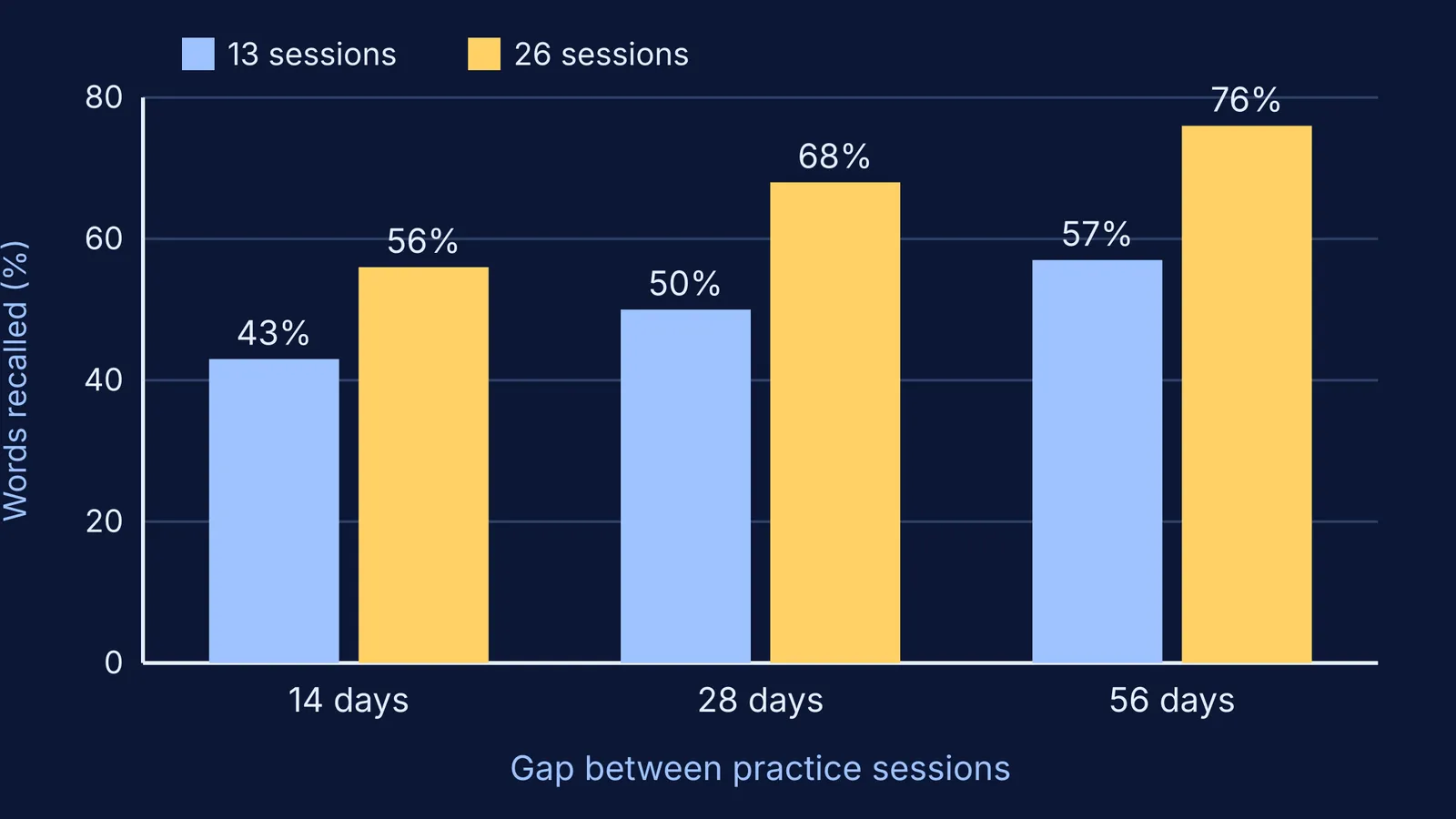
Each of the four learned 300 foreign words, French for three of them and German for one, split into six sets of 50. Each set got 13 or 26 practice sessions, spaced 14, 28 or 56 days apart. After the first session, every session began with a test: see the foreign word, try to recall the English, then go back over only the misses until each had been recalled once. Recall was tested 1, 2, 3 or 5 years after the last session.
What the paper found:
Wider gaps made learning slightly slower during training.
Wider gaps gave clearly better recall later. With 26 sessions, average recall over five years was 56% at 14-day gaps and 76% at 56-day gaps.
13 sessions 56 days apart gave 57% recall, comparable to 26 sessions 14 days apart.
More sessions also helped, at every gap.
The paper quotes Schmidt and Bjork: "Manipulations that maximize performance during training can be detrimental in the long term." That idea runs through Robert Bjork's work on why forgetting helps you learn. The same paper reports an earlier eight-year study by Bahrick and Phelps: people who relearned 50 Spanish words with 30-day gaps recalled 15% of them, against 8% with 1-day gaps and 6% when all the sessions fell on the same day.
The limits are real. It was four people, all psychologists, learning word pairs, and the authors say it is still open whether the effect holds for more complex material.
How can you use Bahrick's spacing in your revision?
The Class 11 and 12 syllabus is a two-year window, close to the length of the 1993 study's 13-session, 56-day schedule: 13 sessions 56 days apart means 12 gaps of 56 days, about 22 months.
Here is a plan for one Class 11 chapter, say kinematics, first learned in July:
Make a deck of 30 to 50 cards: a formula, a definition, a one-step problem, a common trap.
Test before you read. Each session, try every card from memory first and set aside the ones you get right.
Re-study only the misses until you have recalled each one once, as the Bahricks did. Then stop.
Space the sessions wide. After the first week, aim for one session every 6 to 8 weeks: September, November, January and on through Class 12.
Expect a slower start. Early sessions will have more misses than weekly revision would. In the 1993 study, that extra effort came with better recall years later.
For a single exam a month away, our four-week spaced revision schedule fits one chapter into a month, and Ebbinghaus's forgetting curve shows why the first days after learning matter so much.
Some misses come from not understanding an idea rather than forgetting it. For those, the Fermi Concept Library has a lesson for every concept in physics, chemistry, biology, mathematics and computing. If you are unsure which chapters to put on the cycle first, Fermi's AI tutor can work out what you already know and build a plan for the session.
Pick one chapter you finished this term and hold its first spaced session this weekend.


