

On this page
In 1973-75, at the John Curtin School of Medical Research in Canberra, Australia, Peter Doherty and Rolf Zinkernagel, a research fellow from Switzerland, did an experiment that explains a key idea in cell-mediated immunity: T cells need MHC to see an antigen. The facts below come from the Nobel Assembly's 1996 press release, which awarded the two the Nobel Prize in Physiology or Medicine "for their discoveries concerning the specificity of the cell mediated immune defence".
What did Zinkernagel and Doherty actually do?
They infected mice with lymphocytic choriomeningitis (LCM) virus, which can cause meningitis. The infected mice made killer (cytotoxic) T lymphocytes, and in a test tube those T cells killed virus-infected cells, as expected.
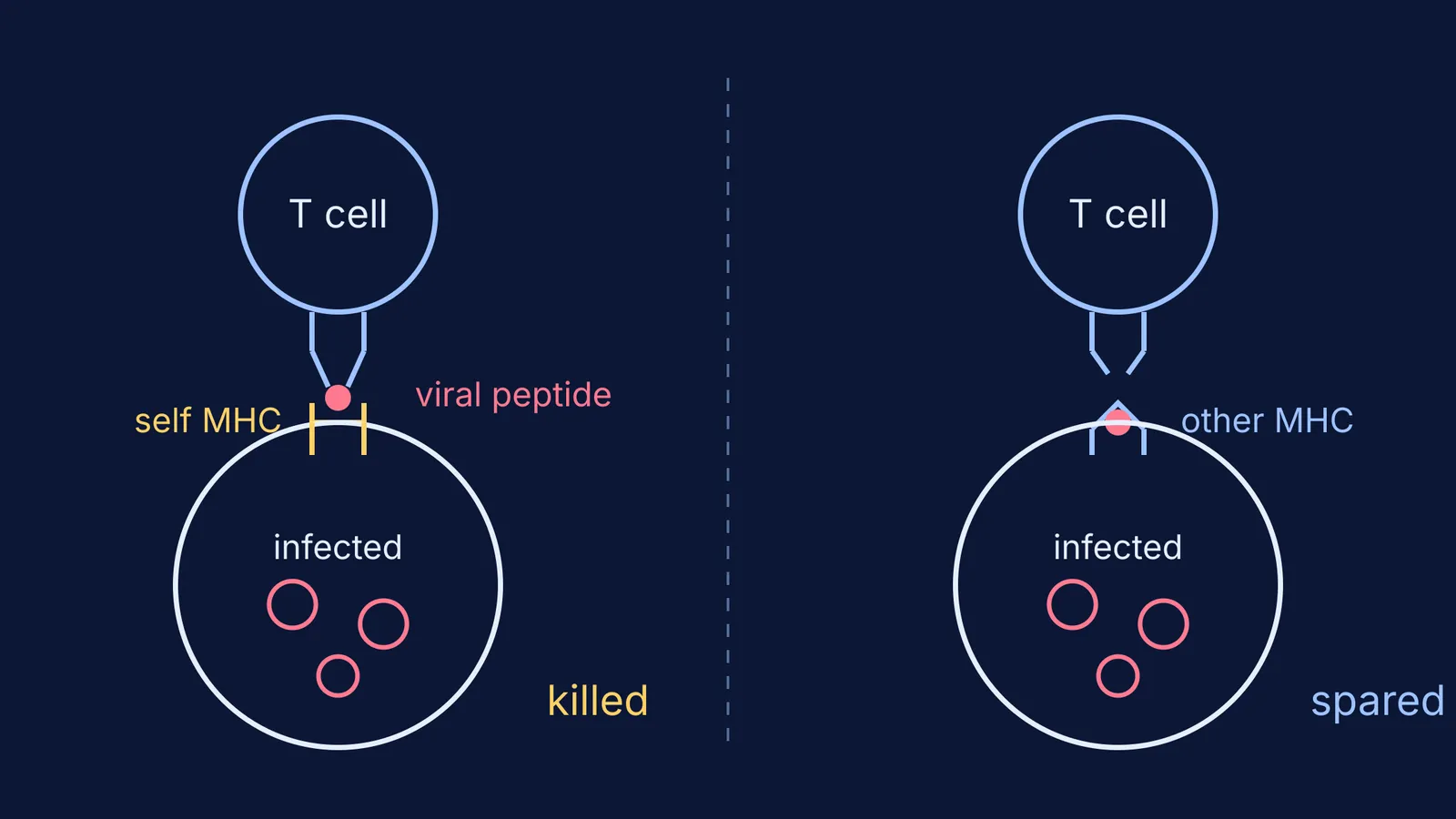
The surprise came when they offered the same T cells infected cells from a different strain of mice. The T cells were primed against that exact virus, yet they did not kill those cells. The Nobel press release says what decided a cell's fate was not only whether it was infected, but whether it carried the "correct" variant of histocompatibility antigens, those of the infected mouse itself.
They published the result in Nature in 1974. Their first paper, "Restriction of in vitro T cell-mediated cytotoxicity in lymphocytic choriomeningitis within a syngeneic or semiallogeneic system", states in its abstract that the interaction of cytotoxic T cells with LCM-infected cells is restricted by the H-2 gene complex, the mouse version of the MHC. A second paper the same year, "Immunological surveillance against altered self components by sensitised T lymphocytes in lymphocytic choriomeningitis", set out how this might work.
Why do T cells need MHC to recognise a virus?
MHC (major histocompatibility complex) molecules are proteins on the surface of your cells; in humans they are called HLA antigens. Before 1974, biologists mostly knew them as the reason transplanted organs are rejected. Zinkernagel and Doherty showed that MHC also does a job every day: a killer T cell recognises the foreign molecule and the self MHC at the same time.
The pair proposed two models to explain this, according to the Nobel press release. In the "altered self" model, the virus changes the MHC molecule. In the "dual recognition" model, the T cell reads foreign and self together. The press release says later molecular research confirmed their models and showed the structural basis. In 1987, Pamela Bjorkman, Don Wiley and colleagues solved the structure of the human MHC molecule HLA-A2 and reported that a groove between its alpha-helices provides a binding site for processed foreign antigens. A short piece of the virus, a peptide, sits in that groove, and the T-cell receptor recognises the peptide and the MHC together.
How can you predict the result of their experiment?
A good way to check you understand MHC restriction is to predict each outcome before reading the answer. Take killer T cells from a mouse of strain A that was infected with LCM virus. Then test them against four kinds of target cells:
Strain A cells, infected: killed. The virus and self MHC are both there.
Strain A cells, not infected: spared. Self MHC is there, but no viral peptide.
Strain B cells, infected: spared. The viral peptide is there, but on the wrong MHC. This was the surprising result.
Strain B cells, not infected: spared in this test. These T cells were primed against virus plus strain A MHC.
If you predicted "killed" for case 3, you assumed a T cell looks only for the virus. Case 3 is the whole discovery.
Why does MHC restriction matter for you today?
The Nobel Assembly's press release notes that within a few years of the discovery it was shown that the T cells allowed to mature and survive in a person are chosen by their ability to recognise that person's own MHC. This is how the immune system tells self from non-self. The same principle guides vaccine design: researchers can work out exactly which parts of a microbe T cells recognise and focus a vaccine on them.
Our explainers on humoral vs cell-mediated immunity and why transplanted organs are rejected cover the same molecules from the transplant side. And the story of Shimon Sakaguchi and regulatory T cells shows how the body stops T cells attacking its own tissues.
For revision, try this three-step check on any immunity question:
Name the cell: B cell (antibodies) or T cell (helper or killer).
Name what it recognises: free antigen for antibodies, or peptide on MHC for T cells.
Ask whose MHC it is: self MHC means a normal response; foreign MHC usually means a transplant.
If words like antigen, peptide and histocompatibility still blur together, the Fermi Concept Library has a lesson for each biology concept and shows where it sits in the map, so you can fill the gap before going back to the chapter. And if you are not sure where to start on immunity, Fermi's AI tutor works out what you already know and builds a plan for the session.


