

On this page
The immune system is a powerful defense network, but it carries a built-in danger: the weapons that destroy viruses and bacteria can also turn against the body's own tissues. For decades, immunologists debated how the body prevents this friendly fire.
In 1995, Japanese immunologist Shimon Sakaguchi provided the answer. He identified a specialized group of white blood cells that actively suppress unwanted immune responses. Today, these are known as regulatory T cells. For this work, Sakaguchi was jointly awarded the 2025 Nobel Prize in Physiology or Medicine alongside Mary E. Brunkow and Fred Ramsdell (Nobel Prize press release).
What did Shimon Sakaguchi discover?
In the mid-20th century, scientists believed the body maintained "central tolerance" by simply destroying any self-reactive immune cells while they were still developing in the thymus. You can read more about early work on this organ in our post on the role of the thymus in immunity. However, it became clear over time that some self-reactive cells always manage to escape into the bloodstream.
Sakaguchi suspected there was a second layer of defense, known as "peripheral tolerance". In a 1995 study, Sakaguchi demonstrated that approximately 10% of peripheral CD4+ cells in normal adult mice express the CD25 receptor (Journal of Immunology).
When his team removed these CD25-expressing cells from the mice, the animals spontaneously developed severe autoimmune diseases, including thyroiditis and gastritis. When he injected the cells back into the mice within a limited period, the autoimmune development was prevented in a dose-dependent manner. This proved that a specific, physical population of cells acts as an active brake on the immune system.
How do regulatory T cells stop the body attacking itself?
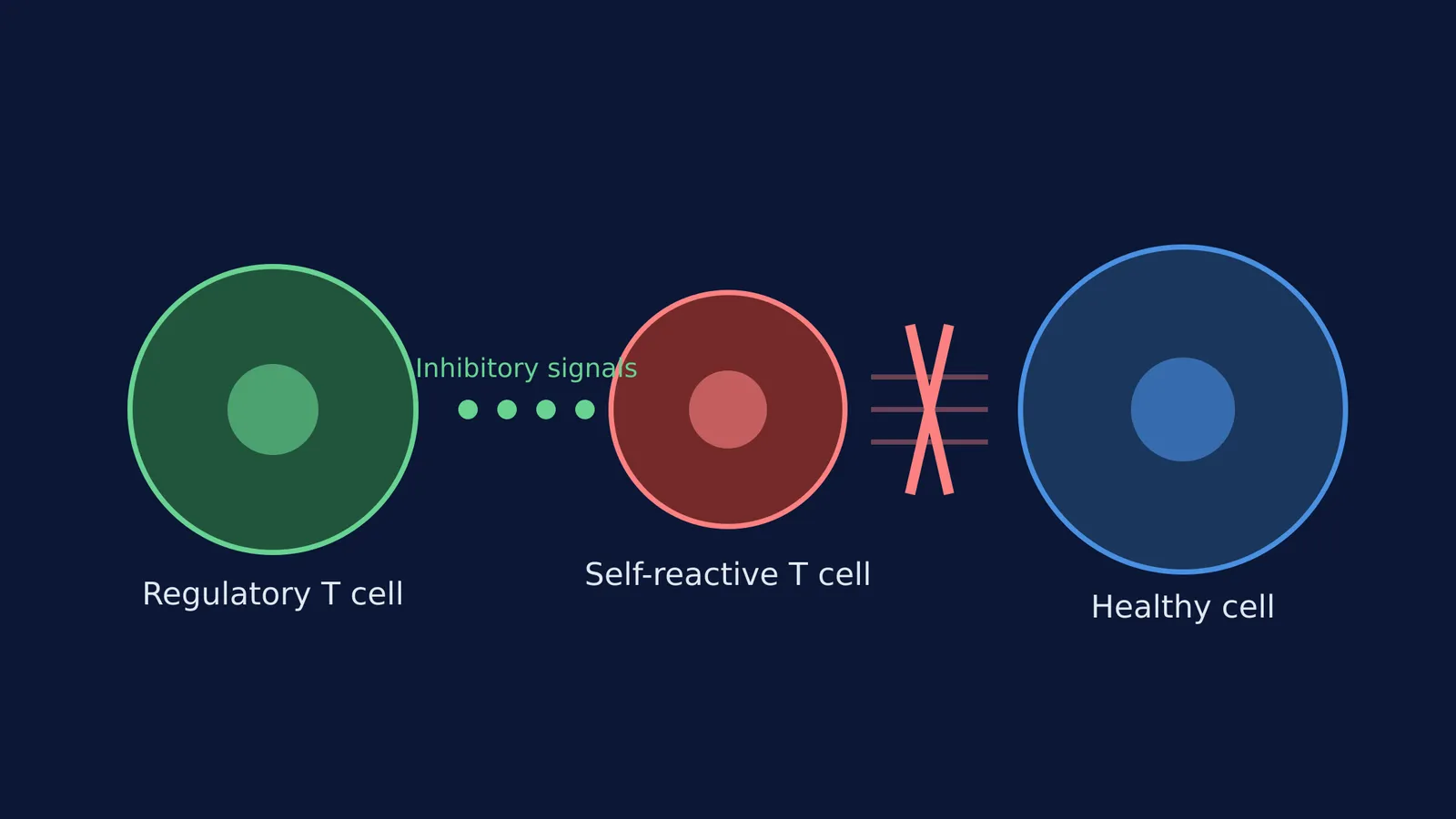
Regulatory T cells are a subset of CD4+ T cells. Unlike helper T cells, which coordinate immune attacks and are the primary targets during HIV replication, regulatory T cells shut down the attack. They patrol the body and release inhibitory signals that disarm self-reactive effector T cells before they can cause tissue damage.
In 2003, Sakaguchi's team published an important result in *Science*, proving that a transcription factor called Foxp3 is the key regulatory gene for the development of regulatory T cells (Science). They found that transferring the Foxp3 gene into naïve T cells converted them toward a regulatory phenotype. Independently, Brunkow and Ramsdell had discovered that mutations in this exact gene cause severe, fatal autoimmune diseases in humans and mice, linking the cellular discovery to genetics.
Why does the discovery of regulatory T cells matter?
Sakaguchi's identification of regulatory T cells has had a major impact on modern medicine. By understanding how the immune system suppresses itself, researchers are developing new therapeutic strategies across three main areas:
Autoimmune diseases: Conditions like rheumatoid arthritis and type 1 diabetes occur when the immune system attacks healthy tissue. Scientists are exploring ways to enhance regulatory T cell function to restore tolerance and stop the attack.
Cancer immunotherapy: Tumours often recruit regulatory T cells to hide from the immune system. By depleting these cells inside a tumour, doctors can unleash the body's natural defenses to attack cancer cells.
Organ transplantation: A major challenge in transplants is the body rejecting the new organ. Therapies using regulatory T cells aim to teach the immune system to accept the graft without requiring lifelong general immunosuppression.
How should you study complex immune pathways?
When studying immunology for exams, the sheer number of interacting cells, signals and receptors can easily become a blur. Instead of trying to memorise isolated facts, try mapping out the system's checks and balances.
A good framework is to ask three questions about any biological component:
What activates it?
What suppresses it?
What happens if it is removed?
Applying this to Sakaguchi's work, removing the suppressor (regulatory T cells) leads to uncontrolled activation (autoimmunity). If you have concept gaps in these pathways, the Fermi Concept Library provides a lesson for each concept and its place in the map. When you do not know where to start with a complex topic, Fermi's AI tutor can work out what you already know and build a plan for the session, guiding you through the reasoning step by step.


