On this page
A bowl of buttons, a pile of leaves or a basket of toys is enough. When a child puts the red buttons in one heap and the blue ones in another, they are choosing a rule, applying it to every object and checking the result. That is the same move a scientist makes when grouping animals. Below is what research says, and a six-step plan for children in preschool, Balvatika or Class 1.
Why do sorting and classifying matter for maths?
Sorting sits inside the maths young children are expected to learn. The US Common Core kindergarten standard K.MD.B.3 asks children to "classify objects into given categories; count the numbers of objects in each category and sort the categories by count." The same page asks them to directly compare two objects "to see which object has 'more of'/'less of'" a measurable attribute such as length or weight.
Comparing is the step that turns sorting into maths. A long-running study by Bethany Rittle-Johnson and colleagues, published in Child Development in 2017, followed 517 low-income children in the United States from age 4 to age 11. Preschool skill in comparing quantities, counting and patterning predicted their maths achievement in fifth grade. In Vanderbilt University's summary, Rittle-Johnson, a Vanderbilt psychology professor who led the study, says comparing quantities "may merit more attention in preschool".
Can teaching sorting skills actually help?
There is direct evidence from small trials. Julie Kidd, Robert Pasnak and colleagues taught kindergartners three reasoning ideas: the oddity principle (finding the one that does not belong), inserting an object into a series ordered by size, and conservation. In their 2008 study in the Journal of Advanced Academics, 78 kindergartners were randomly split into a reasoning group, a numeracy group and an art group, with matched session time.
The reasoning group scored significantly higher on cognitive measures than both other groups. On an applied maths test it beat the art group and matched the group taught numeracy directly. A later trial funded by the US Institute of Education Sciences used 15 minutes a day of small-group practice on odd-one-out and ordering tasks with some of the lowest-scoring five-year-olds in 24 kindergarten classrooms. That group outperformed an art group on all measures, including literacy and numeracy, and did as well as maths and reading groups on their own measures.
These were small American studies: encouraging, not final.
How do you play sorting games at home?
Work through these steps over weeks. Move on when a step feels easy; go back one if your child gets frustrated. Ages are a rough guide, not a timetable.
Free sort (about age 3 and up). Tip out a handful of buttons and say, "Put the ones that go together in the same place." Accept any rule. Then ask, "How did you decide?"
Your rule, one feature. "Let's put all the big leaves here and the small leaves there." Colour is often a good first rule.
Odd one out. Show four things, three alike: three spoons and a pencil, or three green leaves and a yellow one. Ask, "Which one doesn't belong? Why?" Accept any answer the child can explain.
Same pile, new rule. After sorting toys by colour, mix them and ask, "Can you sort them a different way?" Toys can go by size, or by use: things that roll, things we wear. Switching rules is harder than it looks.
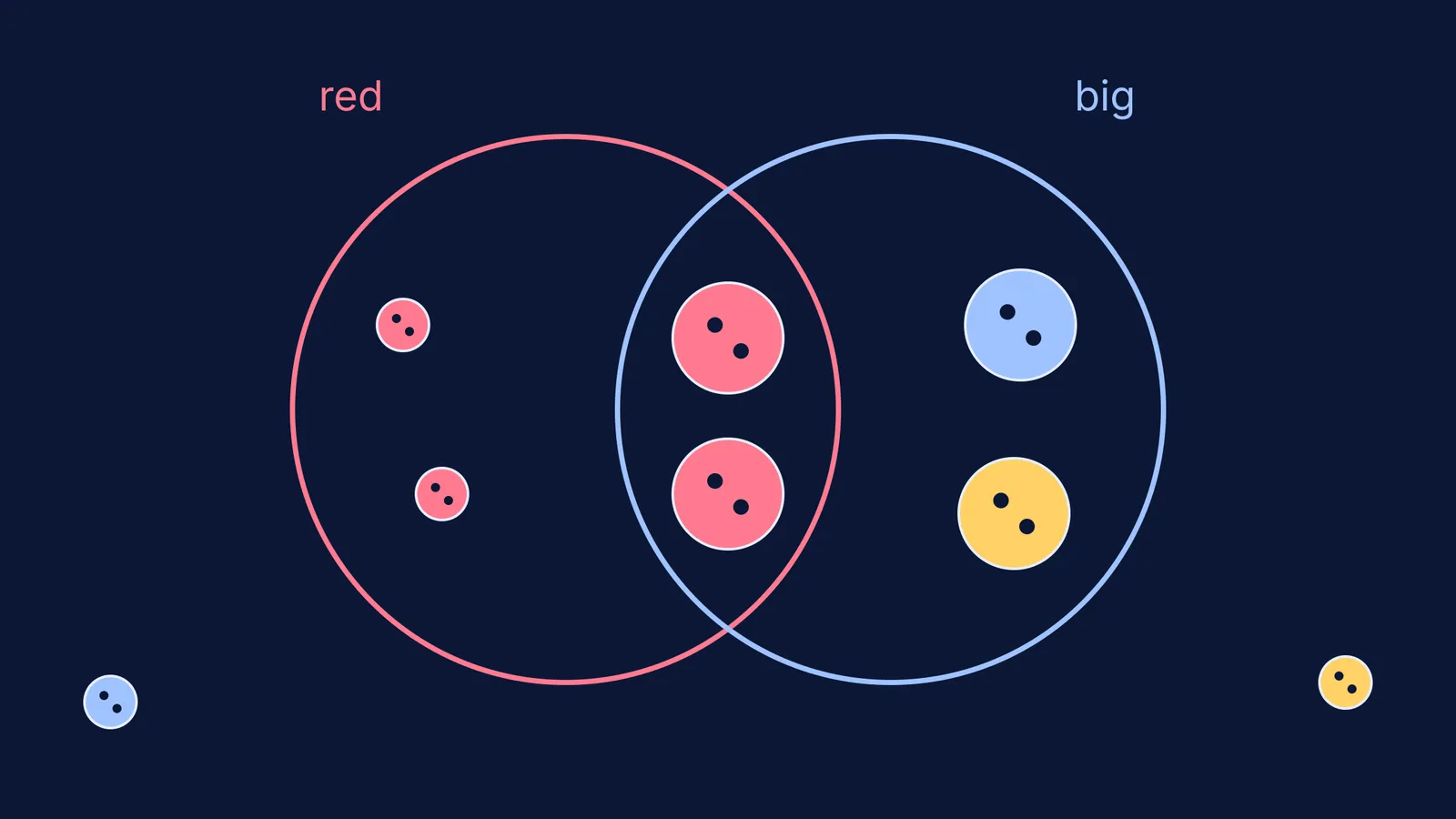
Two rules at once (about age 5 and up). Lay two dupattas or loops of string on the floor so they overlap. One is for red things, one for big things. Ask where a big red button goes. The overlap takes a few tries.
Count and compare. Once the groups are made, count each one. "Which pile has more? How many more?" Then line one group up by size.
What to say while you play
"Tell me your rule." The child puts the rule into words.
"Does this one fit your rule?" They check without you correcting.
"Can you guess my rule?" Children enjoy turning detective.
"Is there another way?" This builds flexible thinking.
Avoid saying "wrong" to an unexpected rule. A child who puts a yellow bus with a banana has sorted correctly by colour.
Where do sorting games show up later in school?
In maths the habit becomes sets, data handling and bar graphs. In science it becomes grouping materials, living and non-living things, and later classifying plants and animals.
For more ideas, try our guide to everyday maths talk with young children, the five safe kitchen science experiments that pair well with sorting by material, and our piece on encouraging curiosity by asking questions.
Years from now, when classifying shows up as organisms in biology or elements in chemistry, the Fermi Concept Library gives each concept its own lesson and its place in the map.
For tonight, put a bowl of mixed buttons or bangles on the table and ask your child for their rule.