On this page
If you cook dinner, drop a younger sibling at tuition, or sit with a grandparent through hospital visits, your study time is not "free time minus distractions". It is what is left after the family's needs. The answer is to plan study into the gaps on purpose, and tell teachers early when the gaps shrink.
How much time do household responsibilities take?
India's official Time Use Survey 2024 factsheet from the National Statistics Office measured this for everyone aged 6 and above. On a given day, 81.5% of females and 27.1% of males did unpaid domestic work for their household. Women who did this work spent 289 minutes a day on it; men spent 88 minutes. Caring for household members took 137 minutes a day for women and 75 minutes for men who did it.
In a survey of 7,592 students at a large US university, Armstrong-Carter and colleagues (2022) found that 5.6% identified as caregivers, and those caring for chronically ill or elderly people faced higher emotional and academic risk. If home duties eat your evenings, you are not lazy; the strain is real.
How do you plan study time around family duties?
Block the fixed duties first. Write down every duty with a set time: cooking, school pickups, a parent's hospital days.
Find two anchor blocks a day. Look for an hour your family rarely needs, early morning or after dinner, and keep it for the hardest work: numericals, proofs, writing.
Fill the gaps with light tasks. A clinic wait is for flashcards or listing doubts, not a new chapter.
Write if-then plans. "If dinner runs late, then I do a short version of my evening block." Psychologists Peter Gollwitzer and Paschal Sheeran pooled 94 studies and found that plans saying exactly when, where and how you will act had a medium-to-large effect on reaching goals (meta-analysis, 2006).
Review on Sunday. Move what slipped, and tell your family next week's test dates so they can plan with you.
On drained days, use our 45-minute minimum study plan for no-energy days.
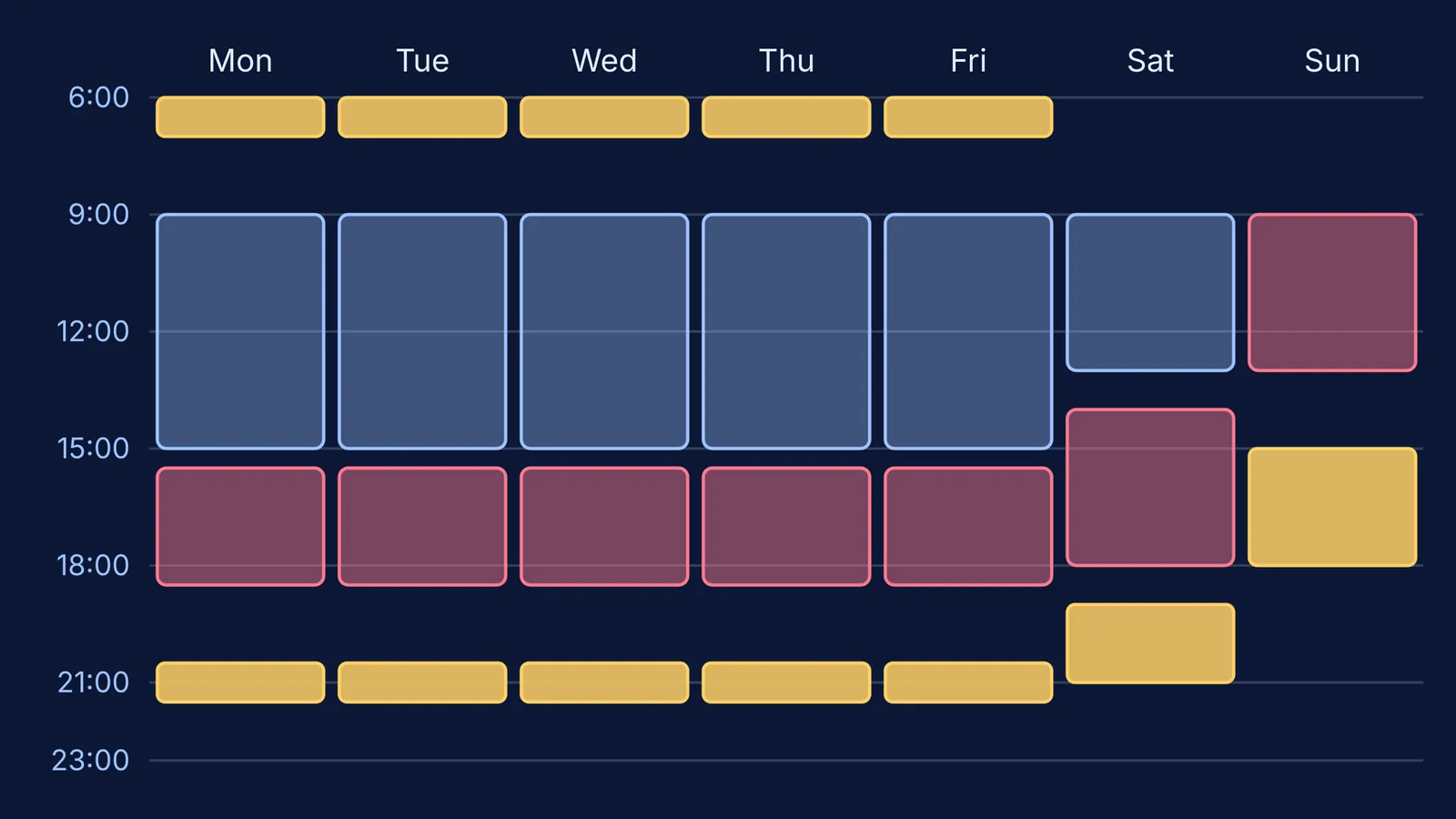
A worked example. Take a second-year BSc student with classes from 9 to 3 on weekdays, who collects and helps a younger brother from 3:30 to 6:30, and does the shopping and cleaning on Sunday morning.
Weekdays: study 6:00 to 7:00 am (hard problems) and 8:30 to 9:30 pm (revise the day's lectures).
Saturday: classes until 1, family duties 2 to 6, study 7 to 9 pm.
Sunday: duties 9 to 1, then 3 to 6 pm for the hardest topic and a weekly review.
That is 15 hours of protected study a week (5 days of 2 hours, plus 2 on Saturday and 3 on Sunday).
In a one-hour block, choosing what to do is half the battle. Fermi's AI tutor can work out what you already know and build a plan for the session, so you sit down to a clear next step.
When should you tell your teacher that responsibilities are piling up?
Early: before the deadline, not after it. Speak up when:
you will miss more than a class or two,
a deadline falls in a week you know is blocked (a surgery, a wedding, a move),
your marks have started to slip.
With notice, a teacher can shift a submission or share notes. If your marks have already led to a formal warning, read our guide on what to do after an academic warning in college. If you also work for money, see whether you can work and study a degree in India.
What should you say to a teacher or professor?
Keep it short and factual, with a proposal. Say it after class or send it by email:
"Ma'am, I wanted to tell you early that I have extra family responsibilities for the next three weeks because a relative is unwell. I don't want to fall behind. Could I submit the lab record on the 18th instead of the 14th? I'll get notes for any class I miss from a classmate, and I'll come to your office hour on Thursday with my doubts."
Afterwards, send a two-line email confirming what you agreed.
To catch up on missed topics, the Fermi Concept Library has a lesson for every concept in physics, chemistry, biology, mathematics and computing.
What if it still feels like too much?
Ask your family to share tasks in exam weeks; someone can often swap one duty if they know the dates early. If you feel constantly overwhelmed, low or unable to cope, talk to your college counsellor or call Tele MANAS, the government's free 24x7 mental-health helpline, on 14416 or 1800-891-4416 (helpline details).
Start this week: list your fixed duties on one sheet, mark two anchor blocks a day, and send one message to the teacher whose deadline worries you most.