On this page
Yes, you can work full time and study for a recognized degree in India, but feasibility depends on the mode of study you choose. Under Indian law, no statute bans employees from pursuing higher education. However, conventional on-campus colleges enforce a mandatory attendance requirement—typically 75% under university ordinances and University Grants Commission (UGC) standards. In addition, full-time employment contracts usually contain exclusive service clauses prohibiting attendance at daytime institutions during business hours. Enrolling in a regular daytime degree while working 9-to-5 inevitably triggers attendance shortages or workplace disciplinary issues.
To support working individuals, Indian regulators provide recognized alternatives. Under Regulation 22 of the UGC (Open and Distance Learning Programmes and Online Programmes) Regulations, 2020, degrees acquired through accredited Open and Distance Learning (ODL) and online modes are equivalent to conventional campus degrees. These qualifications carry identical legal validity for central and state government jobs, private hiring, and higher studies. Furthermore, the UGC's April 2022 Guidelines for Pursuing Two Academic Programmes Simultaneously allow students to enrol in two programmes concurrently if class schedules do not clash.
Which degree formats allow you to earn while learning?
Working students in India can choose between three primary accredited pathways:
UGC-entitled Online Degrees: Delivered digitally with asynchronous recorded lectures, virtual discussion forums, and remote proctored exams. This format lets full-time workers study during evenings and weekends.
Open and Distance Learning (ODL): Offered by institutions like Indira Gandhi National Open University (IGNOU), ODL pairs self-instructional print modules with optional weekend counselling at regional centres.
AICTE Working Professional Programmes: Under the AICTE Approval Process Handbook guidelines for working professionals, approved colleges run regular face-to-face B.Tech and diploma courses with evening and weekend shifts. This requires 1 year of full-time work experience and a workplace within a 50 km radius.
Keep in mind that certain disciplines cannot be taken through distance or online modes. Under UGC Distance Education Bureau regulations, practical-heavy fields—including medicine, dentistry, nursing, pharmacy, architecture, agriculture, physiotherapy, and conventional law—are strictly prohibited from ODL delivery.
How many hours can you work before grades begin to fall?
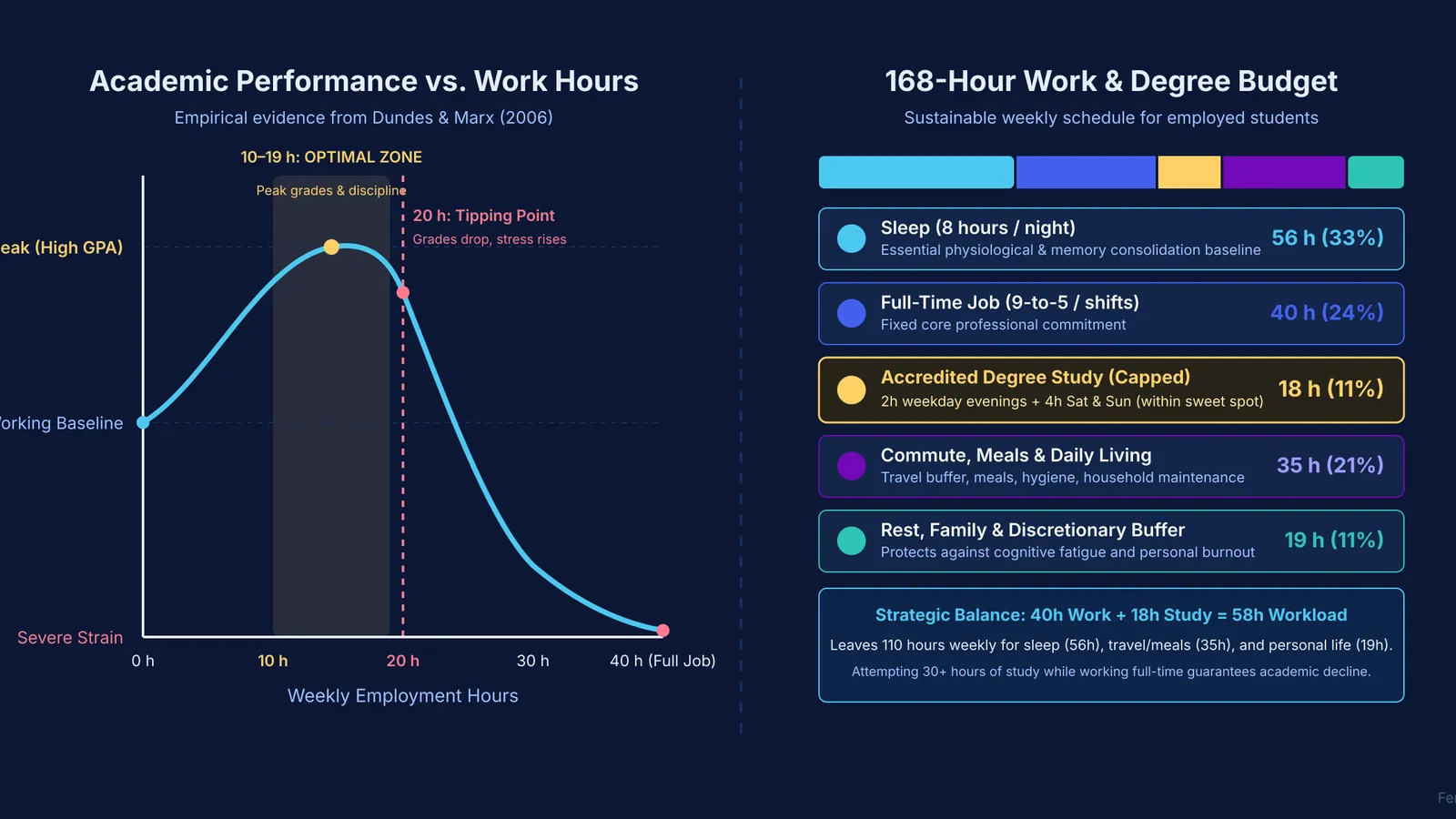
Balancing a job with a degree requires understanding how work hours affect academic stamina. In an empirical study in the *Journal of College Student Retention* (doi:10.2190/7UCU-8F9M-94QG-5WWQ), Lauren Dundes and Jeff Marx analyzed undergraduate academic outcomes across employment levels. They found that students working 10 to 19 hours per week achieved superior academic performance—higher grades and more study hours—than non-working students, because moderate employment created a structured weekly routine.
However, Dundes and Marx found a sharp tipping point: working 20 hours or more per week resulted in lower grades, less study time, and elevated stress. For someone holding a 40-hour job, attempting 30 hours of weekly study leads straight to burnout. Success requires budgeting study as a focused commitment capped at 15 to 18 hours per week.
How do you balance full-time work and independent study?
Structuring your week around non-negotiable study blocks prevents job demands from displacing your coursework:
Protect an 18-hour study budget: Commit to 2 hours on weekday evenings (10 hours total) and 4 hours each on Saturday and Sunday (8 hours total). This leaves 56 hours for sleep (8 hours per night) and over 50 hours for commute and personal life.
Avoid cognitive fragmentation: Research on multitasking while studying shows that switching between work notifications and study materials elevates mental fatigue. Keep work devices silent during study blocks.
Build reliable habits: Sustainable progress relies on habit triggers rather than motivation. Following how to build a study routine that lasts helps anchor your schedule, while weekly time blocking for students ensures coursework is completed before deadlines.
When studying independently late at night or on weekends, students often hit roadblocks without a teacher nearby. The Fermi Problem Library provides worked problems with a step-by-step solver that explains the reasoning rather than printing an answer. For core science topics, Fermi's AI tutor notices where a student is stuck and decides whether to explain, ask, or show, matching the learner's pace. If you are starting fresh, Courses offers university-level courses taught by working scientists, with the AI tutor available on every lecture.