On this page
An email saying "academic warning" or "placed on probation" can feel like a verdict. It is not. It is a notice that your results fell below your college's minimum, with a deadline to recover. Here is what it means, using two IIT rulebooks, and a plan to take to your advisor.
What does an academic warning or probation mean in college?
Every college sets its own trigger, so these numbers apply only to the institutions named. The pattern is often similar: a cut-off, a probation period, and a review if you miss it again.
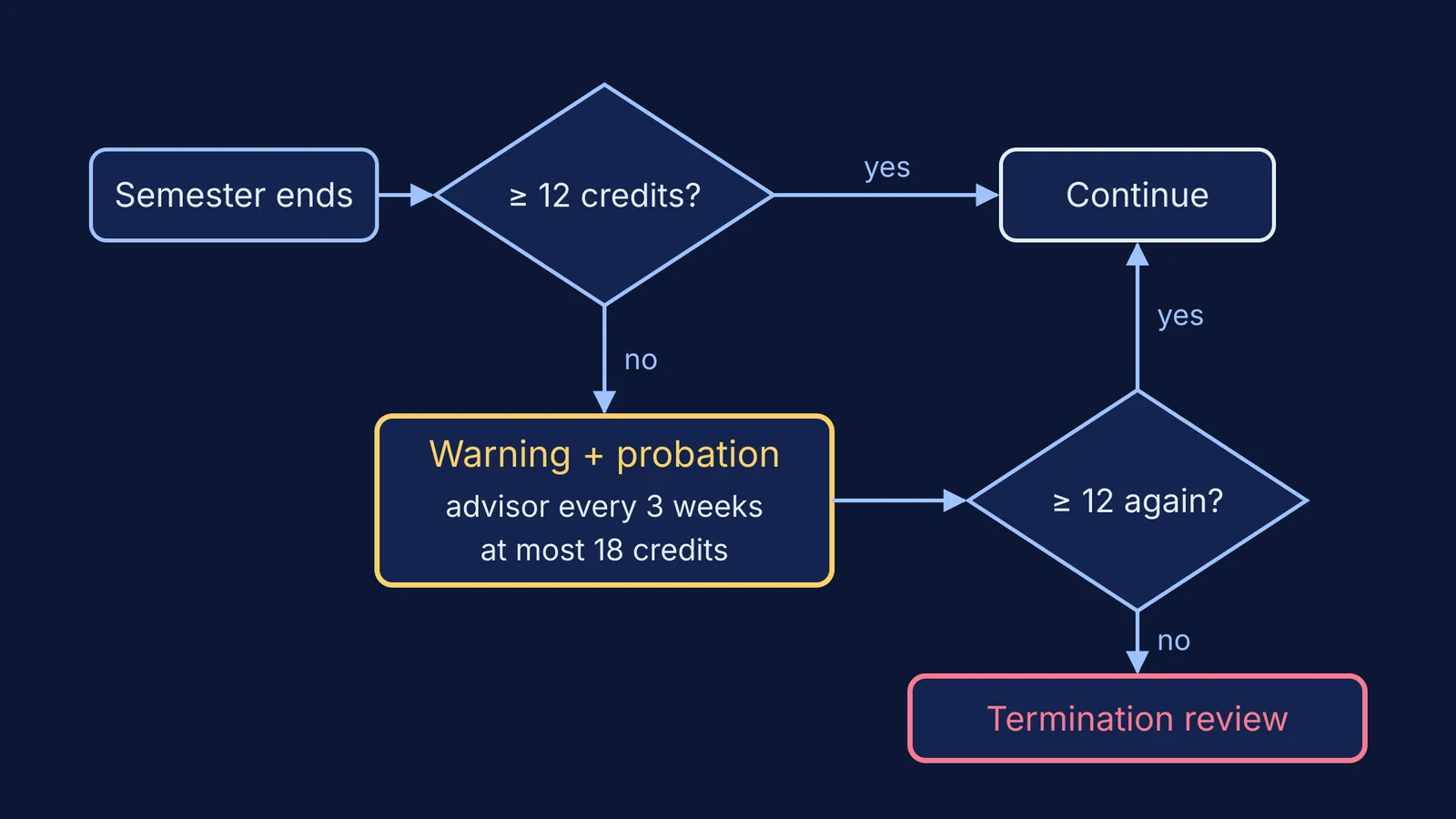
Under IIT Delhi's 2025-26 undergraduate rules, a student who earns fewer than 12 credits in a registered semester is placed on probation, given a warning, and their parents are informed.
Under IIT Goa's M.Tech rules, a student whose course CPI falls below 6.0 at the end of a semester is kept on academic probation for one semester.
If credits and CPI are new to you, our explainer on how credits, SGPA and CGPA work in college walks through the maths, and how relative grading works in college explains how your grade depends on your batch.
What happens if you stay on probation?
At IIT Delhi, a student on probation who again earns fewer than 12 credits faces termination and may continue only if the department makes a favourable recommendation (IIT Delhi rules, section 1.5). At IIT Goa, a student who cannot bring course CPI back to 6.0 is liable to be terminated but can appeal to the Chairperson of the Senate (IIT Goa rules, section 5).
Probation also changes your semester. IIT Delhi caps a student on probation at 18 credits, requires attendance in classes and special tutorials, and assigns a special advisor who normally looks after no more than 5-8 students (sections 1.5 and 1.6). You are expected to meet that advisor at least once every 3 weeks, and an appeal is judged partly on whether you did.
Does academic probation help students recover?
The evidence is mixed, which is why the plan matters. Economists Jason Lindo, Nicholas Sanders and Philip Oreopoulos found that being placed on probation after the first year discouraged some students from returning, while improving the grades of those who did return (2010 study). They also found negative effects on graduation rates, particularly for students with the highest school grades.
Regular contact with a person may help. In a randomised trial of one-to-one student coaching, mostly with nontraditional US college students, Eric Bettinger and Rachel Baker found that coached students were more likely to stay enrolled, during the coaching and a year after it ended (2014 study).
What should you do in the first week after an academic warning?
Read the letter and your college's rule, and note your advisor's name.
Write a one-page diagnosis. For each weak course, list the grade, your attendance and the honest reason: missed classes, shaky basics, poor planning, exam panic, trouble at home.
Book the advisor meeting before registration closes, and bring the page.
Tell a parent or guardian before the college's letter does.
At the meeting, you can open with: "I got a warning for earning too few credits. Here is what I think went wrong in each course. Can we choose a load I can pass and set a target for this semester?" Then ask which failed course to repeat first, whether a reduced load or slow-paced option is open to you, and who runs help sessions.
How do you build a recovery plan with your advisor?
Here is a worked example using the IIT Delhi numbers. Say you earned 9 credits last semester, below the 12-credit bar, and failed a 4-credit maths course.
Load: register for 15 credits, under the 18-credit cap, including the failed maths course. If everything goes well except one 3-credit course, you still earn 12.
Every week: attend every class and tutorial, with a fixed study block per course. If recorded lectures pile up, try a triage and weekly cap for a lecture backlog.
Every 3 weeks: meet your advisor with your quiz and assignment marks so far.
Mid-semester: if a course is heading for a fail, raise it with your advisor early. IIT Delhi bars dropping below 12 credits during withdrawal.
If the failed course rests on basics you never understood, go back to them first. The Fermi Concept Library has every concept in physics, chemistry, biology, mathematics and computing, each with its own lesson. If you don't know where to start, Fermi's AI tutor can work out what you already know and build a plan for the session. Your advisor still sets the direction.
Parents: ask to see the plan, not just the marksheet, and offer to join the advisor meeting if the college allows it.
When should you talk to a counsellor?
If the bad semester came with poor sleep, constant worry or feeling low, tell your advisor and use campus counselling. You can also call Tele MANAS, the government's free, 24x7 mental health helpline, on 14416 or 1800-89-14416 (PIB, 2024).
Start today: find your rule, write the one-page diagnosis, and book the meeting.