

On this page
If you have fallen behind on recorded coaching lectures, the pile is usually not a motivation problem. It is an arithmetic problem: two-hour lectures keep arriving, and watching each one start to finish at normal speed takes longer than the week has. The way out is to stop treating every video the same.
Why does a recorded-lecture backlog keep growing?
Long videos are hard to sit through, and that is not just you. In a study of 6.9 million video-watching sessions on edX, Guo, Kim and Rubin (2014) found that median engagement time was at most 6 minutes, whatever the video's length. Students often made it less than halfway through videos longer than 9 minutes. A coaching lecture is many times that, so it is easy to start three and finish none.
The second reason is that new lectures join the old ones. If this week's classes go onto the pile too, it never shrinks. So the first rule is simple: watch current lectures within a day or two, and give the backlog its own separate slot.
Which recorded lectures should you watch fully?
List every unwatched lecture with its subject, topic and length. Then put each one into one of three groups.
Watch fully if the topic is on your next test, if you could not solve its practice sheet, or if the teacher used a method that is not in your notes or NCERT.
Skim from notes if a classmate's notes or the class PDF exist and you can already solve about half the sheet questions.
Park if it is a revision or doubt session on something you already know, or a topic far from your next test. Parked is not deleted; you come back to it later.
Watching fully does not have to mean 1x. Murphy and colleagues (2022) found minimal loss of comprehension going from 1x to 1.5x or 2x, but performance fell beyond 2x. They note the results may differ for complex or difficult videos, so slow down for heavy derivations. We compared the evidence in what studies found about 2x lecture speed.
Watch in chunks and quiz yourself at each break. Szpunar, Khan and Schacter (2013) split a 21-minute online lecture into four segments. In their second experiment, students who took a short quiz after each segment reported mind wandering on 19% of checks, against 39% and 41% for the comparison groups, and took more notes. Its segments were about 5.5 minutes; for a two-hour lecture, pause every 15 to 20 minutes and write down, without looking, the two main things the teacher just said.
How do you skim a lecture from notes instead of watching it?
A skim takes about 30 minutes instead of two hours:
Read the notes or class PDF for 10 minutes. Mark anything you don't follow.
Attempt four or five sheet questions for 15 minutes, without looking at the notes.
Spend 5 minutes scrubbing the video only for the parts that match the questions you got wrong.
If you are stuck on a question and can't find it in the video, the Fermi Problem Library has a step-by-step solver that explains the reasoning rather than printing an answer. If you use an AI summary of the video instead of notes, check the AI summary against the lecture first.
How many backlog hours should you clear each week?
Pick a fixed cap you can keep in a normal week, say 6 hours (one hour a day, six days a week), and don't borrow from sleep or from current lectures to beat it. The cap is a planning choice, not a research number; what matters is that it is small enough to repeat every week.
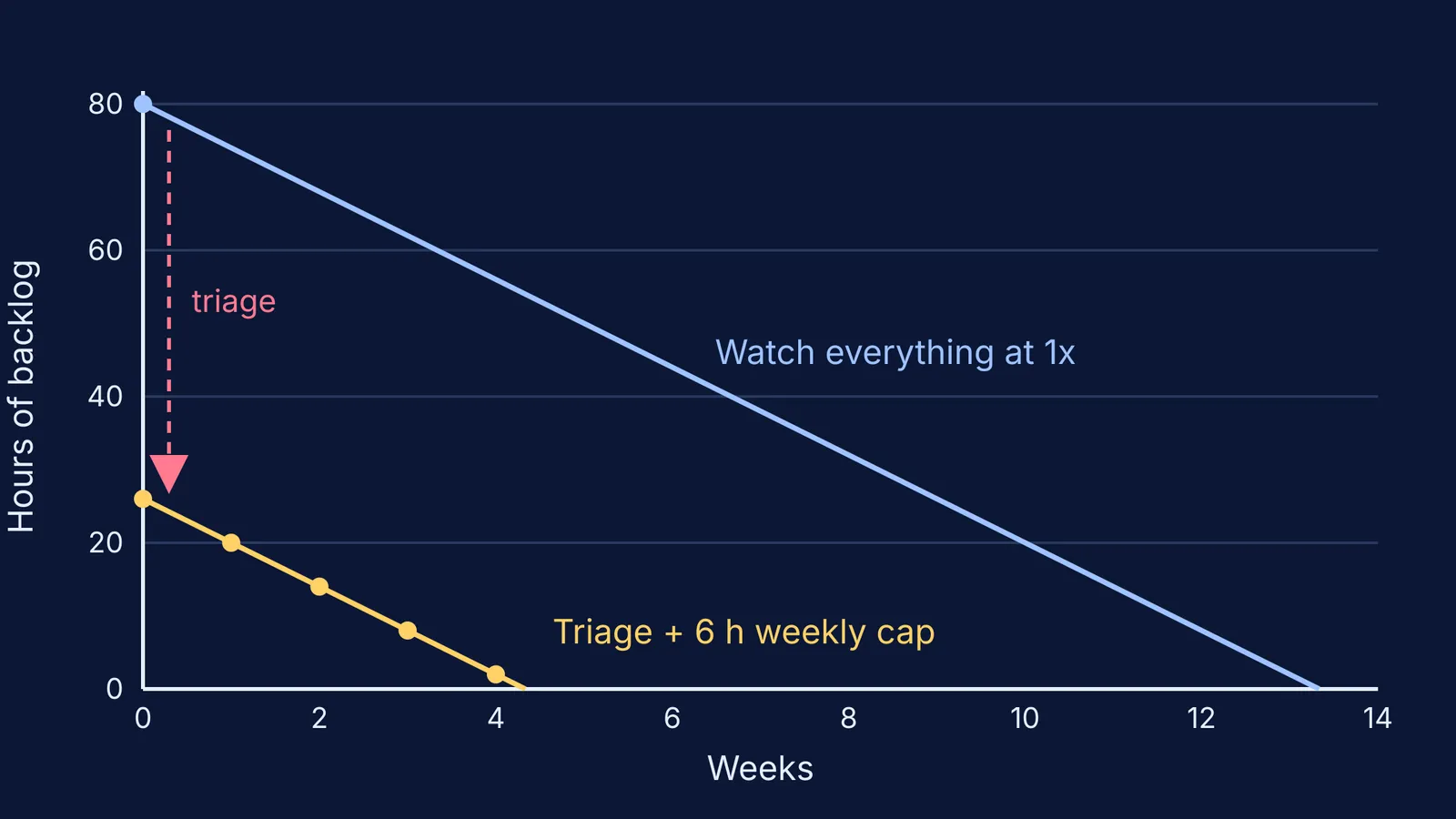
Say you have 40 unwatched lectures of 2 hours each. This example uses 1.5x for watch-fully lectures, within the range where Murphy and colleagues found minimal comprehension loss.
Watching all 40 at 1x is 80 hours. At 6 hours a week, that is about 14 weeks, even if nothing new joins the pile.
Triaged: 12 to watch fully at 1.5x (80 minutes each) is 16 hours. 20 skims at 30 minutes each is 10 hours. 8 parked is 0 hours for now. Total: 26 hours.
At 6 hours a week, 26 hours is cleared in about 5 weeks.
Tick each lecture off your list as you finish it, so you can watch the number fall. For the lectures that arrive this week, a same-day recap keeps them from becoming the next backlog. If you sit down and don't know which lecture to start with, Fermi's AI tutor can work out what you already know and build a plan for the session.
If the pile is leaving you panicky or low for more than a few days, talk to someone you trust. Tele MANAS, the government's free mental-health helpline, is on 14416 or 1800-891-4416, according to the Press Information Bureau.
Tonight, write the list and sort your first ten lectures.


