

On this page
If you watch recorded lectures at 2x, you have a lot of company. In a survey run by Dillon Murphy and colleagues at UCLA, 85% of the students asked said they speed-watch lecture videos, according to UCLA's report on the study. The question is whether the minutes you save cost you marks later.
Is watching lectures at 2x speed bad for learning?
At 1.5x, barely. At 2x and faster, it usually costs you something. A 2025 meta-analysis in Educational Psychology Review by Theepan Tharumalingam, Brady Roberts, Jonathan Fawcett and Evan Risko pooled 24 studies of learning from lecture videos played at normal and faster speeds (Educational Psychology Review, 2025).
Marcus Pearce, a cognitive scientist at Queen Mary University of London, summarised the result in an article on the meta-analysis: up to 1.5x the cost was very small, and at 2x and above the negative effect was moderate to large. In his example, for a class averaging 75% with a typical spread of 20 percentage points, 1.5x playback lowers the average score by about 2 percentage points. At 2.5x the average loss is about 17 percentage points. His explanation is working memory: when information arrives too quickly, it overloads that short-term store and some is lost.
What did the UCLA double-speed experiment find?
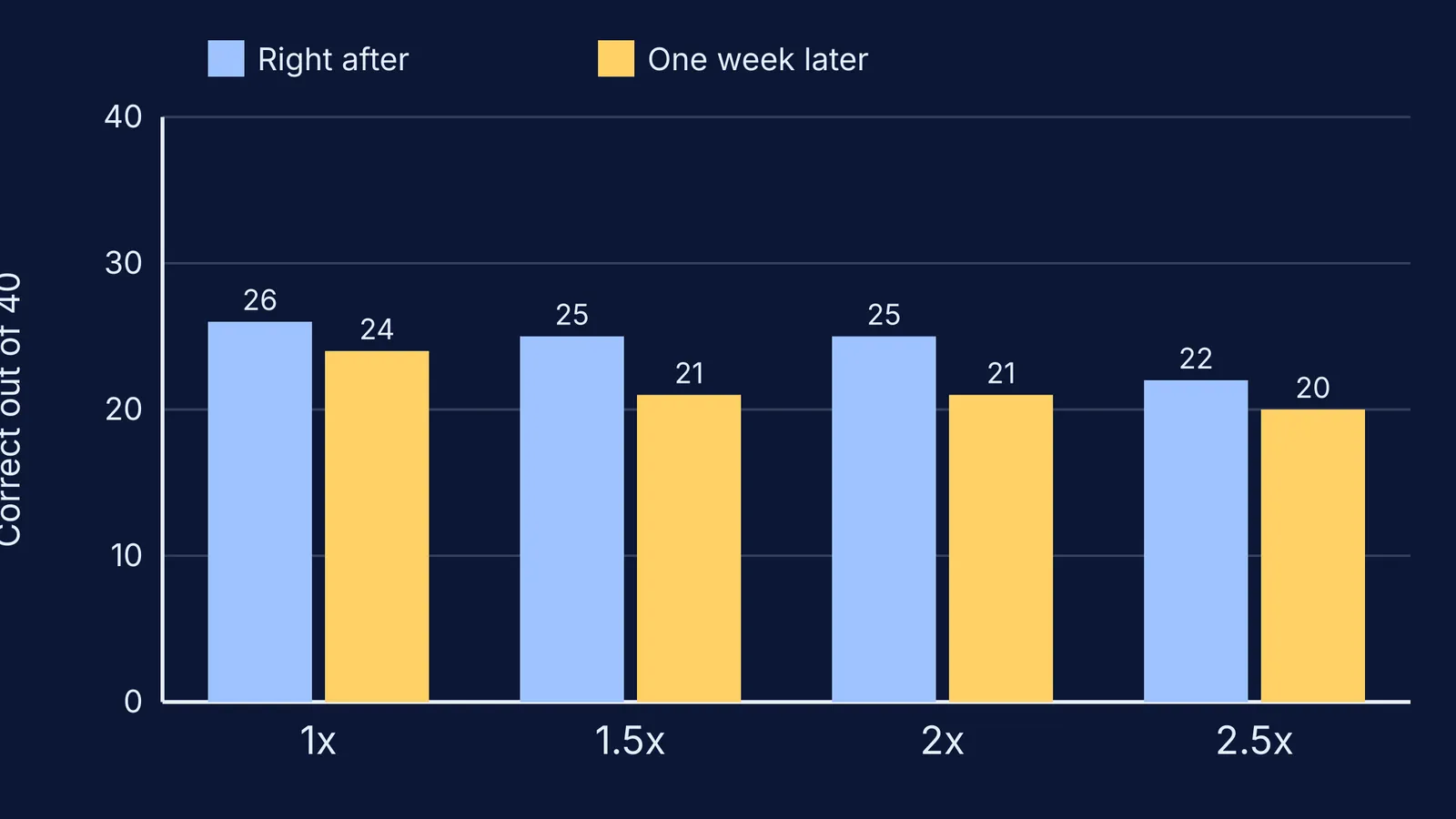
The best-known single study is kinder to 2x. In the main experiment of Murphy and colleagues' 2022 paper in Applied Cognitive Psychology, 231 UCLA undergraduates watched two lectures of about 13 to 15 minutes, one on the Roman Empire and one on real-estate appraisal, at 1x, 1.5x, 2x or 2.5x. They were told not to pause or take notes, then answered 20 questions per video straight away, and a different set a week later. The averages, as reported by UCLA:
Right after watching: about 26 of 40 correct at 1x, 25 at 1.5x, 25 at 2x and 22 at 2.5x.
One week later: 24 of 40 at 1x, 21 at 1.5x, 21 at 2x and 20 at 2.5x.
The authors describe the costs of going from 1x to 1.5x or 2x as minimal, with performance declining beyond 2x. Still, the one-week gap at 2x was about three questions out of 40, in the same direction as the meta-analysis. The topics were non-technical, and the authors note the results may differ for videos with different speech rates, complexity or difficulty.
A later experiment in the same paper is more useful. Students who watched at 2x and rewatched at 2x shortly before a test a week later averaged 24 of 40; students who watched once at 1x a week before the test averaged 22. Viewing time was about the same. This mixes speed with timing, so it mainly shows the value of a second look close to the test.
When should you speed up and when should you slow down?
Use the speed dial according to how new the material is to you, not how much time you have.
1x, and pause often: a new chapter, board derivations, worked numericals, new terms (your first class on rotational motion or organic mechanisms), a fast talker, or a lecture in your weaker language.
1.25x to 1.5x: a topic you have partly studied, a slow-paced teacher, or a talk where the slides carry the key points.
2x: a lecture you have already watched once, or scanning to find the part you need. Drop back to 1x when you reach it.
Then check yourself. Every 10 minutes or so, pause and say the last three points aloud, or write the last step of the derivation without looking. If you can't, rewind two minutes and go down by 0.25x. If it is easy, go up by 0.25x. Your recall is a better guide than how the video feels: fast, smooth watching can feel like understanding when it isn't, the same trap we describe in why rereading feels like learning.
What should you do with the time you save?
Saved minutes only help if they go into active work. A worked plan for a 90-minute recorded physics lecture whose first 20 minutes are a new derivation:
Watch the derivation at 1x (20 minutes) and the remaining 70 minutes at 1.5x (about 47 minutes). Total: about 67 minutes, saving about 23.
Spend 10 of those minutes with the video closed, writing down what you remember, then checking it against your notes.
Spend the other 13 minutes on two problems, without notes.
Before the test, rewatch only the parts you got wrong, at 1.5x or 2x.
More in our guides to learning from video lectures and staying focused in online classes.
If you rewind the same step three times and it still doesn't land, speed is not the problem. Fermi Courses have the AI tutor available on every lecture, so you can ask about the step you missed. Fermi's AI tutor notices where you are stuck and checks your understanding as it goes.
Tonight, try one recorded lecture at 1.5x with the pause check, and let your recall set the speed.


