

On this page
Students in Classes 6 to 8 (typically ages 11 to 14) are in a critical cognitive transition. In this middle stage, they move from arithmetic routines to abstract concepts like algebraic variables, force diagrams, and chemical changes. When a child hands an unsolved question directly to a chatbot, the machine instantly produces a fluent solution. But seeing a polished answer gives a false sensation of understanding while bypassing the mental struggle where memory forms.
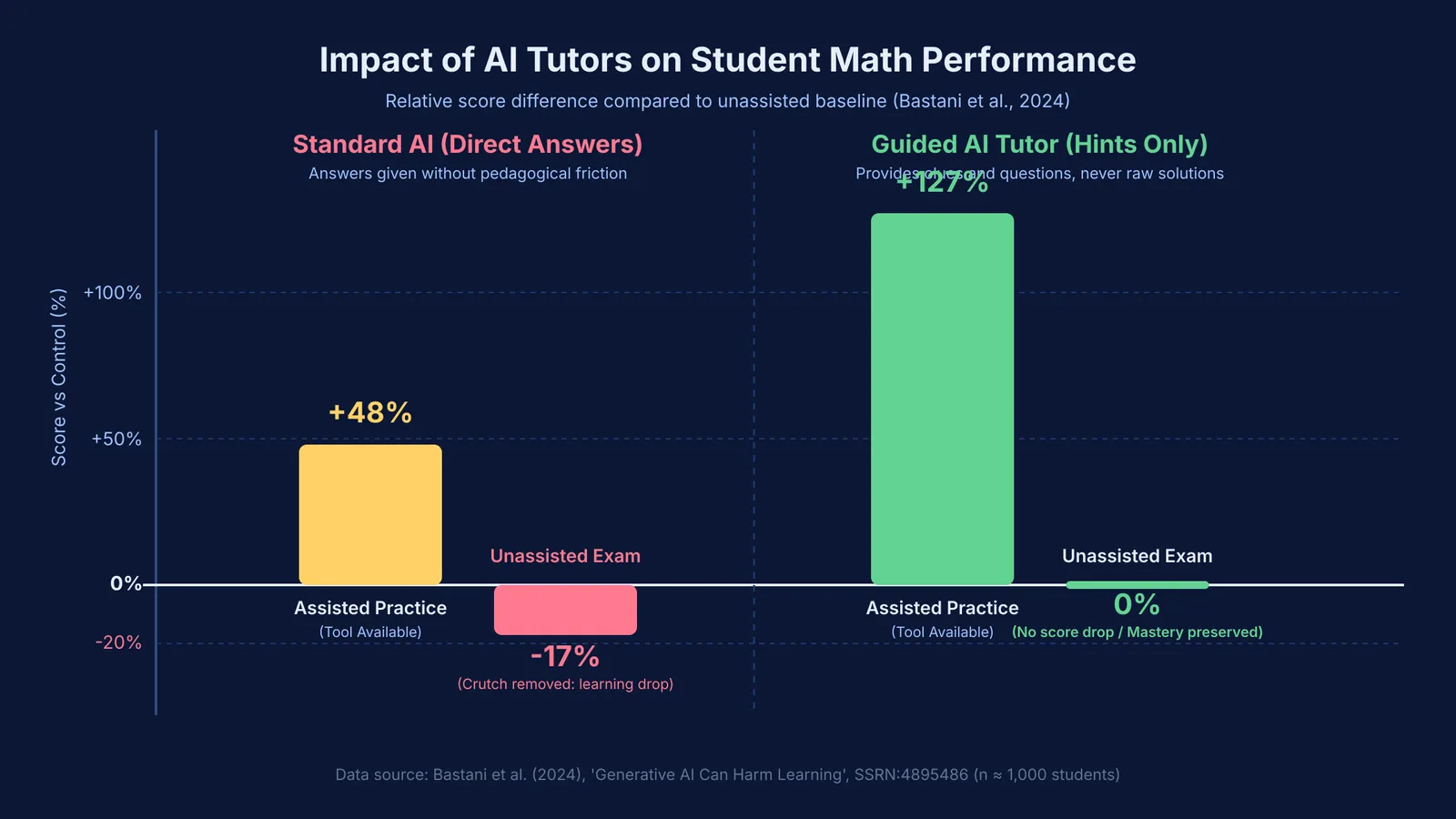
The risk of this mental shortcut was documented in a University of Pennsylvania field study led by Hamsa Bastani and Osbert Bastani across nearly 1,000 high school math students. While students who used a standard conversational model solved 48% more practice questions correctly, their performance collapsed when the tool was removed: they scored 17% lower on unassisted exams than peers who had worked entirely on their own. The researchers found that students treated the AI as a crutch rather than an aid.
Younger learners also struggle to recognise when large language models make errors. The UNESCO guidance on generative AI in education recommends setting a minimum age threshold of 13 for independent use, urging direct adult supervision for younger learners to safeguard developmental agency and prevent uncritical trust. Having a parent or elder sibling sitting at the same table turns an open screen into an accountable study session.
Why should middle school students never use AI alone?
Children aged 11 to 14 naturally take the path of least resistance when facing difficult schoolwork. If left alone in a bedroom with an unmonitored chatbot, the temptation to copy and paste entire worksheets is immense. This turns homework from a diagnostic exercise into an automated transcription chore. Teachers assign homework precisely so children encounter friction, diagnose what they forgot from class, and consolidate recall.
Moreover, chatbots present speculative answers with the same grammatical confidence as proven facts. Middle schoolers have not yet acquired the subject depth required to spot subtle mathematical slips or invented scientific claims. Without a parent nearby to prompt verification, children accept synthetic answers as authoritative, carrying errors straight into their term assessments.
Supervision does not mean hovering over every keystroke or solving the problems yourself. It means providing physical proximity: setting the computer in a common room, observing whether your child reads or merely copies, and requiring them to defend the steps they write down before moving to the next question.
How long should a Class 6 to 8 AI study session last?
Middle schoolers do not need hours of screen time to clear doubts. Excessive screen exposure tires young eyes and increases distraction, especially when a browser tab sits one click away from video games or social feeds.
The official Ministry of Education PRAGYATA guidelines recommend that online learning for Classes 1 to 8 should not exceed two sessions of 30 to 45 minutes each day. The same boundary applies to study sessions with an AI tool at home. A focused 30-minute block is enough time to untangle two or three difficult doubts, draft rough calculations, and return to physical books.
When students need guidance rather than direct solutions, an AI platform designed to teach rather than print answers makes all the difference. For instance, Fermi's AI tutor holds a line of reasoning across a session, notices where a student is stuck, and decides whether to explain, ask, or show rather than handing out finished homework.
What is the three-step routine for homework with an AI tutor?
To prevent the dependency documented in learning studies, establish a strict protocol before the laptop opens:
Attempt on paper first. Your child must write down the formula, draw the diagram, and work at least two steps in their rough notebook before touching any digital tool. As we explore in our guide on sharing your working before asking an AI, uploading an honest attempt prevents the tool from solving the whole question from scratch.
Ask for a hint, never the answer. Teach your child a concrete script: "I am stuck on step 2 of this fractions problem. Here is my rough work. Can you give me a clue without telling me the final number?" This practice aligns with using AI to understand mistakes instead of collecting answers. For multi-step numericals, the Fermi Problem Library provides a step-by-step solver that explains the reasoning rather than printing an answer, helping parents and students review where a calculation drifted off track.
Check the fact in the textbook. Once the concept makes sense, close the tab and open the NCERT textbook. If the AI explained how water transfers heat by convection, have your child find the convection activity in the Class 7 Science chapter on Heat to verify the explanation against the syllabus. Our article on checking NCERT exercise answers with AI shows how textbook verification anchors digital explanations to board requirements.
How can parents tell whether learning actually happened?
An adult sitting nearby does not need a degree in science or mathematics to supervise an AI study session. Your role is not to teach the syllabus, but to monitor cognitive effort and verify independence.
Here is a quick checklist parents can run at the end of each session:
Can your child explain the rule back to you in their own words without looking at the screen?
Can they solve a twin problem with different numbers on a blank sheet of paper?
Did they write notes in their school notebook by hand rather than copy-pasting text?
When you keep sessions short, insist on rough-book attempts, and anchor facts to official school textbooks, an AI tutor becomes a thoughtful study partner rather than an effortless shortcut.


