

On this page
A classic JEE Laws of Motion question: a block rests on a smooth (frictionless) wedge of angle θ, and you must find the horizontal acceleration of the wedge that keeps the block from sliding. We solve it twice, from the ground and from the wedge, so each method checks the other.
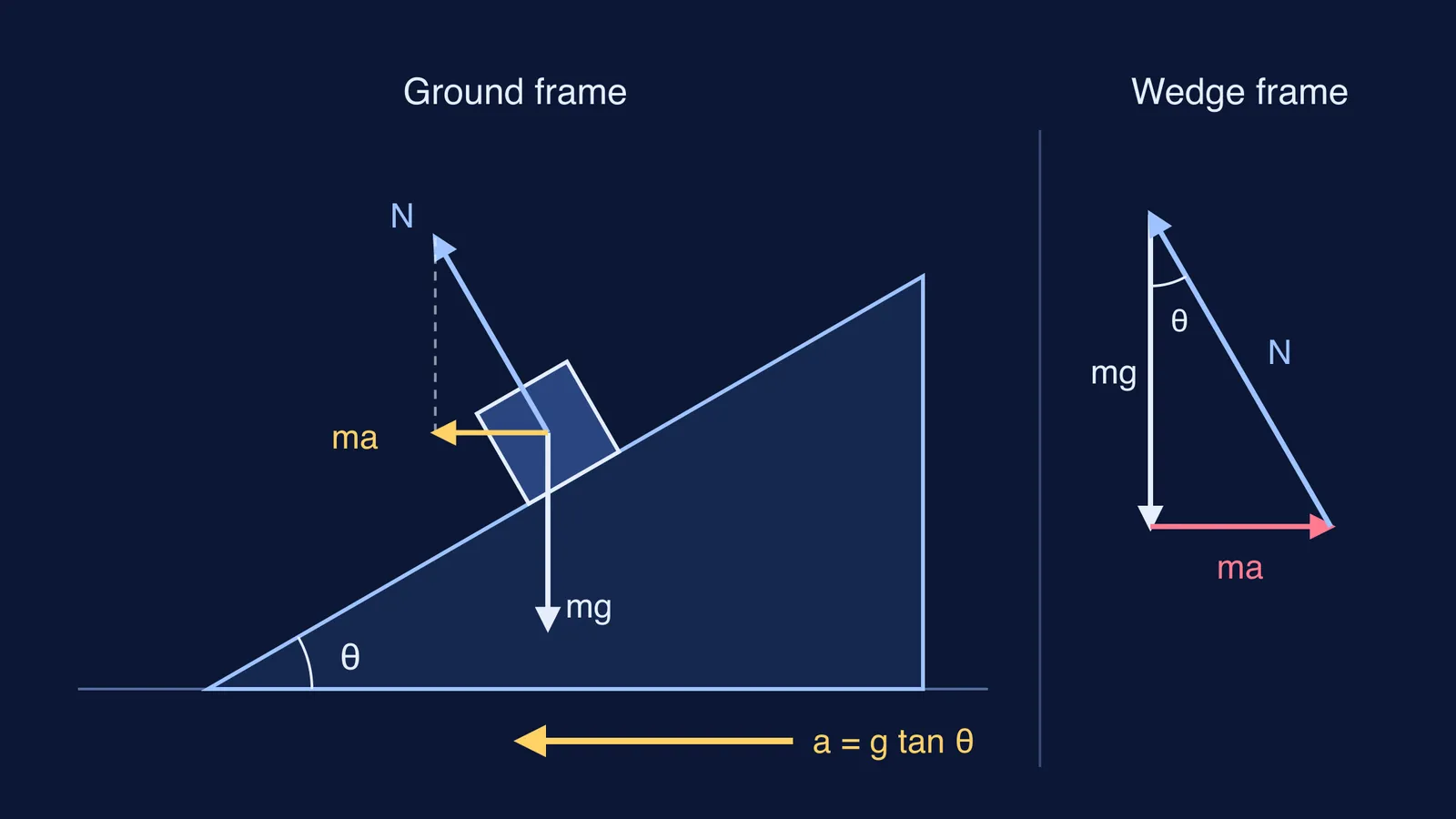
The setup: the slope rises from left to right and the wedge is pushed to the left, so the slope presses into the block. Only two forces act on the block: its weight mg, straight down, and the normal force N, perpendicular to the slope.
How do you solve it in the ground frame?
The ground is an inertial frame, so Newton's second law applies directly. If the block does not slide, it shares the wedge's acceleration a, horizontal and to the left.
A free-body diagram shows only forces, not acceleration or velocity, as OpenStax University Physics, section 6.1 puts it. Draw mg and N, then resolve horizontally and vertically, because the acceleration is horizontal.
Vertical: the block has no vertical acceleration, so N cos θ = mg.
Horizontal: the horizontal part of N is the only horizontal force, so N sin θ = ma.
Divide the second line by the first: tan θ = a/g, so a = g tan θ.
Back-substitute: N = mg/cos θ.
In the hero diagram, the yellow arrow is the sum of N and mg: the net force on the block, exactly horizontal.
How do you solve it in the wedge frame with a pseudo force?
An accelerating frame is non-inertial. To use Newton's laws inside it, you add a pseudo force on each object: its mass times the frame's acceleration, pointing the opposite way. OpenStax section 6.3 explains these inertial forces, which appear only to an observer in an accelerating frame.
The wedge accelerates left, so in its frame the block feels a pseudo force ma to the right. The block is at rest here, so mg, N and ma add to zero. Resolve along the slope, the direction the block would slide:
Along the slope: the pseudo force pushes up the slope with ma cos θ, and gravity pulls down with mg sin θ. Balance gives ma cos θ = mg sin θ, so a = g tan θ.
Perpendicular to the slope: N = mg cos θ + ma sin θ. Put a = g tan θ in and simplify, and you get N = mg/cos θ again.
Both frames agree. The right panel of the hero diagram draws mg, ma and N head to tail as a closed triangle; the angle between mg and N is θ, so tan θ = a/g.
A plumb bob hanging in an accelerating train gives the same result, with string tension in place of the normal force. A similar balance appears when you find the normal force on an incline when you push horizontally.
What happens if the wedge accelerates more or less than g tan θ?
If a is less than g tan θ, ma cos θ is smaller than mg sin θ and the block slides down.
If a is more than g tan θ, the block slides up the slope relative to the wedge.
If a equals g tan θ, the block stays at rest relative to the wedge, and its mass cancels out of the answer.
A worked example with numbers
Take θ = 30°, a block of 2 kg and a wedge of 8 kg on a smooth floor. Use g = 9.8 m/s²; the exact standard value is 9.80665 m/s², listed by NIST.
Acceleration: a = 9.8 × tan 30° = 9.8 × 0.577 ≈ 5.66 m/s².
Normal force: N = mg/cos 30° = 19.6/0.866 ≈ 22.6 N, compared with 17.0 N on a fixed wedge.
Push on the wedge: block and wedge move together, so treat them as one 10 kg body. F = (M + m) g tan θ = 10 × 5.66 ≈ 56.6 N.
In step 3, use the mass of the whole system, not the wedge alone.
Which frame should you use in the exam?
Use the ground frame for forces on the whole system, such as the push F. Use the wedge frame to decide whether the block slides, since that is one balance along the slope. Then check with the other frame; if they disagree, a sign or direction is wrong. For practice choosing axes, our guide to resolving forces on an inclined plane covers the sin-cos swap.
For variations such as a rough wedge, the Fermi Problem Library has worked problems with a step-by-step solver that explains the reasoning rather than printing an answer. To revise pseudo forces and non-inertial frames from the start, look the idea up in the Fermi Concept Library.


