On this page
Hang your keys from a thread inside a train. At steady speed the thread hangs straight down. As the train pulls out, the keys swing back and settle at a small angle behind the vertical. If the train accelerates at a, that angle obeys tan θ = a/g, so the angle tells you how fast the train is speeding up.
Why does a hanging bob tilt backward in an accelerating train?
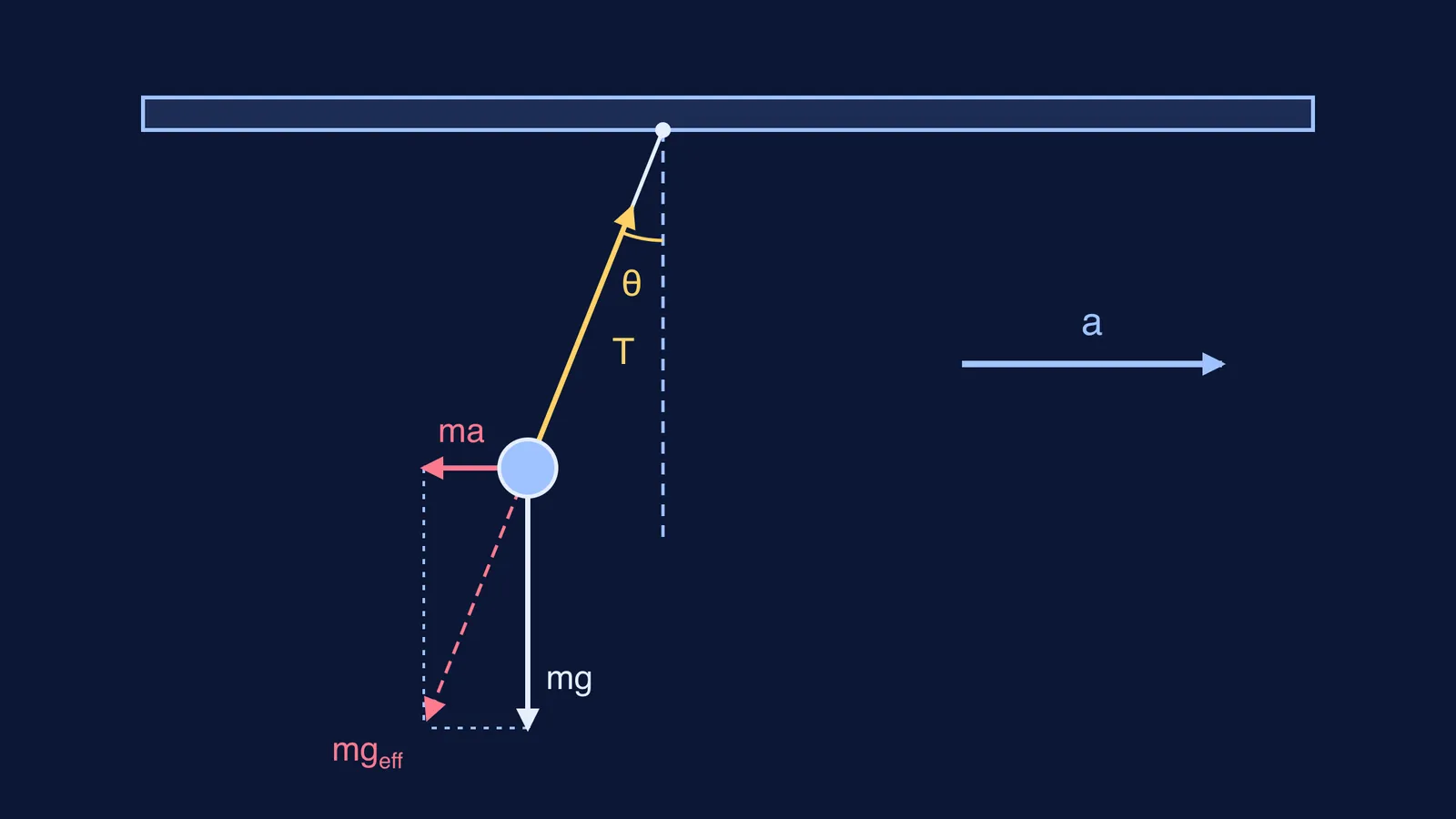
Look from the platform first, an inertial frame. Two forces act on the bob: weight mg down and tension T along the string. The bob must accelerate forward with the train, and only the tension has a forward part, so the string leans with its top ahead of the bob.
Resolve the tension:
Vertical: T cos θ = mg, because the bob is not rising or falling.
Horizontal: T sin θ = ma, because this part gives the bob its forward acceleration.
Divide the second by the first: tan θ = a/g.
Inside the train, a non-inertial frame, the bob looks still, so you add a pseudo force ma pointing backward. Weight and pseudo force add up to a tilted effective gravity, and the string lines up with it: same angle. If pseudo forces are new, our explainer on pseudo forces in non-inertial frames builds it step by step.
What is the angle of a hanging bob in an accelerating train?
The angle is θ = tan⁻¹(a/g), measured from the vertical, on the side opposite to the acceleration. The string tension rises to T = m√(g² + a²), a little more than the bob's weight.
The standard acceleration of gravity is defined as 9.80665 m/s², according to NIST's CODATA reference values. Using that value:
a = 0.5 m/s² gives θ ≈ 2.9°
a = 1 m/s² gives θ ≈ 5.8°
a = 2 m/s² gives θ ≈ 11.5°
a = g gives θ = 45°
The last line is the principle behind a pendulum accelerometer's dial: a 1989 US patent for an accelerometer by Wayne B. Graham states that "rotation of the pendulum by 45 degrees indicates a measured acceleration of 1 standard 'g'" (US patent 4807475).
Mass cancels, so a brass bob and a paper clip settle at the same angle.
How do you read a train's acceleration from the string angle?
Turn the formula around: a = g tan θ.
Take a Vande Bharat leaving the station. A Press Information Bureau factsheet on the Vande Bharat Express, updated on 11 November 2022, says Vande Bharat 2.0's time to reach 160 km/h would be 140 seconds, compared with 145 seconds earlier. What tilt would that give?
Convert the speed: 160 km/h ÷ 3.6 = 44.4 m/s.
Average acceleration: a = 44.4 ÷ 140 ≈ 0.32 m/s².
Ratio: a/g = 0.32 ÷ 9.81 ≈ 0.032.
Angle: θ = tan⁻¹(0.032) ≈ 1.9°.
Size check: on a 30 cm thread, the bob sits about 30 × sin 1.9° ≈ 1 cm behind the vertical.
So an average start tilts the bob under 2 degrees. Real trains do not speed up at a constant rate, so one reading gives the acceleration at that moment, not the average.
Going the other way: if you measure a 5° tilt, a = 9.81 × tan 5° ≈ 0.86 m/s².
Real instruments damp the swing: in the Graham accelerometer patent, the pendulum sits in a viscous liquid so it gives a steady reading without overswinging.
What changes when the train brakes, turns or runs at steady speed?
Steady speed on a straight, level track: a = 0, so the string hangs vertical. A plumb line cannot tell steady motion from rest.
Speeding up: the bob tilts towards the back.
Braking: the bob tilts forward, with tan θ = (deceleration)/g.
Round a level curve at steady speed: the acceleration v²/r points to the centre, so the bob tilts outward, the same geometry as in predicting a conical pendulum's angle from its speed.
In an accelerating lift: the string stays vertical but the tension changes, as in the coin dropped in an accelerating lift problem.
How should you practise this for JEE and board exams?
A checklist that covers most exam twists:
Name your frame first: platform (no pseudo force) or train (add ma opposite to a).
Draw the free-body diagram with T, mg and, if needed, ma.
Write both components and divide to get tan θ = a/g.
For tension, use T = m√(g² + a²).
If the bob swings, use g_eff = √(g² + a²) in the period 2π√(L/g_eff).
The common slip is adding a pseudo force while working from the platform. If that trips you up, the Fermi Problem Library has worked problems with a step-by-step solver that explains the reasoning rather than printing an answer. If the tilt is hard to picture, the Fermi Simulation Lab has interactive simulations for ideas that are easier to see than to read.
On your next train ride, hang your keys from a thread as you leave the platform and work out a = g tan θ yourself.