

On this page
When you spin a mass on a string in a horizontal circle, it traces out the shape of a cone. This setup is called a conical pendulum, and it is governed by a precise balance of forces.
What forces act on a conical pendulum?
To predict the angle of the string, you first need to look at the forces acting on the bob.
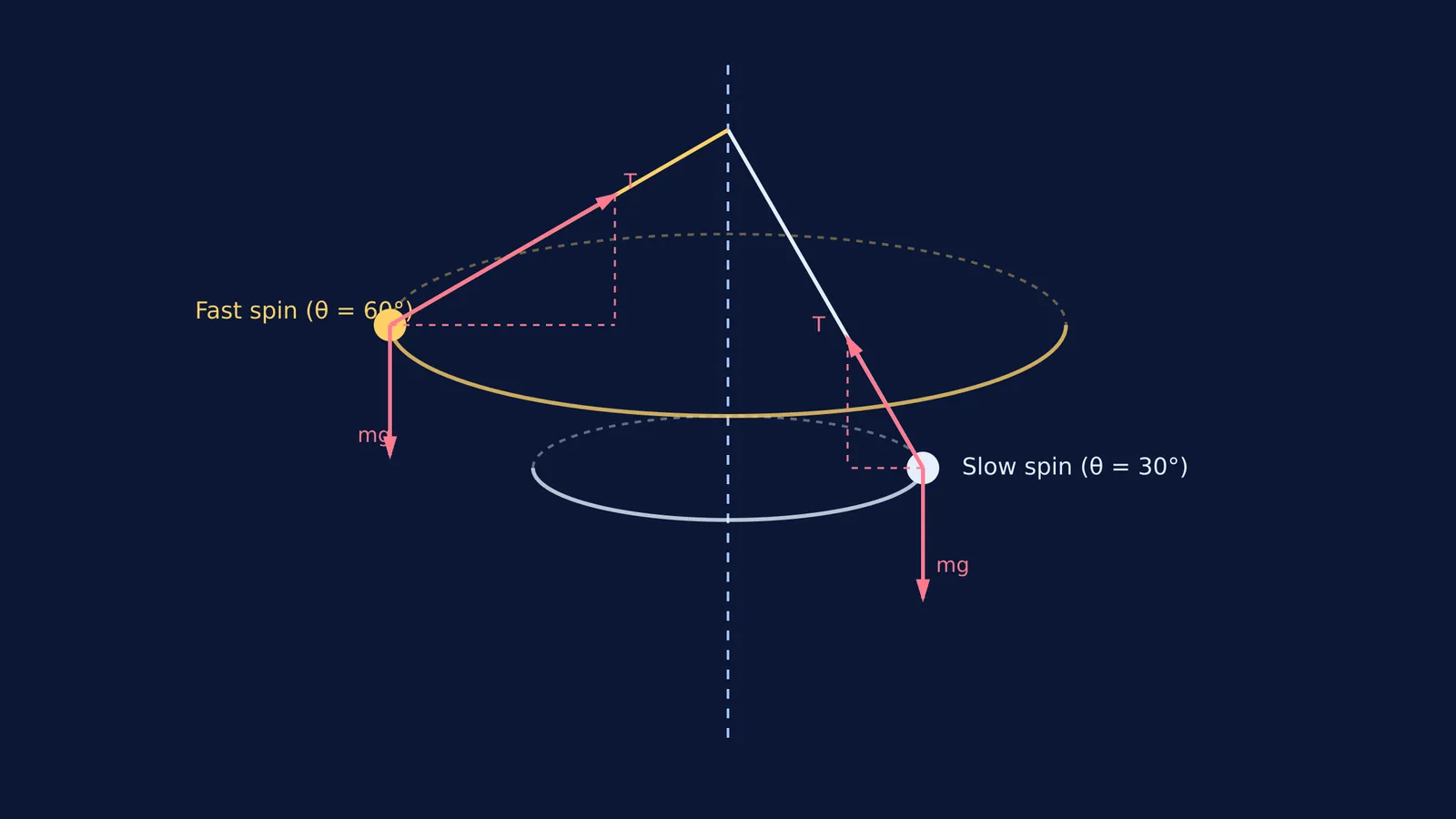
Two primary forces dictate the motion: the downward pull of gravity and the tension acting along the string, as detailed on Wikipedia. Since the bob does not move up or down, the vertical component of the tension (T cos θ) must exactly balance the bob's weight (mg).
Meanwhile, the horizontal component of the tension (T sin θ) provides the centripetal force required to keep the mass moving in a circle. Because the vertical tension must remain constant to fight gravity, the only way to generate a larger inward horizontal force is for the string to swing out to a wider angle.
If you are having trouble visualising how these vectors shift as the pendulum accelerates, you can run the model yourself in the Fermi Simulation Lab, which provides interactive simulations for the ideas that are easier to see than to read.
How does the angle change with speed?
We can find the exact relationship between the string's angle (θ), its length (L), and its angular speed (ω) by combining the horizontal and vertical force equations.
The angle of a conical pendulum is determined by the formula cos θ = g / (ω²L). As the angular speed ω increases, the denominator becomes larger, which forces cos θ to become smaller. For angles between 0° and 90°, a smaller cosine means a larger angle. This proves mathematically what you see in practice: spinning the pendulum faster makes it fly higher and wider.
You can practise deriving these equations and balancing the forces with The conical pendulum: tension, angle and period problems.
How does tangential speed differ from angular speed?
When analysing rotational motion, it is important to distinguish between how many times the pendulum revolves per second (angular speed, ω) and how fast the bob is physically travelling through the air (tangential speed, v).
The tangential speed of the bob is given by the formula v = √(gr tan θ). Here, r is the radius of the horizontal circular path. Because the radius itself depends on the angle (r = L sin θ), tangential speed increases dramatically as the pendulum lifts. A longer string L will result in a much higher tangential speed for the same angle, even though the required angular speed drops. This is why the outer edge of a spinning amusement park ride travels terrifyingly fast, while the inner section feels much slower.
If you struggle to switch between these two types of speed in exam questions, Fermi's AI tutor works out what you already know and builds a plan for the session, teaching you how to step between linear and angular variables without memorising isolated formulas.
Why can the string never be horizontal?
A common question is whether a conical pendulum spun fast enough could ever become perfectly horizontal, with θ = 90°.
The string of a conical pendulum can never be perfectly horizontal because the vertical component of tension must always carry the bob's weight. At a 90-degree angle, the string would have no vertical component to its tension to counteract gravity.
For the formula cos θ = g / (ω²L) to yield cos 90° = 0, the rotational speed ω would need to be infinite. Since infinite speed and infinite tension are physically impossible, the string will always maintain a slight downward dip, no matter how fast it spins.
If you change the effective gravity, the required angle changes too. For example, if you set up the experiment in a moving elevator, the upward or downward acceleration alters the apparent weight, a concept covered in Simple pendulum in a lift or accelerating car.
A worked example: spinning a one-metre string
To see how sensitive the angle is to changes in speed, let us test the conical pendulum formula with a string length of 1 metre.
First, imagine spinning the pendulum at 30 revolutions per minute (RPM).
Convert 30 RPM to angular velocity: ω = π ≈ 3.14 rad/s.
Apply the formula: cos θ = 9.8 / (π² × 1) ≈ 0.993.
Find the angle: θ = arccos(0.993) ≈ 6.8°.
At 30 RPM, the pendulum barely lifts away from the vertical axis.
Now, double the speed to 60 RPM (ω = 2π ≈ 6.28 rad/s).
Apply the formula: cos θ = 9.8 / (4π² × 1) ≈ 0.248.
Find the angle: θ = arccos(0.248) ≈ 75.6°.
By doubling the rotational speed, the angle has jumped from a subtle 6.8° to a very wide 75.6°. However, pushing it from 75.6° to a flat 90° is impossible, as the required energy and tension scale toward infinity.


