

On this page
The directrix is the anchor line that gives a conic section its shape. While a parabola has just one directrix and one focus, an ellipse and a hyperbola each have two.
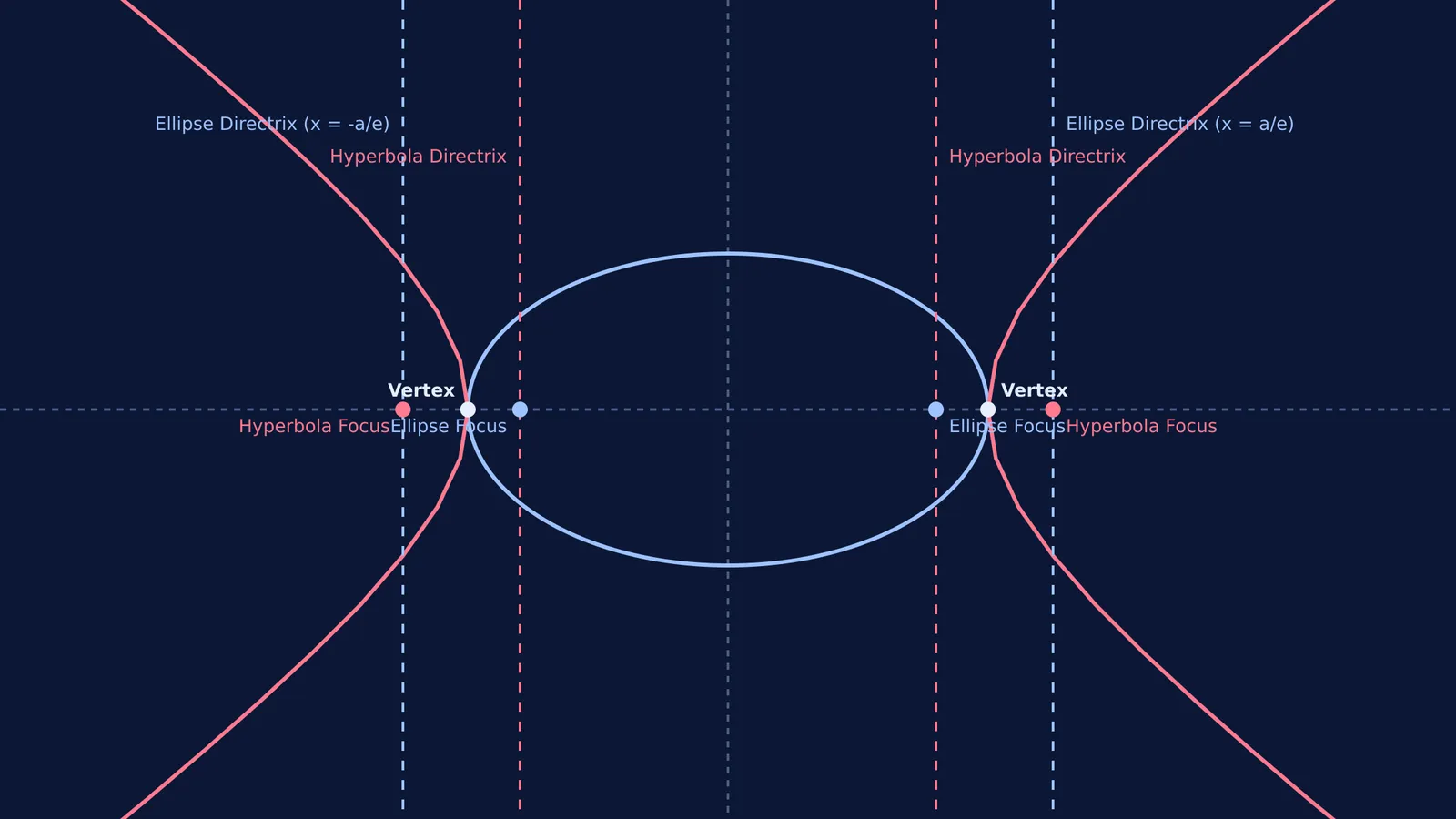
For both shapes in their standard horizontal orientation, the equation of the directrices is the same: x = ±a/e. The difference lies in where those lines fall.
If you are preparing for JEE or just making sense of coordinate geometry, keeping this shared foundation in mind saves you from memorising two separate sets of formulas. Read our conic sections for JEE: a five-step method for any problem for a unified strategy.
What is the equation of the directrix?
To find the directrix, we look at the focus-directrix definition of a conic. A conic section is the set of all points where the ratio of the distance to a fixed point (the focus) to the distance to a fixed line (the directrix) is a constant called the eccentricity, e [[1]](https://openstax.org/books/precalculus-2e/pages/10-5-conic-sections-in-polar-coordinates).
For a curve centred at the origin (0, 0) with its major or transverse axis along the x-axis, the vertices are at x = ±a. The two directrices are vertical lines with the equation: x = ±a/e [[2]](https://en.wikipedia.org/wiki/Ellipse)
Since eccentricity e is the ratio of the focal distance c to the vertex distance a (e = c/a), you can also write the equation of the directrix as: x = ±a²/c [[2]](https://en.wikipedia.org/wiki/Ellipse)
If the major axis runs vertically along the y-axis, you swap the coordinates. The directrices become horizontal lines: y = ±b/e (where b is the semi-major axis)
Why does the directrix lie outside the ellipse?
The position of the directrix depends entirely on the eccentricity. The distance from the centre of the ellipse to either directrix is a/e [[2]](https://en.wikipedia.org/wiki/Ellipse).
An ellipse has an eccentricity strictly between zero and one (0 < e < 1) [[1]](https://openstax.org/books/precalculus-2e/pages/10-5-conic-sections-in-polar-coordinates). Because you are dividing the vertex distance a by a fraction smaller than 1, the result is always larger than a.
Vertex distance from centre: a
Directrix distance from centre: a/e
Since e < 1, a/e > a.
This means the directrices lie further from the centre than the vertices. They sit completely outside the closed curve of the ellipse. As the ellipse becomes more circular and e approaches 0, the directrices are pushed further and further away toward infinity. (For more on ellipse geometry, see Ellipse for JEE: eccentricity, tangents and auxiliary circle).
Where is the directrix of a hyperbola?
A hyperbola uses the exact same directrix equation, x = ±a/e, but its eccentricity is greater than one (e > 1) [[1]](https://openstax.org/books/precalculus-2e/pages/10-5-conic-sections-in-polar-coordinates).
When you divide a by a number larger than 1, the result is smaller than a.
Vertex distance from centre: a
Directrix distance from centre: a/e
Since e > 1, a/e < a.
Therefore, the directrices of a hyperbola lie between its centre (at 0) and its vertices (at ±a) [[3]](https://en.wikipedia.org/wiki/Hyperbola). The two branches of the hyperbola open outward from the vertices, leaving the directrices trapped in the empty space between them. We cover the geometry of these branches in Hyperbola for JEE: asymptotes, rectangular hyperbola and tangents.
Distance between the two directrices
Because the two directrices are positioned symmetrically at x = a/e and x = −a/e, the distance between them is the difference between these coordinates: Distance = a/e − (−a/e) = 2a/e
You can use this distance to quickly find the eccentricity of an unknown conic if you know its major axis. If the distance between directrices is greater than the distance between vertices (2a), you have an ellipse. If it is less, you have a hyperbola.
Solving conic problems step by step
Coordinate geometry problems often try to hide the directrix by shifting the centre away from the origin. When the centre moves to (h, k), the directrices shift with it, becoming x = h ± a/e.
If you are stuck on a problem where the directrix is given as a slanted line, you cannot use the standard x = a/e formula directly. Instead, you must fall back to the fundamental definition: the distance to the focus equals e times the perpendicular distance to the directrix.
Building a robust understanding in the Fermi Concept Library—where you will find every concept in physics, chemistry, biology, mathematics and computing, each with its own lesson and its place in the map—means you can solve rotated or shifted conics without learning new formulas. If you want to see how this fundamental property sets up every equation in the chapter, the Fermi Problem Library has worked problems with a step-by-step solver that explains the reasoning rather than printing an answer.
A framework for directrix problems
When faced with a question asking for the directrix of a conic, follow these steps:
Find the centre: Group the x and y terms to complete the square, bringing the equation into standard form.
Identify a and b: Read the denominators of your squared terms. The larger one is a² (for an ellipse) or the positive one is a² (for a hyperbola).
Calculate e: Use e = √(1 − b²/a²) for an ellipse, or e = √(1 + b²/a²) for a hyperbola.
Find the standard directrix: Compute a/e.
Shift to match the centre: Add your centre's coordinate (h or k) to place the directrices in their final position.


