

On this page
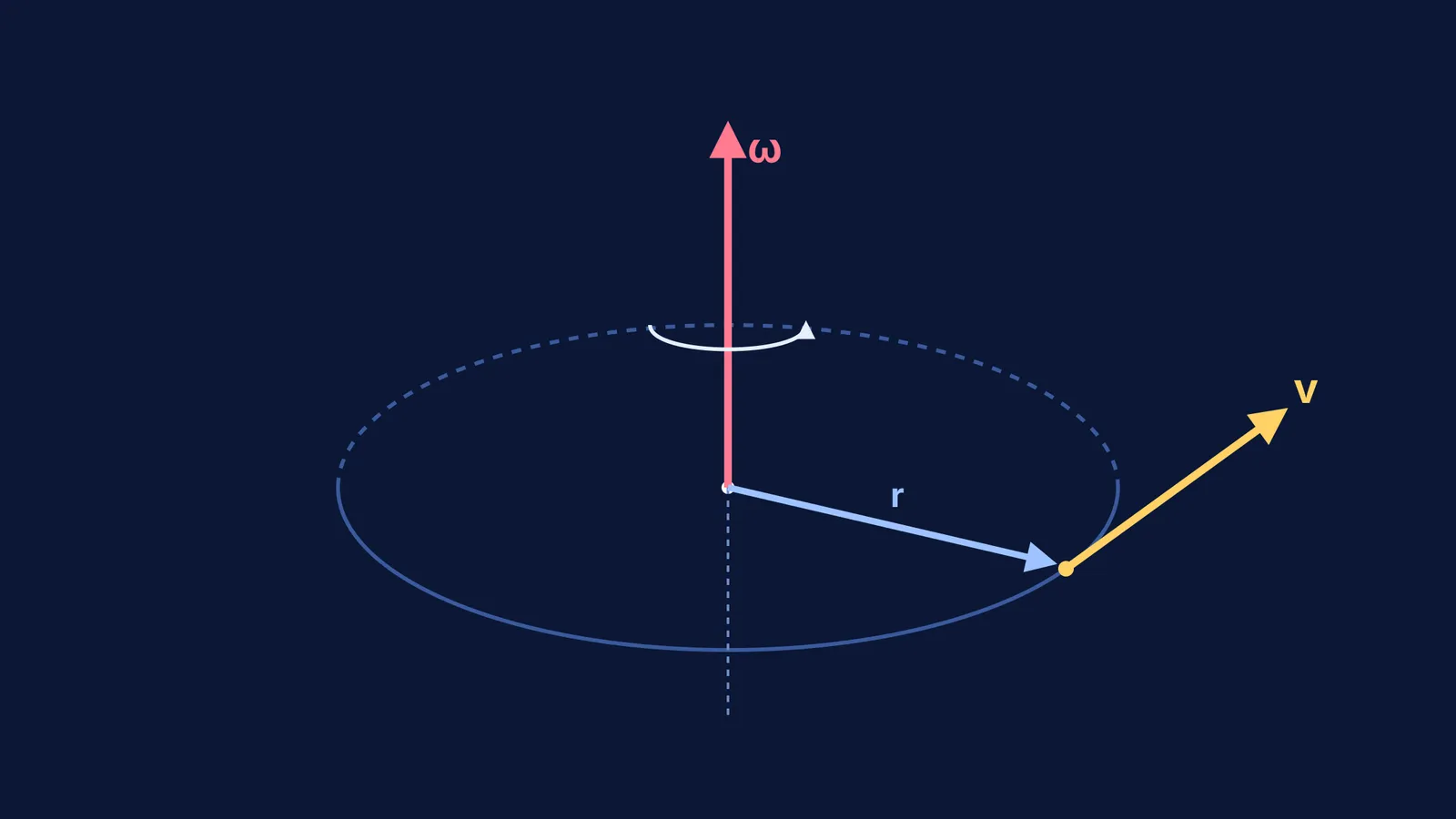
When an object moves in a circle, such as a stone tied to a string or a point on a spinning wheel, it has an angular velocity (ω). While the object itself moves along a flat circular path, its angular velocity vector points away from that plane entirely (Wikipedia).
This can feel counter-intuitive at first. If a wheel spins flat on a table, why does its angular velocity point straight up toward the ceiling? The answer lies in the geometry of three-dimensional space and a standard mathematical convention known as the right-hand rule.
Why does angular velocity point along the axis?
In kinematics, angular velocity is a three-dimensional vector that uniquely identifies the plane, direction and angular speed of a rotating particle (Wikipedia).
Because an object in circular motion is constantly changing its direction of travel, its linear velocity vector is always shifting. However, the axis it rotates around stays perfectly still. By defining the angular velocity vector to point along this fixed axis of rotation, physicists get a constant vector (in both magnitude and direction) for uniform circular motion. The direction of ω is always normal (perpendicular) to the instantaneous plane of rotation.
If you are struggling to picture how these vectors sit in three dimensions, the Fermi Concept Library maps out the relationship between rotational and linear variables, with its own lessons to help you see the geometry.
How do you find the direction with the right-hand rule?
Because there are two directions along any axis (e.g., straight up or straight down), physics uses a convention to decide which way ω points. This is the right-hand rule (Wikipedia).
Here is how to apply it:
Hold out your right hand.
Curl your fingers in the direction the object is rotating (for example, counter-clockwise).
Stick your thumb straight out.
Your thumb now points in the direction of the angular velocity vector. A counter-clockwise rotation, as viewed from "above" the plane, means ω points up toward you. If the object spins clockwise, you must turn your hand upside down to curl your fingers that way, making your thumb point down.
How does angular velocity relate to linear velocity?
The angular velocity vector is not just a bookkeeping trick; it connects directly to the object's linear (or tangential) velocity (v) through the cross product.
If a particle is at a position vector r relative to the centre of rotation, its linear velocity is given by the cross product (Wikipedia): v = ω × r
The cross product of two vectors produces a third vector that is perpendicular to both of them. Because ω points along the axis and r points out from the centre to the edge of the circle, they are at right angles to each other. Their cross product, v, is therefore perpendicular to the radius—making it perfectly tangent to the circular path.
You can use the right-hand rule again here to check the direction of the cross product:
Point the fingers of your right hand in the direction of the first vector, ω (along the axis).
Curl them toward the second vector, r (outward along the radius).
Your thumb will point in the direction of v (tangent to the circle).
For the geostationary satellite sitting 42,000 km from the Earth's centre, the angular speed is roughly 0.26 rad/h. Multiplying the magnitude of the radius by the angular velocity gives a tangential speed of approximately 11,000 km/h through space (Wikipedia).
If you are working through rotation problems and the cross products are getting tangled, Fermi's AI tutor can work out what you already know and build a plan for the session, writing on a board and drawing the figures until the 3D geometry clicks.


