

On this page
In 1735, Carl Linnaeus laid the foundations of modern taxonomy with his book *Systema Naturae*. When he first introduced this system, he classified all living things into just two broad kingdoms: plants and animals. Over the centuries, the discovery of microscopic life and advancements in genetics have vastly expanded this framework. Modern taxonomists now often use a three-domain system (Archaea, Bacteria and Eukarya) sitting above the traditional kingdoms, reflecting the deep evolutionary divides between different types of cells. Despite these additions, the core hierarchy that Linnaeus created remains the standard way biologists use to organise life into a descending series of ranks. Carl Linnaeus also introduced binomial nomenclature, the two-part naming system still used today. Every species receives a unique name combining its genus and specific epithet, such as *Homo sapiens*. This standardisation ended the confusion of regional common names and allowed scientists worldwide to communicate clearly. A 2011 study in *PLOS Biology* estimated that there are 8.7 million eukaryotic species on Earth, of which only about 1.2 million had been formally described.
Every one of those described species is filed into seven main, or "obligate", categories.
What is the taxonomic hierarchy in order?
The seven obligate ranks of the taxonomic hierarchy, from largest to smallest, are:
Kingdom: The broadest category in the traditional system. For example, Animalia (animals) or Plantae (plants). Organisms in the same kingdom share only the most basic biological characteristics.
Phylum (or Division for plants): Groups classes that share fundamental body plans or structural features.
Class: A collection of related orders.
Order: An assembly of similar families.
Family: A group of related genera.
Genus: A cluster of closely related species.
Species: The basic unit of classification. Members of the same species can interbreed to produce fertile offspring. John Ray's seed test was an early attempt to define this boundary.
Organisms that do not neatly fit this structure, such as viruses and viroids, sit outside the five-kingdom system entirely. You can read more about them in our guide to Viruses, viroids and lichens: the misfits of five-kingdom biology.
How to remember the taxonomic hierarchy?
For board exams, you must be able to write the sequence forwards or backwards without skipping a step. The easiest way is to use a mnemonic sentence where the first letter of each word matches the first letter of the rank:
Keep Pots Clean Or Family Gets Sick
Alternatively, some students prefer another popular phrase: King Phillip Came Over For Good Soup. Both mnemonics achieve the exact same goal, so simply choose whichever one you find more memorable.
Keep = Kingdom
Pots = Phylum
Clean = Class
Or = Order
Family = Family
Gets = Genus
Sick = Species
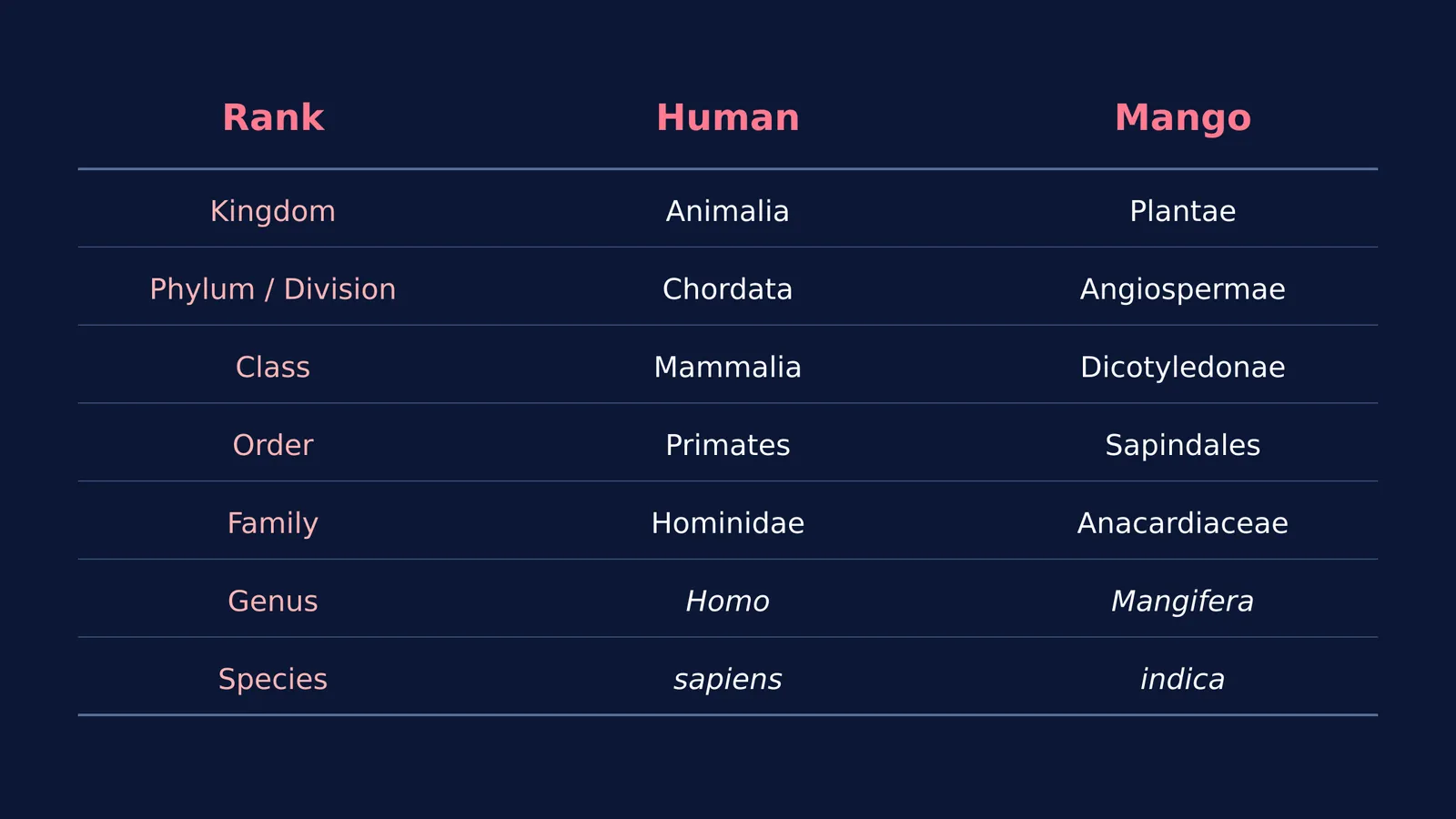
What is the taxonomic hierarchy of a human?
To see how the ranks narrow down, look at our own classification in detail:
Kingdom: Animalia. We are multicellular organisms that rely on consuming other living things for energy (heterotrophic).
Phylum: Chordata. At some point in our development, we possess a dorsal nerve cord and a notochord.
Class: Mammalia. We have hair on our bodies and mammary glands to nurse our young.
Order: Primates. This group features forward-facing eyes for binocular vision and grasping hands with opposable thumbs.
Family: Hominidae. Known as the great apes, this family includes humans, chimpanzees, gorillas and orangutans.
Genus: *Homo*. This genus includes modern humans and our extinct close relatives, such as *Homo neanderthalensis*.
Species: *sapiens*. The specific epithet for modern humans, meaning "wise" in Latin.
What is the taxonomic hierarchy of a housefly and mango?
The Class 11 biology syllabus requires you to know a few standard examples inside out.
For a common animal, the housefly (*Musca domestica*), the hierarchy highlights its place among insects:
Kingdom: Animalia (animals)
Phylum: Arthropoda (invertebrates with jointed legs and an exoskeleton)
Class: Insecta (insects with a three-part body and six legs)
Order: Diptera (true flies with a single pair of functional wings)
Family: Muscidae (a family of flies including the housefly and stable fly)
Genus: *Musca* (typical flies)
Species: *domestica* (meaning associated with the house)
For a common plant, the mango (*Mangifera indica*), the classification shifts slightly to accommodate botanical terms:
Kingdom: Plantae (plants)
Division: Angiospermae (flowering plants; notice we use Division instead of Phylum for plants)
Class: Dicotyledonae (plants with two seed leaves or cotyledons)
Order: Sapindales (an order of flowering plants including citrus and maple)
Family: Anacardiaceae (the cashew family, which also includes pistachios)
Genus: *Mangifera* (tropical fruiting trees)
Species: *indica* (meaning from India)
Fungi have their own kingdom, which is split into four distinct classes based on their spores and mycelium. Learn how they fit together in Kingdom Fungi for NEET: the four classes and how fungi reproduce.
Study smarter
Taxonomy is heavy on memorisation, but breaking it down with mnemonics and concrete examples makes it stick. If you want to review the living world chapter or see how taxonomy concepts connect, try the Fermi Concept Library. Our AI tutor will walk you through the classifications step by step, helping you avoid mixing up an order with a family.


