On this page
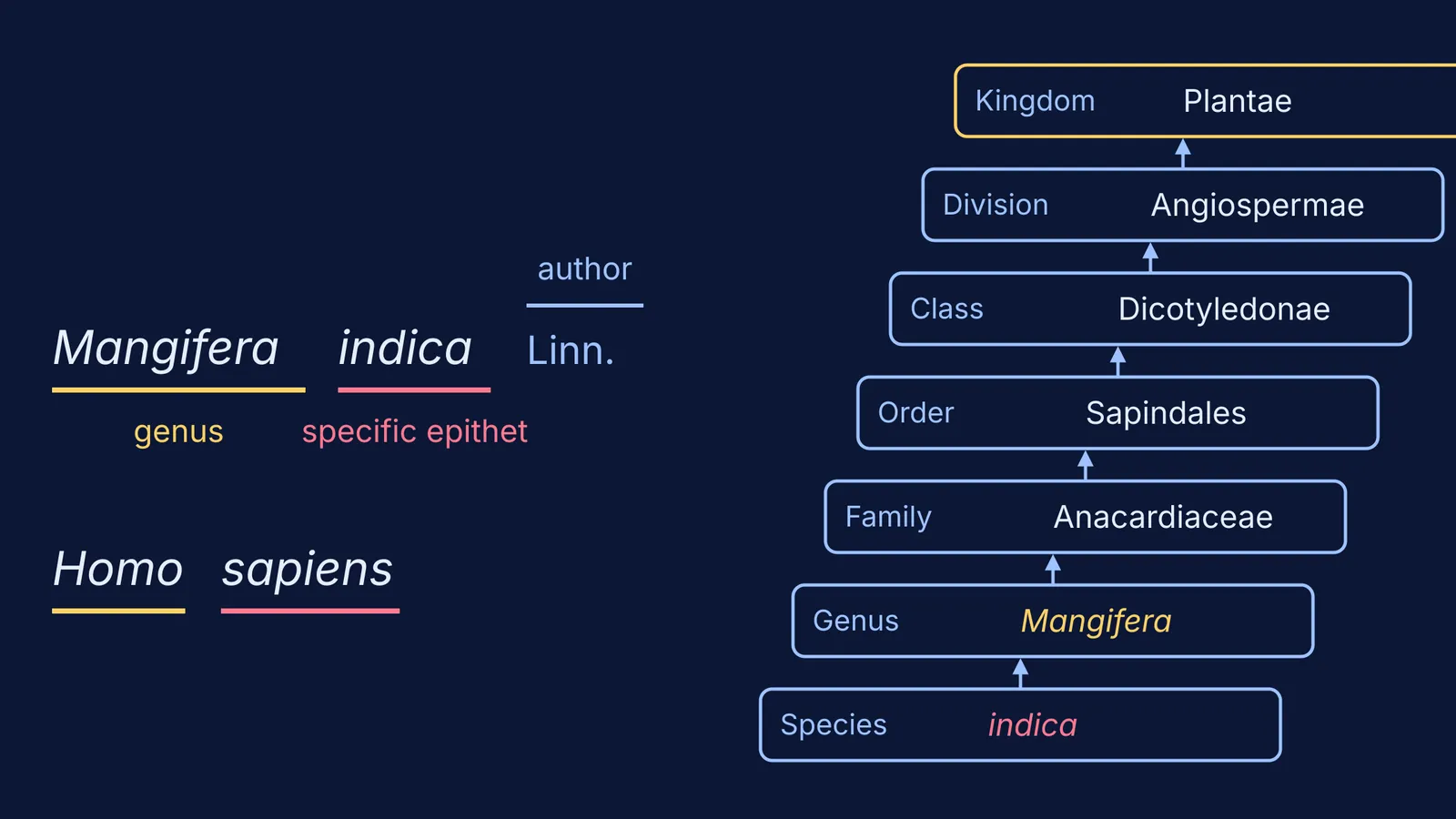
A scientific name has two parts, a generic name and a specific epithet, and this two-word system is called binomial nomenclature, as NCERT's Class 11 chapter The Living World explains. The genus starts with a capital letter, the epithet with a small letter, and both are printed in italics or underlined separately when handwritten. Our guide to writing scientific names correctly covers those rules in detail.
We read 10 chapters of the 2026-27 reprint, the ones where organisms are named most: Class 11 Chapters 1 to 4 and Class 12 Chapters 4 and 6 to 10. Every name below is spelled exactly as NCERT prints it, with the organism the textbook attaches to it.
What are the scientific names in NCERT Class 11 biology?
Start with Chapter 1, The Living World, because it uses these names to teach the naming rules themselves (pages 4 to 8):
Homo sapiens: human (man)
Musca domestica: housefly
Mangifera indica: mango
Triticum aestivum: wheat
Solanum tuberosum: potato
Panthera leo: lion
Panthera pardus: leopard
Panthera tigris: tiger
The chapter also names Solanum nigrum and Solanum melongena as other species of Solanum, and notes that potato and brinjal are different species of the same genus.
Chapters 2 to 4 mostly give genus names. Biological Classification and Plant Kingdom print no full binomials for organisms, only genera with a role: Plasmodium (malarial parasite), Puccinia (wheat rust), Agaricus (mushroom), Albugo (parasitic fungus on mustard), Sphagnum (a moss) and Sequoia (the giant redwood tree).
Animal Kingdom repeats Panthera tigris and Panthera leo on page 51. Everything else is a genus with a common name, for example Pila (apple snail), Pinctada (pearl oyster), Labeo (rohu), Catla (katla), Hemidactylus (wall lizard), Naja (cobra), Pavo (peacock) and Balaenoptera (blue whale).
Which scientific names appear in Class 12 biology?
In Chapter 4, Principles of Inheritance and Variation, Drosophila melanogaster is the fruit fly Thomas Hunt Morgan and his colleagues worked with (page 67).
Chapter 6, Evolution, names Tyrannosaurus rex (a dinosaur), Homo habilis (which NCERT calls the first human-like being, the hominid), Homo erectus (fossils found in Java) and Homo sapiens.
Chapter 7, Human Health and Disease, names pathogens and drug plants:
Salmonella typhi: typhoid fever
Streptococcus pneumoniae and Haemophilus influenzae: pneumonia
Plasmodium vivax, P. malaria and P. falciparum: malaria (P. falciparum causes malignant malaria)
Entamoeba histolytica: amoebiasis (amoebic dysentery)
Wuchereria bancrofti and W. malayi: filariasis (elephantiasis)
Papaver somniferum: opium poppy
Cannabis sativa: source of cannabinoids
Erythroxylum coca: coca plant, source of cocaine
Atropa belladona: a plant with hallucinogenic properties
Which microbes do the Class 12 microbes and biotechnology chapters name?
Chapter 8, Microbes in Human Welfare:
Saccharomyces cerevisiae: baker's and brewer's yeast; ethanol
Propionibacterium sharmanii: large holes in Swiss cheese
Penicillium notatum: the mould behind penicillin
Aspergillus niger: citric acid
Acetobacter aceti: acetic acid
Clostridium butylicum: butyric acid
Trichoderma polysporum: cyclosporin A
Monascus purpureus: statins
Bacillus thuringiensis: biocontrol of butterfly caterpillars
Chapters 9 and 10, Biotechnology: Principles and Processes and Biotechnology and its Applications:
Escherichia coli: host for recombinant DNA
Salmonella typhimurium: source of the plasmid in the first recombinant DNA
Agrobacterium tumifaciens: plant pathogen whose Ti plasmid became a cloning vector
Thermus aquaticus: source of the heat-stable DNA polymerase used in PCR
Bacillus thuringiensis: source of the Bt toxin genes
Meloidegyne incognitia: nematode that infects tobacco roots
How do you remember scientific names without mixing them up?
Sorting the names by what each organism does gives every name a hook. Try this four-box plan over one week.
Make four boxes: disease-causers (Salmonella typhi, Entamoeba histolytica), factory microbes (Aspergillus niger, Monascus purpureus), lab workhorses (Escherichia coli, Thermus aquaticus, Drosophila melanogaster) and everyday organisms (Mangifera indica, Musca domestica).
Write each name once by hand, underlining genus and epithet separately, as NCERT asks for handwriting.
Cover the name and say it from the organism, then cover the organism and say it from the name. Mark the ones you miss.
Revisit only the marked ones two days later, then again at the end of the week.
A worked example: if a question asks which organism gives citric acid, the factory box gives you Aspergillus niger at once. Then add the pattern: a fungus makes citric acid, while bacteria (Acetobacter aceti, Clostridium butylicum) make acetic and butyric acid. That pattern stops you swapping the three.
If the idea behind a name is the weak spot, say why Panthera and Felis sit in one family, the Fermi Concept Library gives every biology concept its own lesson and its place in the map. For practice questions, the Fermi Problem Library has worked problems with a step-by-step solver that explains the reasoning.
Two related lists pair well with this one: chromosome numbers in common organisms and biology abbreviations with their NCERT chapters.