

On this page
Every known plant and animal on Earth has a scientific name that is understood by researchers regardless of their native language. This naming system is called binomial nomenclature.
Before this system, scientists used long, descriptive phrases that were difficult to remember and write. A binomial name simplifies this by using only two parts: the genus and the specific epithet. To ensure absolute clarity in exams and research papers, these names must be formatted according to a strict set of universal rules.
Why are scientific names in Latin?
Biological names are generally derived from Latin or are Latinised, regardless of where the species was discovered 1.
Using a single classical language provides a standard protocol that allows biologists worldwide to identify organisms. This ensures global consistency, preventing the confusion that happens when everyday local names are used.
What are the rules for writing binomial nomenclature?
When writing scientific names, you must follow four main rules 1:
Two parts: Every scientific name has two components. The first word is the genus and the second word is the specific epithet 1.
Capitalisation: The genus name always starts with a capital letter, while the specific epithet always starts with a small (lowercase) letter 1.
Formatting in print: When printed in a book, on a worksheet or on a screen, the scientific name must be written in italics to show its Latin origin 1.
Formatting by hand: When you write the name by hand in an exam, both words must be underlined separately 1.
If you struggle to recall definitions like these, you can look them up in the Fermi Concept Library to refresh your memory before a test.
How to write the scientific name of mango?
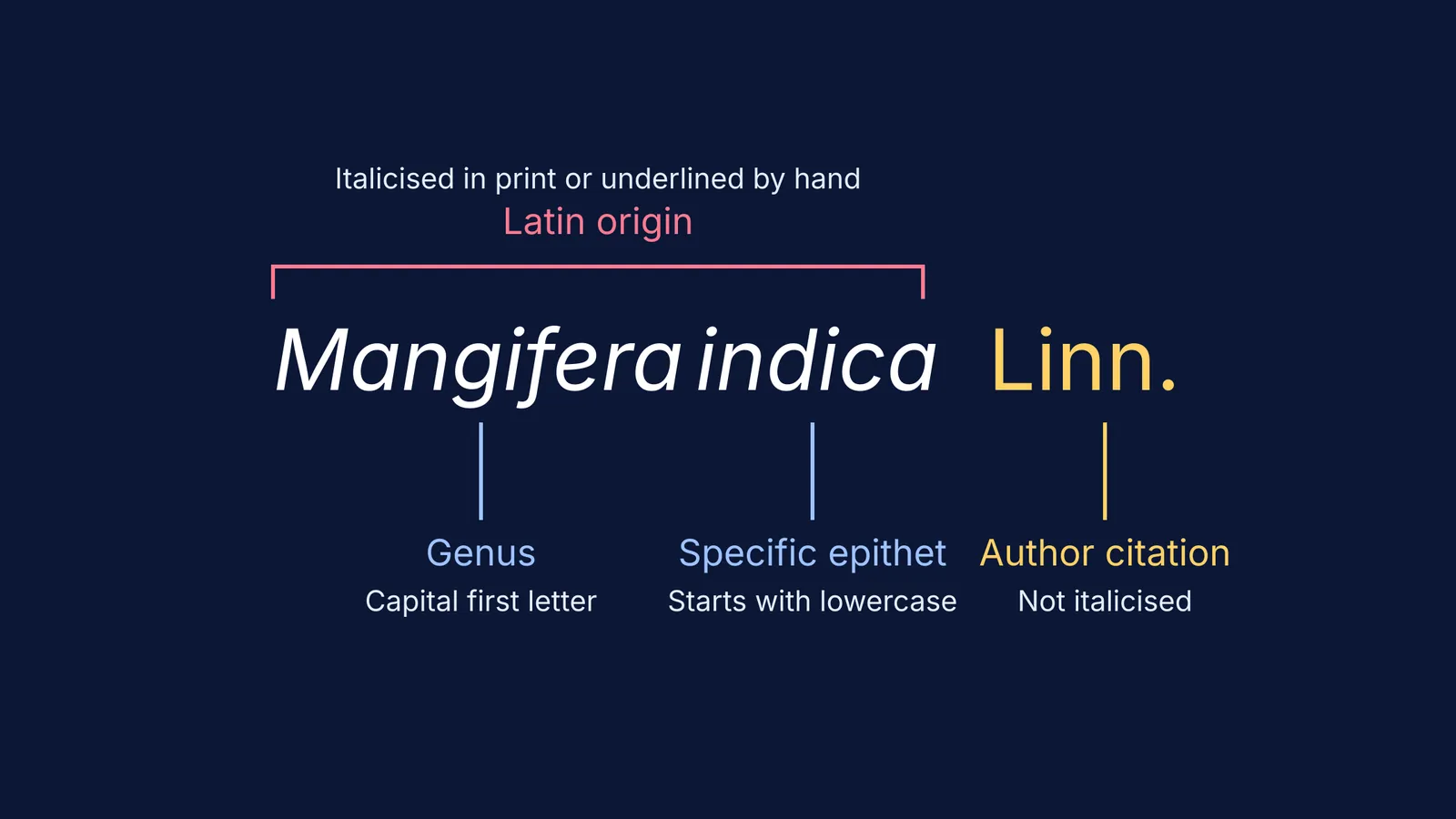
The universal rules are easiest to understand through a worked example. The scientific name for the mango tree is *Mangifera indica* 2.
Let us apply the rules to this name step by step:
Genus: *Mangifera* begins with a capital M.
Specific epithet: *indica* begins with a lowercase i.
Format: It is italicised in print. In your notebook, it would be written with a separate underline beneath the word Mangifera and the word indica.
You will sometimes see a third word added to the very end of a scientific name.
How do you write the author citation?
The name of the scientist who first discovered and described the species is occasionally added to the end of the binomial name. This is known as the author citation.
For example, the mango tree was first scientifically described by Carl Linnaeus. Its full scientific name can be written as *Mangifera indica* Linn. 2.
The author citation is written in an abbreviated form. Unlike the genus and specific epithet, the author's name is not italicised or underlined. It simply begins with a capital letter.
Why do we need scientific names?
Common names for animals and plants change from one region to another. A bird known as a "sparrow" in one country might be a completely different species in another.
By using binomial nomenclature, scientists ensure that one specific name applies to exactly one species globally. This precision helps researchers track how populations evolve, such as when studying branching descent in Darwin's theory, or when identifying endemic and endangered species on the IUCN Red List. It also allows botanists to classify plants accurately, such as when comparing Fabaceae, Solanaceae and Liliaceae.
If you need help practicing these biological conventions, Fermi's AI tutor can teach you by checking your understanding as it goes and explaining where you are stuck.


