

On this page
When you study evolution, it is easy to picture it as a straight line from simple organisms to complex ones, or to think of "survival of the fittest" as a test of physical strength. But Charles Darwin used these terms to describe something very specific.
In the NCERT Class 12 Biology textbook, you will find this foundational statement: "Branching descent and natural selection are the two key concepts of Darwinian Theory of Evolution." Understanding what branching descent means, and how Darwin defined fitness, is the key to making sense of the rest of the chapter.
What is branching descent?
Branching descent is the pattern by which evolution happens. It says that all living organisms are connected by descent from common ancestors.
Instead of one species turning entirely into a new one in a straight line, a single ancestral population splits. As different groups spread into new environments or ecological niches, they face different challenges and accumulate different adaptations over time. This continuous divergence creates a tree-like structure of life, rather than a ladder of progress.
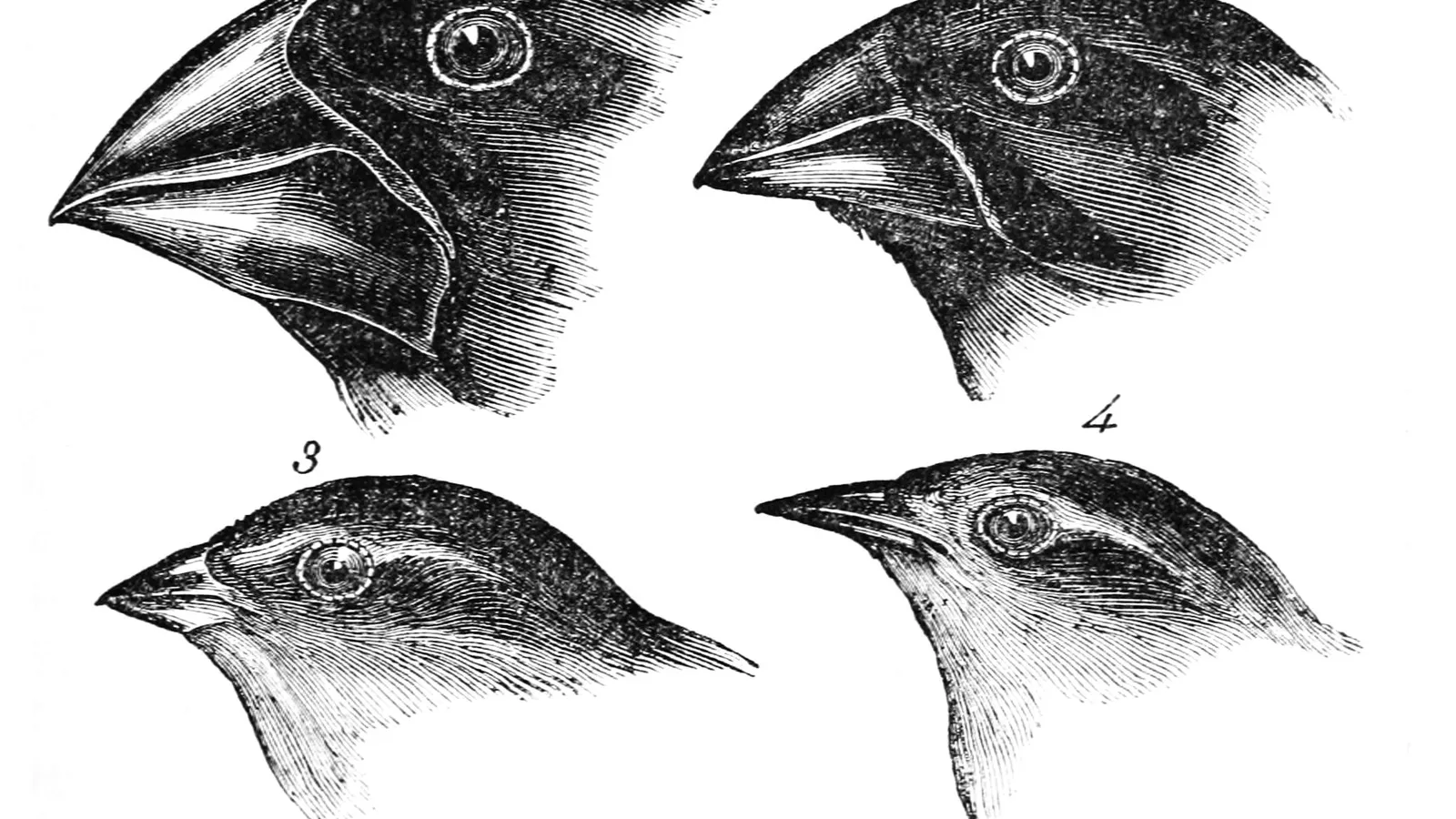
A classic example is Darwin's finches on the Galapagos Islands (a process the scientists Peter and Rosemary Grant spent decades watching evolution in Darwin's finches). A single ancestral finch species arrived from the mainland. Over many generations, groups of these birds adapted to different islands and different food sources. Some groups developed thick, heavy beaks to crack hard seeds, while others developed thin, pointed beaks to catch insects. One ancestor branched into many distinct species.
Branching descent is strongly supported by the study of homologous organs. For example, the forelimbs of whales, bats, cheetahs, and humans share the same basic bone structure. Even though these animals use their limbs for entirely different tasks—swimming, flying, running, and grasping—they all inherited this underlying skeletal blueprint from a common mammalian ancestor. Over millions of years, as they adapted to different environments, the limbs were modified. This pattern of change from a common form is called divergent evolution, and it is the physical footprint of branching descent.
What does fitness mean to Darwin?
If you go to a gym, fitness means physical strength, speed and endurance. But in evolutionary biology, the definition is much narrower. As the NCERT textbook states, "fitness, according to Darwin, refers ultimately and only to reproductive fitness."
It does not matter if an animal is the fastest, the strongest, or the most aggressive if it does not leave behind any offspring. Darwinian fitness is a measure of an individual's ability to survive in its specific environment and leave a greater number of progeny compared to others in the population.
For instance, if a small, well-camouflaged insect survives to produce many offspring, while a large, brightly coloured one is spotted and eaten by predators before it can reproduce, the small insect is considered more "fit" in that environment. Individuals with heritable traits that help them survive their specific surroundings will reproduce more successfully, passing those advantageous traits to the next generation. This driving mechanism is called natural selection.
Natural selection operates on this variation in reproductive fitness. Nature selects for traits in different ways depending on the pressures of the environment. If the environment is stable, it might favour the average individuals in a population (stabilising selection). If the environment gradually changes, it might favour one extreme over the other (directional selection). In all these scenarios, the individuals who are selected by nature are simply the ones whose fitness—their ability to survive and leave viable progeny—is highest in that specific situation.
How do you answer assertion-reason questions on evolution?
When answering Evolution for NEET or your board exams, assertion-reason questions often test these exact definitions to check if you have understood the core concepts. Use this simple checklist to verify the statements you encounter:
Does it say fitness means health or physical strength? False. Fitness in a Darwinian context means reproductive fitness, which is the ability to leave behind more offspring.
Does it mention common ancestry? True. Branching descent means that different species diverge from a shared ancestral population over time.
Does it list the two key concepts of Darwin's theory? True. Branching descent (the overall pattern of divergence) and natural selection (the mechanism driving the change) are the two foundational pillars of Darwinian theory.
Where can you explore biology concepts with an AI tutor?
When you are reading a textbook and getting stuck on the difference between natural selection and branching descent, you can bring the topic to the Fermi Concept Library.
Instead of just answering questions or printing a summary, Fermi's AI tutor teaches. A student brings a topic, a course, a problem set or a scanned assignment. Fermi works out what you already know, builds a plan for the session, and teaches through it—writing on a board, drawing the figure, running the simulation, and checking your understanding as it goes. Because it holds a line of reasoning across a whole session, you can ask questions until the idea clicks.


