On this page
Most abbreviation lists give you full forms and nothing else. In NEET-UG and CBSE board questions, the full form is only half the answer: you also need the process it belongs to and the detail that tests whether you understood it. Below, each abbreviation is matched to the NCERT Class 12 Biology chapter that spells it out, checked against the 2026-27 reprint.
Which NCERT chapter does each biology abbreviation come from?
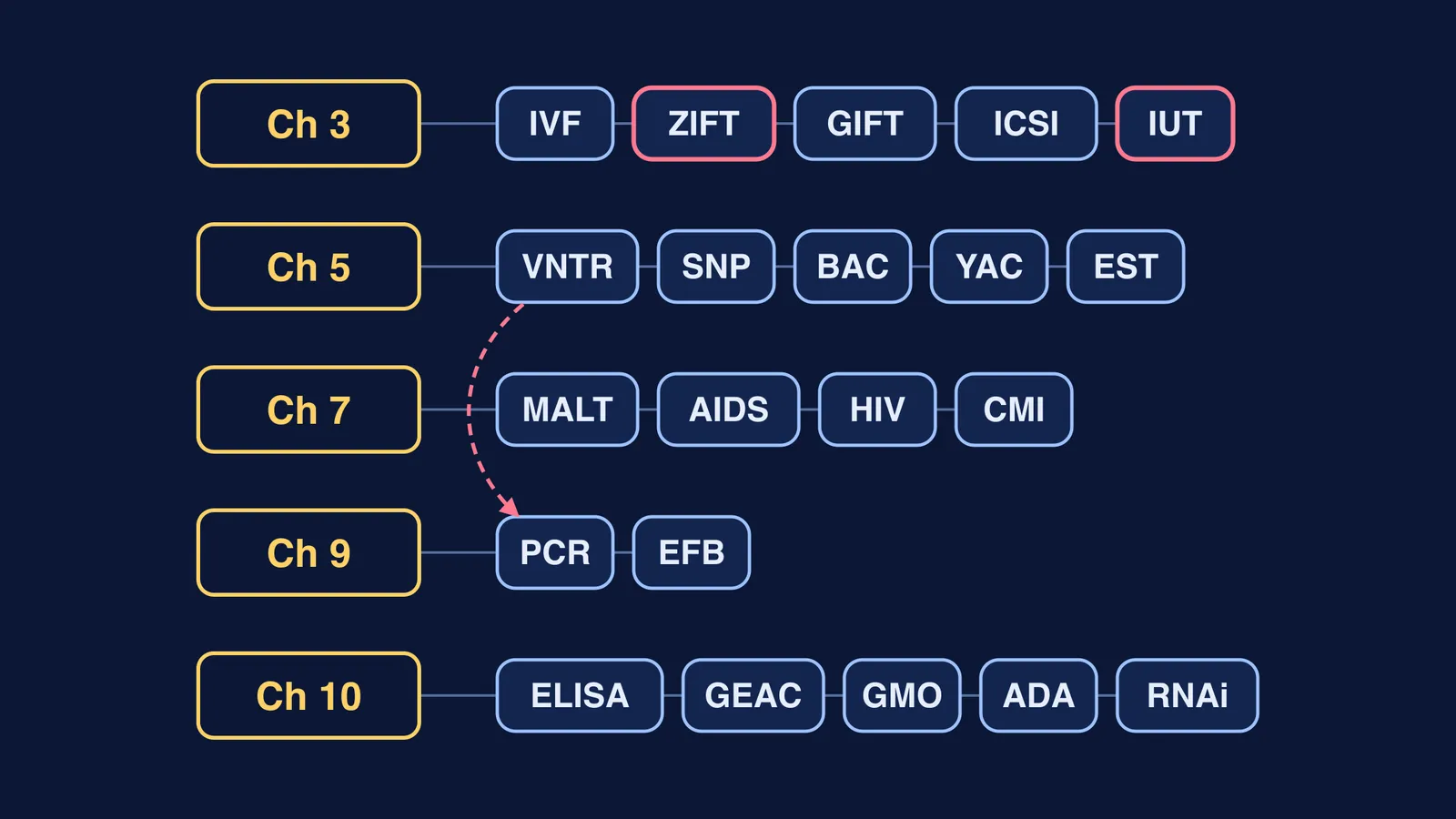
Chapter 3, Reproductive Health has the biggest cluster, most of it under assisted reproductive technologies (ART).
IVF: in vitro fertilisation, followed by ET, embryo transfer (the ‘test tube baby’ programme)
ZIFT: zygote intra fallopian transfer
IUT: intra uterine transfer
GIFT: gamete intra fallopian transfer
ICSI: intra cytoplasmic sperm injection
AI and IUI: artificial insemination and intra-uterine insemination
MTP: medical termination of pregnancy
STIs: sexually transmitted infections
RCH: Reproductive and Child Health Care
MMR and IMR: maternal mortality rate and infant mortality rate
Chapter 5, Molecular Basis of Inheritance gives the genome and fingerprinting terms.
VNTR: Variable Number of Tandem Repeats, the satellite DNA probe Alec Jeffreys used for DNA fingerprinting
SNP: single nucleotide polymorphism, pronounced ‘snip’
EST: Expressed Sequence Tags
BAC and YAC: bacterial artificial chromosome and yeast artificial chromosome
Chapter 7, Human Health and Disease carries the immunity and AIDS terms.
MALT: mucosa-associated lymphoid tissue, found in the lining of the respiratory, digestive and urogenital tracts
AIDS: Acquired Immuno Deficiency Syndrome, caused by HIV, the Human Immuno deficiency Virus
ELISA: enzyme linked immuno-sorbent assay, which the chapter calls a widely used diagnostic test for AIDS
CMI: cell-mediated immunity, mediated by T-lymphocytes
PMNL: polymorpho-nuclear leukocytes (neutrophils)
PCR stands for Polymerase Chain Reaction, and EFB for the European Federation of Biotechnology, in Chapter 9, Biotechnology: Principles and Processes. Chapter 10, Biotechnology and its Applications adds:
ELISA again: Enzyme Linked Immuno-sorbent Assay, based on antigen-antibody interaction
GEAC: Genetic Engineering Approval Committee, set up by the Indian Government to decide on the validity of GM research and the safety of introducing GM organisms for public services
GMO: Genetically Modified Organisms
Bt: Bacillus thuringiensis
RNAi: RNA interference
ADA: adenosine deaminase
What about SCID? The current Chapter 10 does not use that abbreviation. It describes the first clinical gene therapy, given in 1990 to a 4-year-old girl with ADA deficiency. If you meet SCID in a revision list, it stands for severe combined immunodeficiency, which MedlinePlus Genetics says most people with ADA deficiency also have.
Which biology abbreviations do students mix up?
The full form is rarely the hard part. The traps are pairs that sound alike.
ZIFT vs IUT: Chapter 3 says embryos with up to 8 blastomeres go into the fallopian tube (ZIFT), and embryos with more than 8 blastomeres go into the uterus (IUT).
ZIFT vs GIFT: ZIFT transfers a zygote or early embryo; GIFT transfers an ovum from a donor into the fallopian tube of a female who cannot produce one.
IUT vs IUI: transfer moves an embryo; insemination introduces semen.
ELISA vs PCR: both help early diagnosis, but ELISA detects antigens or antibodies, while PCR amplifies a pathogen’s nucleic acid, as Chapter 10 explains with HIV testing.
VNTR and PCR: Chapter 5 says PCR increased the sensitivity of fingerprinting so that DNA from a single cell is enough, and points you forward to Chapter 9 for how PCR works.
In Chapter 9, Figure 9.6 shows 30 cycles of denaturation, primer annealing and extension amplifying the target about 1 billion times.
How should you memorise biology abbreviations for NEET and boards?
Use a three-column recall drill instead of rereading a list. Cover everything but the abbreviation, then:
Write the full form.
Write the chapter number from memory.
Write one testable fact in your own words.
A worked row looks like this. MALT: mucosa-associated lymphoid tissue; Chapter 7; lines the respiratory, digestive and urogenital tracts and is about 50 per cent of the lymphoid tissue in the human body, per NCERT Chapter 7.
A five-day plan for the list above:
Day 1: Chapter 3, the ART cluster.
Day 2: Chapters 5 and 7.
Day 3: Chapters 9 and 10.
Day 4: all rows shuffled out of chapter order, with the trap pairs side by side.
Day 5: redo only the rows you missed, then check each against the NCERT page.
The same blank-table idea works for organisms; see the blank-table method for NEET plant and animal examples. If you build cards, turning your notes into active recall cards shows how, and checking AI-made NEET biology mnemonics covers what to verify letter by letter.
For that, the Fermi Concept Library has a lesson for every biology concept, each with its place in the map. For practice, the Fermi Problem Library has worked problems with a step-by-step solver that explains the reasoning rather than printing an answer.
Start with Chapter 3 tonight: ten abbreviations, three columns, no peeking.