

On this page
A mnemonic is a memory shortcut, such as a sentence whose first letters stand for a list you must recall. Ask a chatbot for one on taxonomic categories, pituitary hormones or a plant family and you get something catchy in seconds. The catch is that you may remember it for a long time, including any letter that is wrong.
Can AI make good mnemonics for NEET biology?
It can make good drafts. It is less reliable about the list itself.
Researchers explained in a 2025 paper on why language models hallucinate that models “sometimes guess when uncertain, producing plausible yet incorrect statements instead of admitting uncertainty.” A wrong hormone tucked into a neat mnemonic is exactly that kind of plausible guess.
Mnemonics have limits even when they are right. A 2013 review of ten study techniques by John Dunlosky and colleagues rated the keyword mnemonic, which links a new term to a sound-alike word, as low utility, partly because it appeared to help only for a limited range of materials and over short retention intervals. The lesson: use a mnemonic to hold a list you already understand, not in place of understanding it.
Why does one wrong letter matter so much?
Because wrong answers you read can stick. In a 2005 experiment by Henry Roediger and Elizabeth Marsh, students who had read more wrong multiple-choice options later produced more of those wrong options as answers, and the authors warned that such testing “may inadvertently lead to the creation of false knowledge.” That study was about test questions, not mnemonics, but a wrong mnemonic is something you rehearse on purpose, again and again, so check it before you rehearse it.
How do you check an AI mnemonic against NCERT?
Run these five steps on every mnemonic:
Write the list first, from NCERT, before you look at the mnemonic. Open the exact section and copy the terms.
Decode the mnemonic letter by letter. Write what each letter stands for in the AI's version next to your list.
Match one to one. Every letter must map to one item, and every item must have a letter. Extra letters and missing items are both errors.
Check the category, not only the name. A hormone can be real but come from a different part of the gland; a plant can be real but sit in a different family.
Test it cold the next day. Write the list from the mnemonic without the book, then compare.
If the AI quotes an NCERT page number, verify that too, because chatbots can invent NCERT page numbers that look real.
A worked example: anterior pituitary hormones
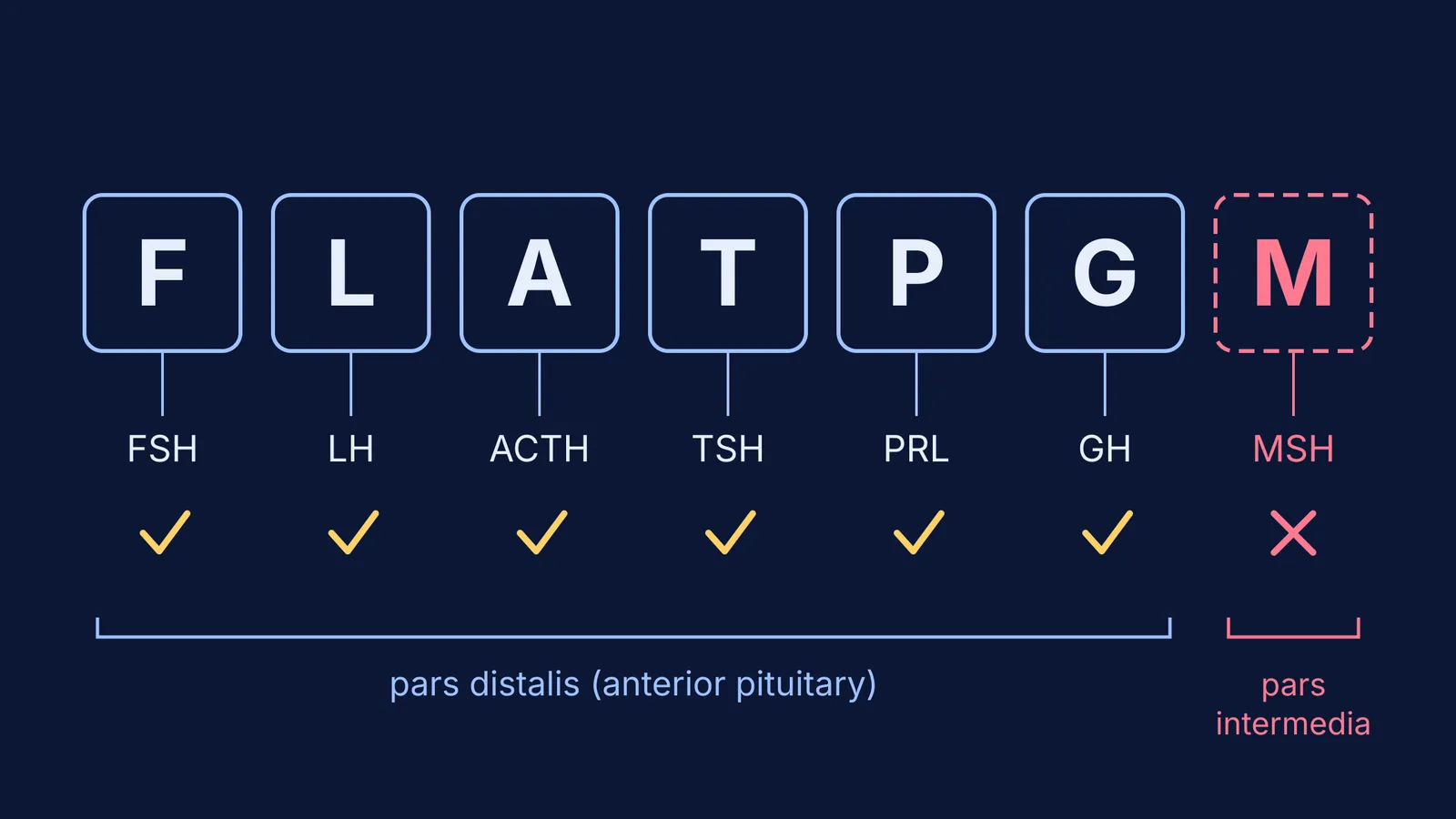
The Class 11 NCERT chapter Chemical Coordination and Integration states that the pars distalis, commonly called the anterior pituitary, produces six hormones: GH, PRL, TSH, ACTH, LH and FSH. The same section says the pars intermedia secretes only one hormone, MSH, and that the posterior pituitary stores and releases oxytocin and vasopressin.
Suppose a chatbot offers “FLAT PiG Me” for the anterior pituitary, with M for MSH. Run the check:
F, L, A, T, P and G match FSH, LH, ACTH, TSH, PRL and GH.
M for MSH fails step 4. MSH is a real hormone, but NCERT places it in the pars intermedia, not the pars distalis.
Nothing on the NCERT list is missing, so the fix is simply to drop the M.
Classification and plant families: what should you check?
Other chapters hide different traps.
Taxonomic hierarchy. NCERT's The Living World lists kingdom, phylum or division (for plants), class, order, family, genus and species. A mnemonic built only for animals has no slot for division, so note it beside the sentence, or compare with our taxonomic hierarchy order guide.
Plant families. In the current reprint of Morphology of Flowering Plants, Solanaceae is described with its floral formula and examples including tomato, brinjal, potato, chilli, ashwagandha, tobacco and petunia. If an AI mnemonic covers families or members you cannot find in your book, ask your teacher whether they are in your syllabus.
What should you type into the AI?
Give it the facts instead of asking for them:
“Here is a list from my NCERT Class 11 biology book: [paste the list]. Make a first-letter mnemonic that uses exactly these items, one letter each, no extras.”
“Now write each letter next to the term it stands for.”
“Which items on my list might a student confuse with something from a neighbouring category?”
Apply the same habit to AI-made practice questions and check the answer key against the book.
If the list itself makes no sense yet, learn the idea before the shortcut. Fermi's AI tutor works out what you already know, builds a plan for the session and checks understanding as it goes, and the Fermi Concept Library has a lesson for every concept in biology.
Paste the list, make the mnemonic, check every letter, and only then say it out loud.


