

On this page
Chromosome numbers are easy one-mark questions to lose. The trap is rarely the number itself but whether the question wants the diploid count (2n) or the haploid count (n), and for which cell. Here is a sourced list, a method for the tricky versions, and why a fern can have far more chromosomes than you.
What is the chromosome number in humans?
The diploid number (2n) is the count in a body cell, which carries two sets of chromosomes, one from each parent. The haploid number (n) is the count in a gamete, which carries one set.
In humans, each cell normally contains 23 pairs of chromosomes, for a total of 46, according to MedlinePlus Genetics from the US National Library of Medicine. Twenty-two of those pairs are autosomes; the 23rd pair is the sex chromosomes, XX in females and XY in males. So a human sperm or egg has n = 23.
What are the chromosome numbers of onion, pea and house fly?
The counts asked most often:
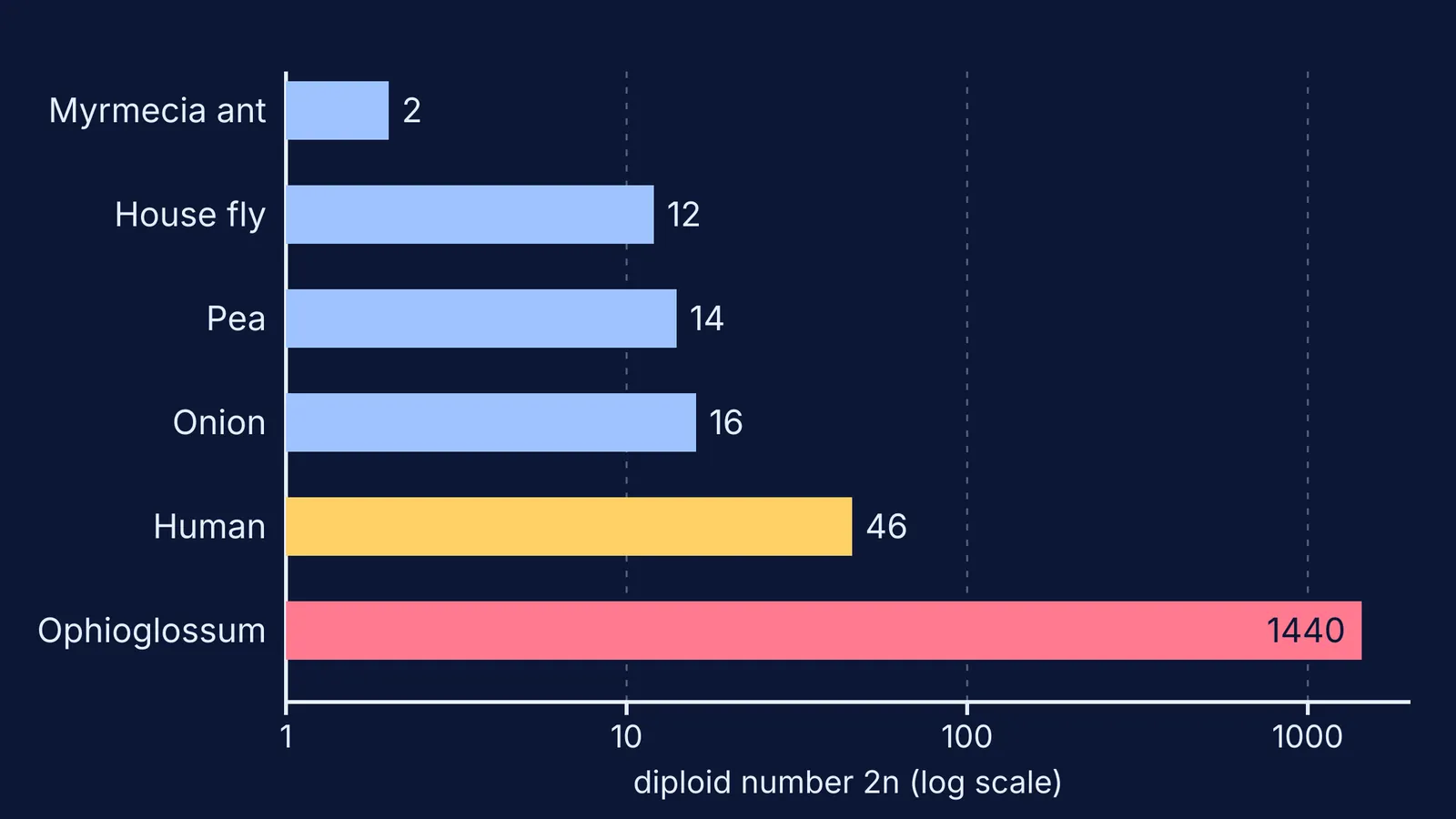
Human: 2n = 46, n = 23 (MedlinePlus Genetics).
Onion (Allium cepa): 2n = 16, n = 8, with a karyotype of 2n = 16 = 14m + 2sm reported in a 2022 karyotype study in the Bangladesh Journal of Botany.
Garden pea (Pisum sativum): 2n = 14, n = 7, the count given in most of the pea records in the Chromosome Counts Database (CCDB). Pea is Gregor Mendel's original genetic model, as the 2019 pea reference genome paper in Nature Genetics notes.
House fly (Musca domestica): 2n = 12. The 2014 house fly genome paper in Genome Biology describes five autosomes plus the X and Y, which gives six pairs, and a cytogenetics paper in Caryologia notes that 2n = 12, five autosome pairs and one sex pair, is the most constant diploid set among muscoid flies.
Myrmecia pilosula group (an Australian ant): 2n = 2. In a sibling species of this ant, workers carry a single pair and males, which are haploid, carry just one chromosome (Crosland and Crozier, Science, 1986).
Ophioglossum reticulatum (adder's-tongue fern): a population from the Shevaroy Hills in south India was reported at n = 720, 2n = 1,440, described as the highest chromosome number of any plant or animal (Scientific Reports, 2021).
Does more chromosomes mean a more complex organism?
No. The Myrmecia ant manages with 2 chromosomes, you have 46 and the fern has a reported 1,440. Chromosome number describes how an organism's DNA is packaged into pieces, not how much the organism can do.
DNA content does not track complexity either. The pea genome is about 4.5 billion base pairs against 3.2 billion for humans, close to half again as large, according to France's CEA, one of the institutes behind the pea genome, even though pea packs it into 14 chromosomes to your 46.
Counts change over evolution because chromosomes break, join and get copied. The Nature Genetics pea paper reports translocations and transpositions across pea lineages, and the CCDB pea records include polyploid counts such as 2n = 28 and 2n = 56, where whole sets have been multiplied. The number is a fact about a species, not a ranking.
How do you work out chromosome numbers in different cells?
Use three steps for any version of the question:
Find n for the organism (half the diploid number).
Decide the ploidy of the cell asked about: n, 2n or, for the endosperm of flowering plants, 3n.
Multiply, and check whether the question asks about chromosomes or chromatids.
Here is the method worked through for onion, where n = 8 (Bangladesh Journal of Botany):
Root tip cell: 2n = 16.
Egg cell or male gamete: n = 8.
Zygote: 2n = 16, because two gametes of 8 fuse.
Endosperm: 3n = 24, from two polar nuclei and one male gamete.
Meiocyte (pollen mother cell): 2n = 16, since it has not yet divided.
Root tip cell at mitotic metaphase: still 16 chromosomes, but 32 chromatids, because each chromosome has copied itself.
The same steps handle the reported fern count: if each gamete has 720 chromosomes, the meiocyte that made it had 1,440.
If the gaps are in the ideas underneath, such as meiosis, ploidy or what a chromatid is, the Fermi Concept Library gives each concept in biology its own lesson and shows where it sits in the map. For practice on the multi-step versions, the Fermi Problem Library has worked problems with a step-by-step solver that explains the reasoning rather than printing an answer.
Next step: copy the list above into your notes, then rewrite the onion example for pea (n = 7) without looking.


