On this page
Limits and Derivatives is Chapter 12 of the NCERT Class 11 Mathematics textbook (Reprint 2026-27), your first calculus chapter. This is the whole-chapter guide for the school exam. The long-hand method has its own post, derivatives from first principles with worked examples; for the entrance exam, see our limits and continuity guide for JEE.
What does the CBSE 2026-27 syllabus include, and how many marks?
The CBSE Mathematics curriculum for 2026-27 puts this chapter in Unit IV, Calculus: derivative as rate of change, the intuitive idea of a limit, limits of polynomial, rational and trigonometric functions, the definition of the derivative linked to the tangent, and derivatives of sums, differences, products and quotients of polynomial and trigonometric functions.
In the Class 11 course structure, Calculus carries 08 of the 80 theory marks, and Limits and Derivatives is the only chapter in that unit. Below the table it adds: "*No chapter/unit-wise weightage. Care to be taken to cover all the chapters."
It also lists Class 11 topics under this note: "The following topics are included in the syllabus but will be assessed only formatively to reinforce understanding without adding to summative assessments." For this chapter it names derivatives of composite functions (the chain rule): learn it, but it is not for the year-end paper. The curriculum also names exponential and logarithmic limits, which the current NCERT chapter does not cover, so ask your teacher about them.
What does the NCERT chapter cover?
Intuitive idea of derivative (12.2): average velocity of a falling body over shrinking time intervals.
Limits (12.3): left- and right-hand limits, the algebra of limits, polynomial and rational functions, and lim (xⁿ − aⁿ)/(x − a) = naⁿ⁻¹ as x → a.
Limits of trigonometric functions (12.4): the sandwich theorem and sin x/x → 1 and (1 − cos x)/x → 0 as x → 0.
Derivatives (12.5): the definition, the sum, difference, product and quotient rules, d/dx(xⁿ) = nxⁿ⁻¹, and derivatives of sin x and cos x.
Continuity and the chain rule come back in Class 12; our continuity and differentiability board guide picks up from here.
How do you evaluate limits in Class 11?
Substitute first. If you get 0/0, change the expression before substituting: factorise, rationalise or use a standard limit. We checked every answer here by hand and in Python.
Example 1. Find lim (x³ − 1)/(x² + 2x − 3) as x → 1. Substitution gives 0/0, so factorise: (x − 1)(x² + x + 1) over (x − 1)(x + 3). Cancel x − 1 (allowed, because x ≠ 1), then substitute: (1 + 1 + 1)/4 = 3/4.
Example 2. Find lim (sin 3x + 1 − cos x)/x as x → 0. Split it: 3 × (sin 3x)/(3x) + (1 − cos x)/x. The first part tends to 3 × 1 and the second to 0, so the limit is 3.
How do you find derivatives using the rules?
Example 3 (definition at a point). For f(x) = 1/(x + 1) at x = 1: [f(1 + h) − f(1)]/h = [1/(2 + h) − 1/2]/h = −1/[2(2 + h)]. As h → 0 this tends to f′(1) = −1/4.
Example 4 (product rule). y = (x² + 1) cos x. With u = x² + 1 and v = cos x, y′ = u′v + uv′ = 2x cos x − (x² + 1) sin x.
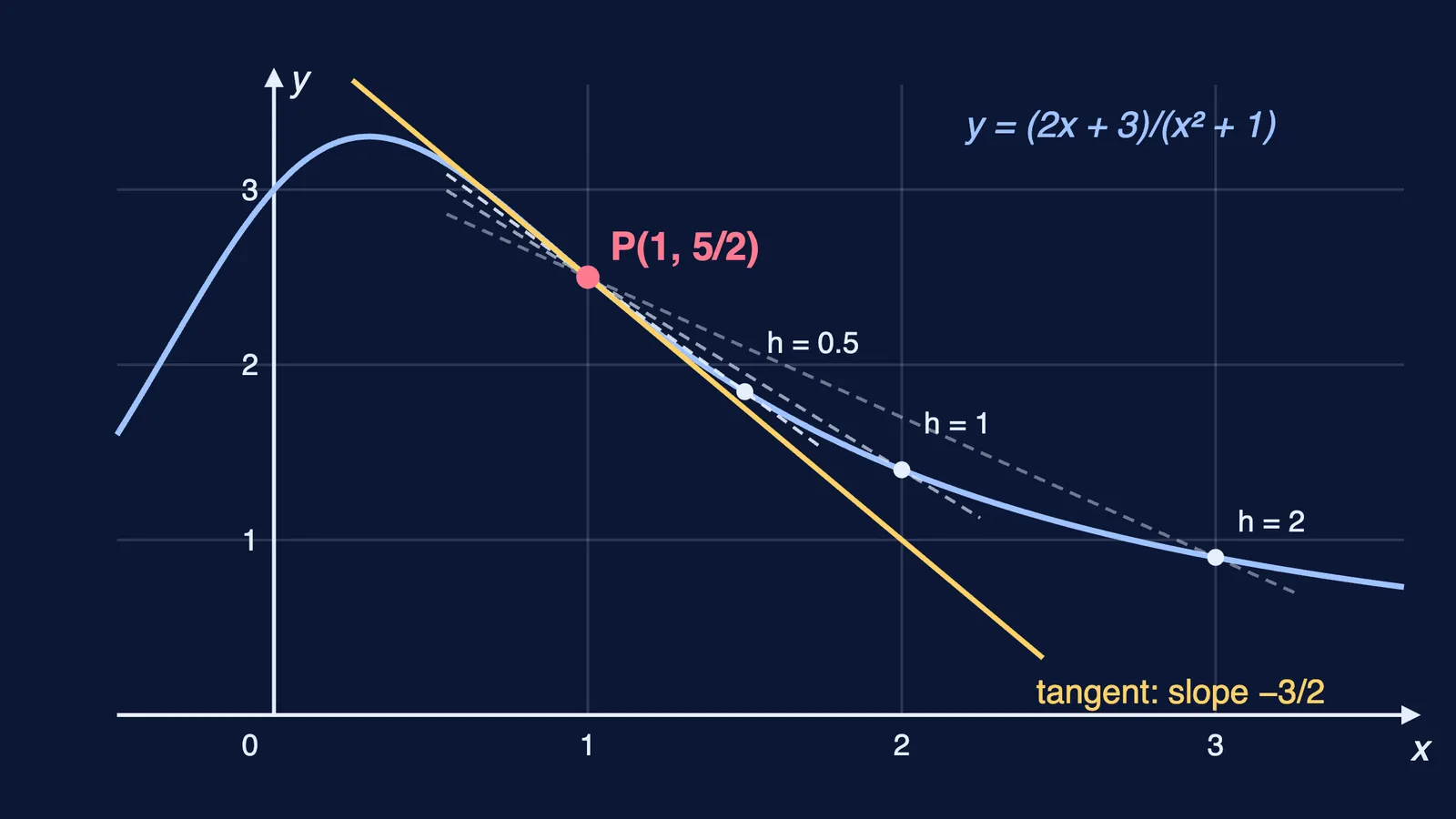
Example 5 (quotient rule). y = (2x + 3)/(x² + 1). y′ = [2(x² + 1) − (2x + 3)(2x)]/(x² + 1)² = (−2x² − 6x + 2)/(x² + 1)². At x = 1 it is −6/4 = −3/2.
The graph above shows Example 5: secants from P(1, 5/2) with h = 2, 1 and 0.5 have slopes −0.8, −1.1 and about −1.31, nearing −3/2. In the quotient rule, keep the order: bottom times derivative of top, minus top times derivative of bottom.
What questions can you practise for the school exam?
These are our own questions. The mark labels are our suggestion, not a CBSE pattern.
(1 mark) Evaluate lim (x² + 4x + 3)/(x + 1) as x → −1.
(2 marks) f(x) = x² + k for x < 2 and f(x) = 3x − 1 for x ≥ 2. Find k for which lim f(x) exists as x → 2.
(2 marks) Evaluate lim (x⁵ − 32)/(x − 2) as x → 2.
(3 marks) Evaluate lim (sin 7x − sin 3x)/x as x → 0.
(5 marks) Differentiate y = (x² − 1)/(x² + 1) using the quotient rule. Find where dy/dx = 0 and the value of dy/dx at x = 1.
Answers: (1) It reduces to x + 3, giving 2. (2) Left limit 4 + k, right limit 5, so k = 1. (3) 5 × 2⁴ = 80. (4) 7 − 3 = 4. (5) dy/dx = 4x/(x² + 1)², zero only at x = 0, and 1 at x = 1.
Stuck on a step? Fermi's AI tutor notices where a student is stuck and decides whether to explain, ask or show.