On this page
Biological Classification is Chapter 2 of Class 11 NCERT Biology. Here is what the 2026-27 syllabus keeps, a five-kingdom comparison, the key groups, and practice questions we wrote.
What does the 2026-27 syllabus include for Biological Classification?
The CBSE Biology curriculum for 2026-27 places this chapter in Unit I, Diversity of Living Organisms, which carries 15 marks of the 70-mark Class XI theory paper. The 15 marks are shared with The Living World, Plant Kingdom and Animal Kingdom; there is no chapter-wise figure.
It lists the five kingdom classification, the major groups of Monera, Protista and Fungi, and lichens, viruses and viroids.
A boxed note in the same document says: "The following topics are included in the syllabus but will be assessed only formatively to reinforce understanding without adding to summative assessments." For Class XI it lists only Digestion and Absorption, so this whole chapter is examinable.
We followed the current NCERT chapter (Reprint 2026-27). It also introduces prions, which the curriculum does not name; learn the definition anyway. CBSE has no Class XI sample paper, so we modelled question types on the Class XII Biology sample paper for 2026-27 (1, 2, 3, 4 and 5-mark questions).
How do Whittaker's five kingdoms compare?
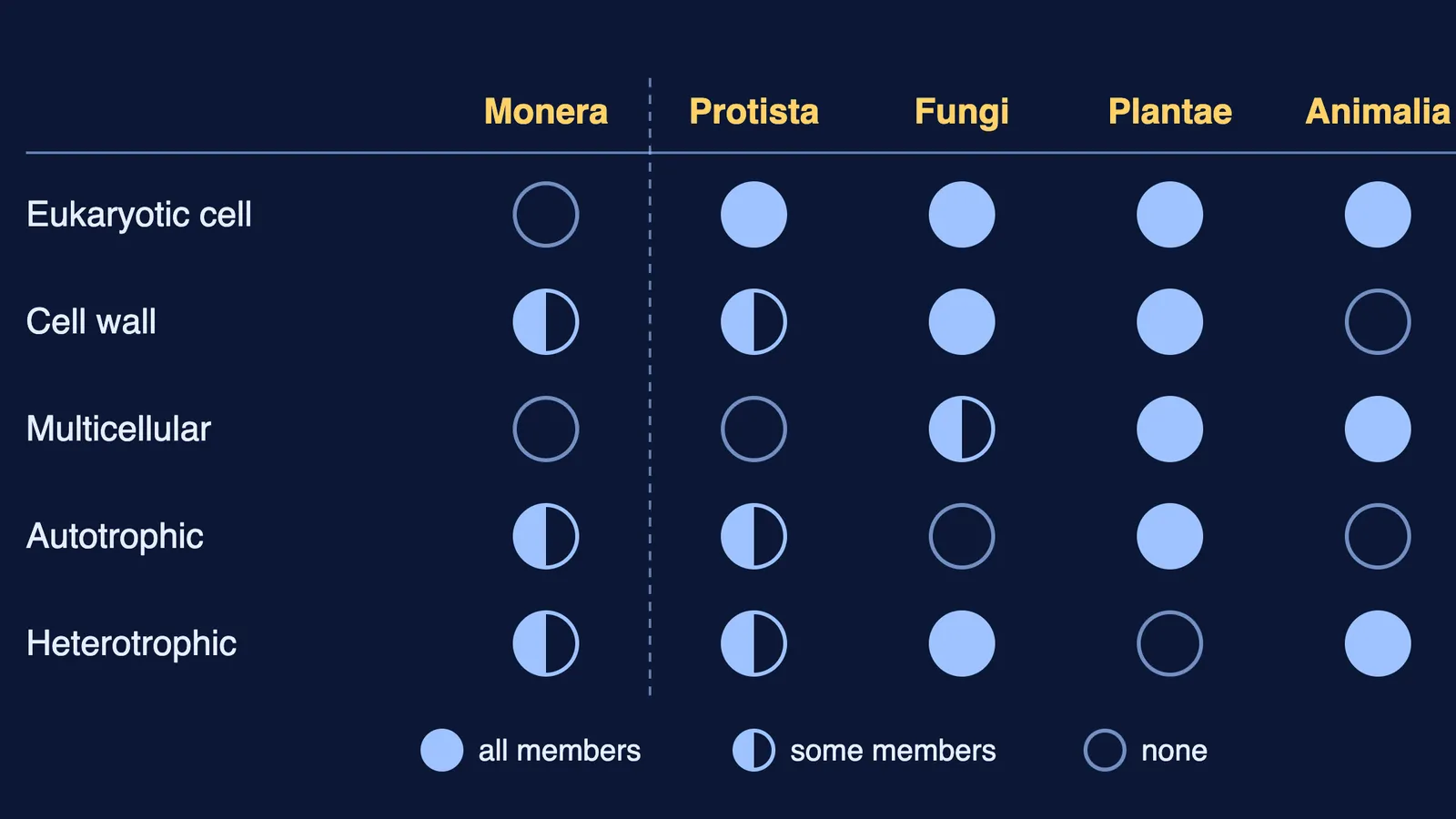
According to the NCERT chapter, R.H. Whittaker proposed the five kingdom classification in 1969. His criteria: cell structure, body organisation, nutrition, reproduction and phylogenetic relationships.
The two-kingdom system lumped prokaryotic bacteria with eukaryotic plants, and chitin-walled fungi with cellulose-walled plants.
Monera: prokaryotic, no nuclear membrane; cell wall noncellulosic; single cells; autotrophic or heterotrophic.
Protista: eukaryotic, single-celled; cell wall in some; autotrophic or heterotrophic.
Fungi: eukaryotic; wall with chitin; mostly multicellular (yeast is the unicellular exception); heterotrophic, saprophytic or parasitic.
Plantae: eukaryotic; cellulose wall; tissues and organs; autotrophic.
Animalia: eukaryotic; no cell wall; organ systems; heterotrophic, mostly holozoic.
Worth knowing: Protista puts Chlamydomonas (once an alga) beside Amoeba (once an animal) because the criteria changed.
What should you learn about Monera, Protista and Fungi?
Monera (bacteria). Know the four shapes: coccus, bacillus, vibrio and spirillum. Archaebacteria live in extremes: halophiles (salty areas), thermoacidophiles (hot springs) and methanogens (marshes, and cattle guts, where they make methane). Among eubacteria, cyanobacteria such as Nostoc and Anabaena fix nitrogen in heterocysts. Mycoplasma lack a cell wall entirely.
Protista. NCERT includes five groups:
Chrysophytes: diatoms and desmids; silica-rich diatom walls build up as diatomaceous earth.
Dinoflagellates: cellulose plates, two flagella; Gonyaulax causes red tides.
Euglenoids: a flexible pellicle instead of a wall; Euglena switches to heterotrophy without light.
Slime moulds: saprophytic; plasmodium, then spore-bearing fruiting bodies.
Protozoans: amoeboid (Amoeba), flagellated (Trypanosoma), ciliated (Paramoecium) and sporozoans (Plasmodium).
Fungi. Sex runs plasmogamy, karyogamy, then meiosis. Learn the four classes by mycelium and spores:
Phycomycetes: aseptate, coenocytic mycelium; zoospores or aplanospores; zygospore. Mucor, Rhizopus, Albugo.
Ascomycetes (sac fungi): septate; conidia; ascospores in asci. Penicillium, yeast, Aspergillus.
Basidiomycetes: septate; basidiospores on a basidium. Agaricus, Ustilago, Puccinia.
Deuteromycetes (imperfect fungi): only asexual conidia known. Alternaria, Trichoderma.
How are viruses, viroids and lichens different?
The NCERT chapter places these outside the five kingdoms.
Viruses: non-cellular nucleoproteins, inert outside a host; RNA or DNA, never both; a capsid of capsomeres. Know Ivanowsky (1892), Beijerinck (1898) and Stanley (1935).
Viroids: found by T.O. Diener in 1971; free RNA, no protein coat; potato spindle tuber disease.
Prions: abnormally folded protein; cause BSE in cattle and CJD in humans.
Lichens: an alga (phycobiont) and a fungus (mycobiont) in symbiosis; good pollution indicators.
What practice questions should you try?
The mark labels are our suggestion, not a CBSE allocation.
(1 mark) Which kingdom holds organisms with a chitin cell wall?
(1 mark) Name the cells in which Nostoc fixes nitrogen.
(2 marks) Give two reasons the two-kingdom system was found inadequate.
(2 marks) A free RNA without a protein coat causes potato spindle tuber disease. Name the agent and its discoverer.
(3 marks) A fungus has septate mycelium, conidia and ascospores in asci. Name its class and one example, and contrast its asexual spores with those of phycomycetes.
(3 marks) A pond cell has a flexible body, two flagella and feeds on smaller organisms in the dark. Name its group and two features placing it in Protista.
(5 marks) Using Whittaker's criteria, explain why Chlamydomonas and Amoeba share a kingdom while yeast and Penicillium share another.
Answers: 1. Fungi. 2. Heterocysts. 3. It mixed prokaryotes with eukaryotes, and fungi with green plants. 4. A viroid; T.O. Diener (1971). 5. Ascomycetes, e.g. Aspergillus; conidia form externally, phycomycete spores inside a sporangium. 6. Euglenoids: eukaryotic and single-celled. 7. Both are single-celled eukaryotes (Protista); both are chitin-walled heterotrophs (Fungi).
How should you revise this chapter?
Redraw the comparison from memory, then check it. Flashcard each group with one example and one feature. Then read The Living World on why species is the basic unit of classification and Plant Kingdom on why bryophytes are called amphibians. If the terms pile up, try studying Class 11 biology in weekly clusters.
Mixing up fungal classes? The Fermi Concept Library covers every concept in biology, each with its own lesson and its place in the map.