On this page
What hits you first in Class 11 biology is the vocabulary: chapter after chapter of long Greek and Latin words that look almost the same. The fix is not more rereading. It is a weekly routine of grouping terms, decoding their parts and testing yourself.
Why does Class 11 biology have so many terms?
You are not imagining it. In 1988 James Wandersee wrote about "the terminology problem in biology education" in The American Biology Teacher, examining the complexity of biological terminology and the difficulties students often meet (ERIC record).
A harder problem is that you may think you know a word when you don't. In a 2019 study, researchers analysed 1,276 student responses to 72 biology terms and found that students generally overestimated their own understanding (Zukswert, Barker and McDonnell, CBE Life Sciences Education). Their self-checks were least accurate for terms the students had already seen a lot, and for terms whose meaning in biology differs from everyday use.
So distrust the feeling of "I've read this, I know it". A test tells you what you actually know.
How do you break a heavy chapter into term clusters?
A cluster is a small group of terms that answer one question, so you can learn and test one group at a time.
Read the chapter once and list every new term on one page.
Group them by the question they answer: where is it, what does it do, what type is it, or what comes before or after.
Keep each cluster to about five to eight terms. If a group grows bigger, split it.
Give each cluster a heading in your own words, such as "where the ovary sits in a flower".
How do word roots help you remember biology terms?
Many biology terms are built from a few repeating parts, so learning one root helps with several words. A meta-analysis of 22 studies found that morphological instruction (teaching the meaningful parts of words) benefits learners, looking at effects on reading, spelling and vocabulary. Those studies were of children from preschool to Grade 8, not Class 11 biology (Bowers, Kirby and Deacon, Review of Educational Research).
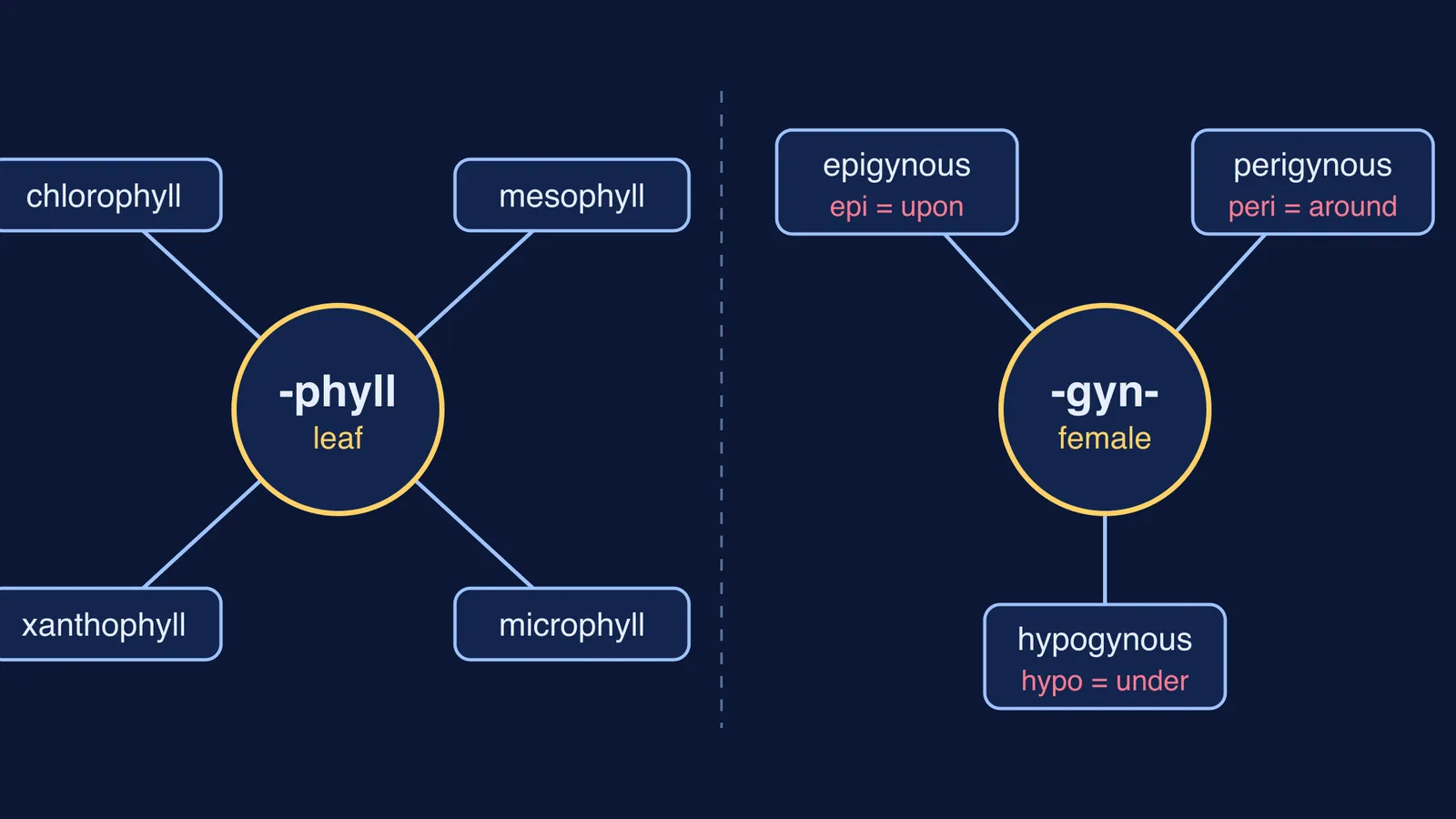
A worked example from the cluster on flower types:
hypo- means "under" (Wiktionary).
peri- means "around" (Wiktionary).
epi- means "upon" or "above" (Wiktionary).
gyno- comes from the Greek for "woman, female" (Wiktionary).
Now the three terms explain themselves. A hypogynous flower has a superior ovary, attached directly to the receptacle like the other floral parts, which sit under it (Wiktionary). In a perigynous flower the stamens, petals or sepals sit around the ovary (Wiktionary). An epigynous flower has an inferior ovary buried in the receptacle, so the other parts sit above it (Wiktionary).
Likewise, -phyll means "leaf", as in mesophyll and xanthophyll (Wiktionary).
If a term still makes no sense once you have split it into parts, the gap is usually the idea, not the word. The Fermi Concept Library gives each biology concept its own lesson and its place in the map, so you can fill that gap first.
What should a weekly recall test look like?
Testing yourself is a way of learning, not just checking. In Roediger and Karpicke's experiments, students who took recall tests on a passage remembered more two days or a week later than students who restudied it the same number of times, even though the restudying students felt more confident (Psychological Science, 2006). A major review rated practice testing and spaced-out practice as the two "high utility" study techniques, and rated rereading and highlighting low (Dunlosky and colleagues, 2013).
The closest match to your problem comes from university neuroanatomy and physiology courses. In a 2019 study, students who took 10-minute, low-stakes quizzes with feedback on jargon terms before those terms were taught did better on exam questions about those terms up to 12 weeks later (Pan and colleagues, CBE Life Sciences Education). The benefit did not reliably carry over to conceptual questions, so your weekly test needs one "why" or "how" question per cluster as well as definitions.
A seven-day plan for one heavy chapter
Day 1: Read the chapter and make your term list.
Day 2: Sort the terms into clusters and add new roots to your root sheet.
Day 3: Learn clusters 1 to 3. Cover the meanings and say each one aloud before you check.
Day 4: Learn the remaining clusters the same way.
Day 5: Take a 10-minute written quiz on everything from memory. Circle what you missed.
Day 6: Relearn only the circled terms, then answer one "why" question per cluster in two or three lines.
Day 7: Retest the circled terms. Carry anything still wrong into next week's quiz.
Parents: instead of asking "did you study?", offer to read out the Day 5 quiz.
For pairs that keep tripping you up, see our list of commonly confused plant biology terms. If your board exam needs exact wording, use our guide to learning definitions word for word. For cycles and pathways, try memorising long biology sequences in chunks.