On this page
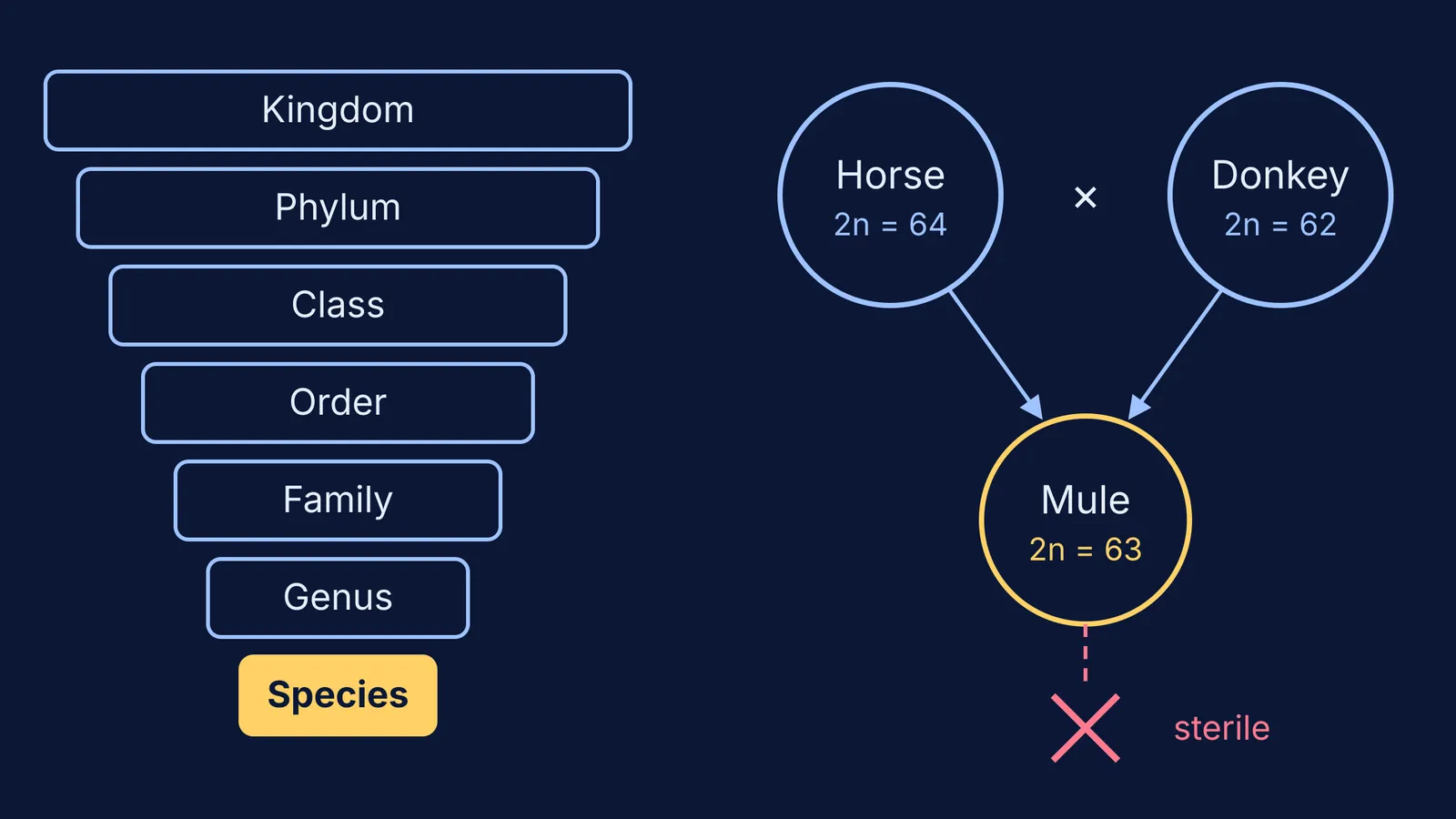
Open NCERT Class 11 Biology at the first chapter and you meet a ladder: kingdom, phylum, class, order, family, genus, species. Every rung above species is a group of groups. Species is where the ladder touches the ground, and explaining why is a common short-answer question.
What is a species in biology?
The NCERT Class 11 Biology chapter The Living World lists the common taxonomic categories as kingdom, phylum or division, class, order, family, genus and species, and says all organisms have species as the lowest category. The same chapter describes a species as a group of individual organisms with fundamental similarities, which you should be able to tell apart from closely related species by distinct morphological differences.
The biological test comes from Ernst Mayr, whom the NCERT chapter credits with pioneering the currently accepted definition of a biological species.
Mayr's 1942 definition reads: "Species are groups of actually or potentially interbreeding natural populations, which are reproductively isolated from other such groups", as quoted in Kevin de Queiroz's chapter Ernst Mayr and the Modern Concept of Species, published by the National Academies Press. De Queiroz adds that interbreeding means not only mating but also producing viable and fertile offspring.
In plain words: members of one species can mate and produce fertile offspring, and they do not normally exchange genes with other species.
Why is species the basic unit of classification?
Three reasons, each worth a line in an exam answer:
It is the lowest rank. Every higher category is built by grouping species. A genus is a set of related species, a family is a set of related genera, and so on up.
It is defined by the organisms themselves. Higher ranks are drawn by taxonomists from shared characters. A species, in Mayr's sense, is held together because its members interbreed and keep a shared gene pool.
It is the unit a scientific name points to. A binomial name such as *Mangifera indica* names one species, with *Mangifera* as the genus and *indica* as the specific epithet, as the NCERT chapter explains.
For the full ladder, our guide to the taxonomic hierarchy from kingdom to species walks through each rank with examples, and the rules for writing scientific names cover italics, capitals and author names.
Why is a mule not a separate species?
A mule is the offspring of a horse and a donkey, so why are horses and donkeys still two species?
According to an answer written by a Stanford genetics PhD candidate for The Tech Interactive's Ask a Geneticist, a horse has 64 chromosomes and a donkey has 62, so a mule inherits 32 from its horse parent and 31 from its donkey parent, for 63 in total. The same source explains that mules have trouble making sperm or eggs because the horse and donkey chromosomes do not match up well during meiosis. Its editor's note adds that a few female mules have given birth, so mules are almost always, not always, sterile.
No steady supply of fertile offspring means no shared gene pool. Horses and donkeys stay reproductively isolated, so they remain two species, and the mule is a hybrid rather than a new species.
Where does the interbreeding test not work?
The biological species concept needs sex. Bacteria and many other organisms reproduce asexually, so "can they interbreed?" has no useful answer. De Queiroz's National Academies chapter notes two views here: either purely asexual organisms do not form species, or processes other than the exchange of genetic material, such as natural selection, set their species limits.
In practice, taxonomists also rely on structure, development and ecology, as the NCERT chapter notes. For a school answer, give Mayr's definition and then add one line saying it applies to sexually reproducing organisms.
How do you write this answer in an exam?
Use this four-line frame for a short-answer question:
Define: A species is a group of organisms that can interbreed in nature to produce fertile offspring and is reproductively isolated from other groups.
Place it: It is the lowest category in the taxonomic hierarchy; every higher rank is a grouping of species.
Justify: It is the unit held together by interbreeding, and it is the unit given a binomial name.
Example: Horse (2n = 64) and donkey (2n = 62) produce a mule (2n = 63), which is almost always sterile, so horse and donkey are separate species (chromosome numbers from The Tech Interactive).
Quick check for any "same species or not?" question:
Can they mate in nature, not just in captivity?
Is the offspring fertile, not just alive?
Does the group reproduce sexually at all? If not, say the interbreeding test does not apply.
If the ranks still blur together, the Fermi Concept Library covers every concept in biology, each with its own lesson and its place in the map. For practice questions, the Fermi Problem Library has worked problems with a step-by-step solver that explains the reasoning rather than printing an answer.
Next, see how species fit into the bigger groups in our comparison of the five kingdoms for NEET.