On this page
Anatomy of Flowering Plants is Chapter 6 of NCERT Class 11 Biology, the middle chapter of Unit II. This guide is for your CBSE school exam. For the entrance exam, read our separate guide to preparing Anatomy of Flowering Plants for NEET. The chapter before it has its own guide: Morphology of Flowering Plants for Class 11.
How many marks is Anatomy of Flowering Plants in Class 11?
The CBSE Class XI Biology curriculum for 2026-27 gives Unit II, Structural Organization in Plants and Animals, 10 marks out of 70 in the theory paper. Those 10 marks are shared by three chapters: Morphology of Flowering Plants, Anatomy of Flowering Plants and Structural Organisation in Animals. CBSE prints no separate figure for Chapter 6.
The curriculum lists the anatomy and functions of tissue systems in dicots and monocots. None of it is formative-only; in Class XI that note covers only Digestion and Absorption.
The chapter also feeds the 30-mark practical. Experiment 2 is preparing and studying T.S. of dicot and monocot roots and stems (primary), and Experiment 5 is the distribution of stomata on the upper and lower leaf surfaces. Both sit in the slide-preparation group (Experiments 2, 4 and 5), which carries 5 marks.
What is in the 2026-27 NCERT chapter?
The current NCERT chapter (Reprint 2026-27), pages 71 to 78, has just two sections.
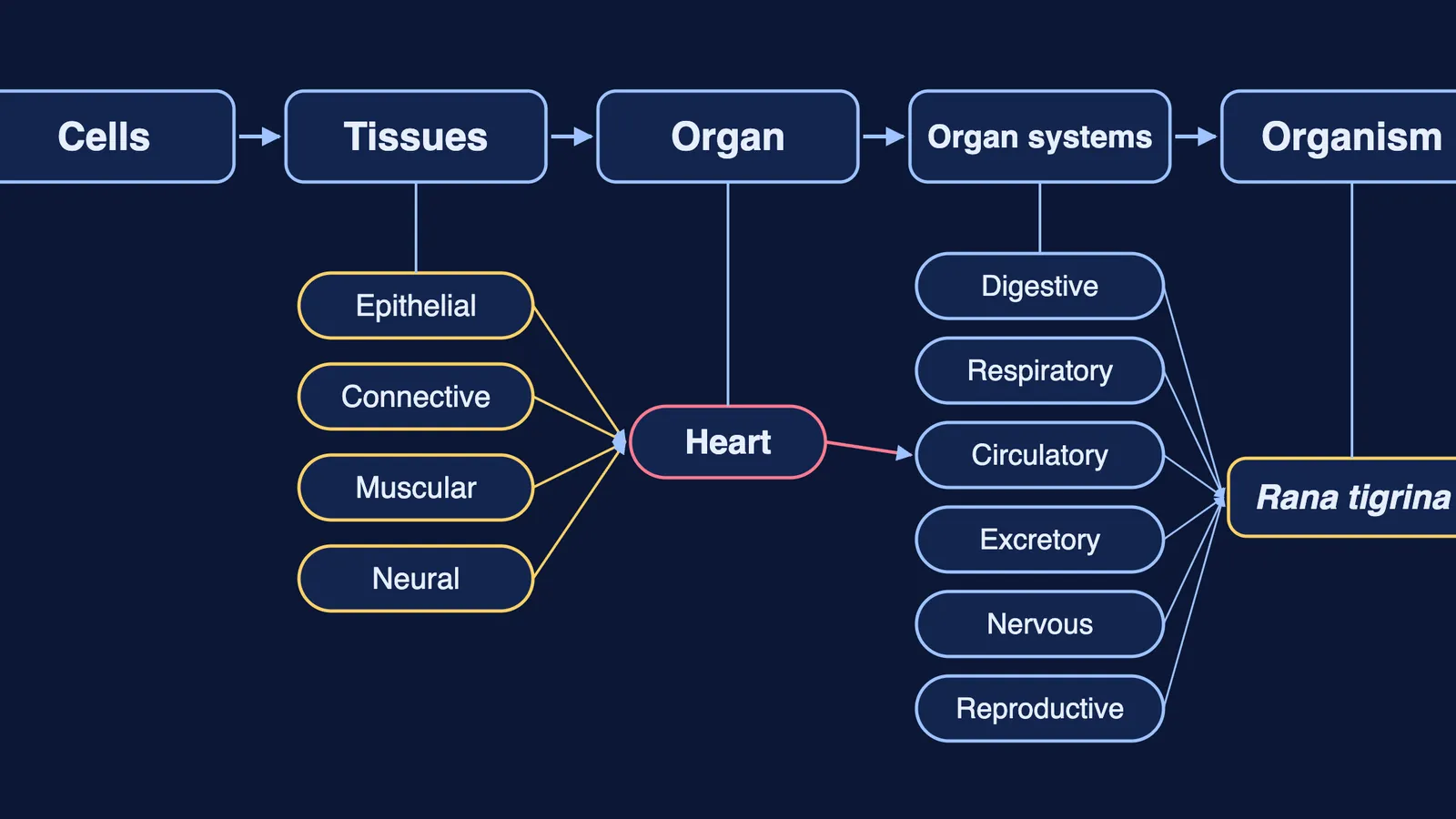
6.1 The tissue system: epidermal (epidermis, cuticle, stomata, root hairs, trichomes), ground (parenchyma, collenchyma, sclerenchyma; mesophyll in leaves) and vascular (xylem and phloem in radial, conjoint open or conjoint closed bundles).
6.2 Dicot and monocot anatomy: transverse sections of the root and stem, and vertical sections of the dorsiventral and isobilateral leaf.
Two topics you may meet in other guides have no section here. There is no section on tissue types: meristematic and permanent tissues appear only in the chapter summary. Nor is there one on secondary growth. The text mentions it only in passing: open bundles can form secondary xylem and phloem, the root pericycle starts the vascular cambium, monocot roots never undergo it, and the summary says most dicot roots and stems have it.
How is a monocot root, stem or leaf different from a dicot one?
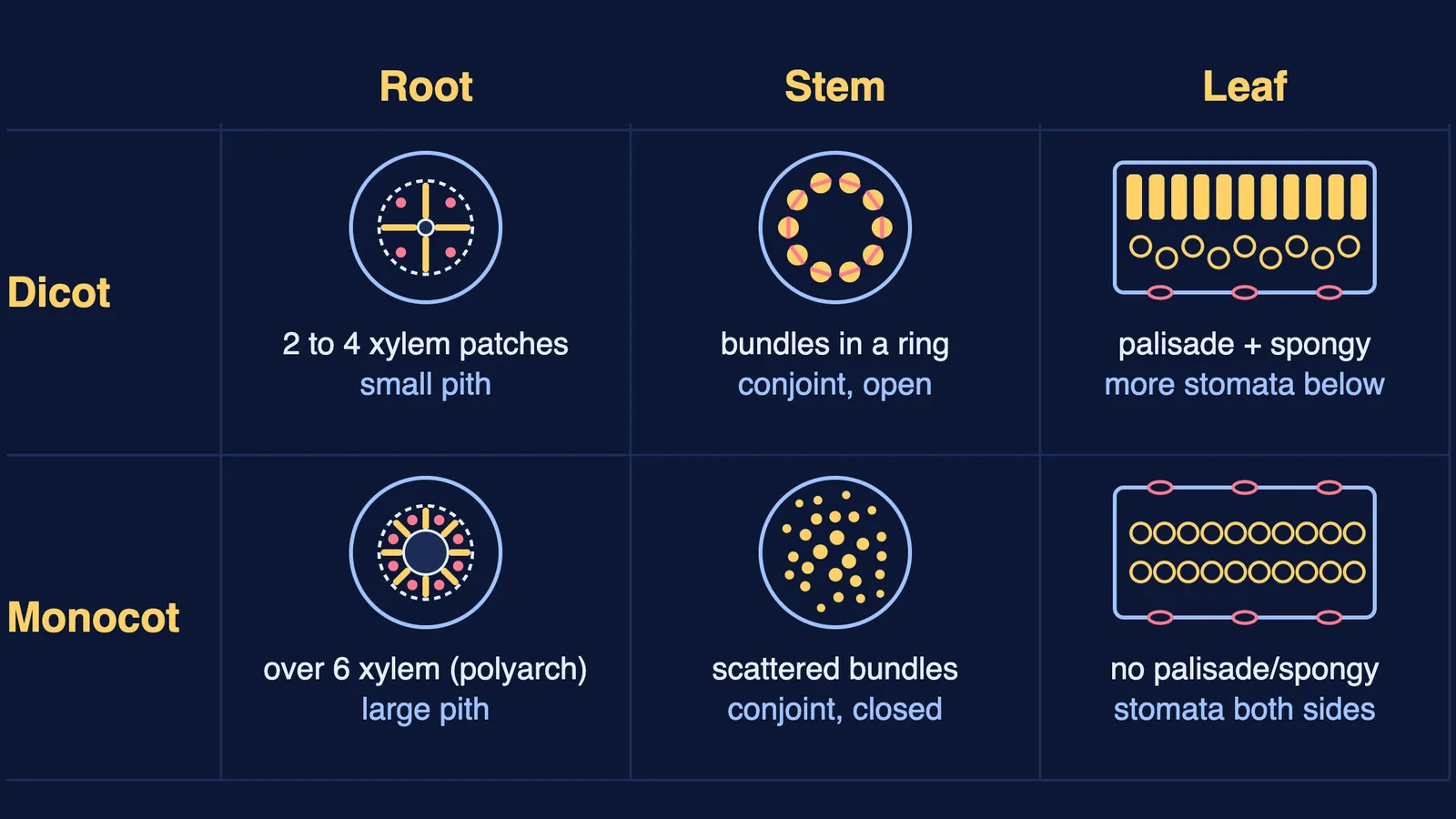
The grid above sums up all six; here is each pair in exam words, from the NCERT chapter.
Root: the dicot (sunflower) root has two to four xylem and phloem patches as a rule, and a small or inconspicuous pith. The monocot root typically has over six xylem bundles (polyarch) and a large, well-developed pith. Both have radial bundles, and the root endodermis carries waxy, water-impermeable suberin as casparian strips.
Stem: the dicot stem has a collenchymatous hypodermis, a starch sheath and a ring of conjoint, open bundles with endarch protoxylem. The monocot stem has a sclerenchymatous hypodermis and scattered conjoint, closed bundles, each in a sclerenchymatous sheath, with no phloem parenchyma and water-containing cavities. Peripheral bundles are generally smaller than central ones.
Leaf: the dorsiventral leaf has palisade above and spongy parenchyma beneath, and its lower (abaxial) epidermis bears more stomata. The isobilateral leaf has stomata on both surfaces and undivided mesophyll; grasses also have bulliform cells that make the leaf curl in water stress.
How do you draw labelled diagrams for full marks?
Draw a large, clean circle (root, stem) or band (leaf) in pencil.
Label from outside in, in NCERT's order. For a dicot root: epiblema with root hairs, cortex, endodermis, pericycle, protoxylem, metaxylem, phloem, pith.
Put the one feature that identifies the section in the diagram itself: the count of xylem arms, the ring or the scatter of bundles, the stomata on one or both surfaces.
Add a title under the figure, such as "T.S. of monocot stem".
Which questions should you practise?
These are our own questions; the marks in brackets are our suggestion, not CBSE's. The curriculum prints a question-paper design only for Class XII, so ask your teacher how your school sets the Class 11 paper.
Assertion: the vascular bundles of a monocot stem do not form secondary xylem. Reason: they have no cambium between xylem and phloem. Choose the correct option. (1 mark)
Leaf peels show stomata equally on both surfaces, and a vertical section shows no palisade layer. Dorsiventral or isobilateral? Give two reasons. (2 marks)
Name the waxy material in the endodermal walls of a root and the form in which it is laid down. (2 marks)
In a monocot stem, are edge bundles larger or smaller than central ones? Name one feature of these bundles that dicot stem bundles lack. (2 marks)
Sketch radial, conjoint closed and conjoint open bundles, naming one organ with each. (3 marks)
Give five differences between a monocot root and a monocot stem. (5 marks)
Check question 2: isobilateral, since stomata occur on both faces and the mesophyll lacks a palisade layer. Check question 3: suberin, laid down as casparian strips.
Stuck on one section? Fermi's AI tutor works out what you already know and builds a plan for the session, so you start from the gap.