On this page
Anatomy of Flowering Plants is one of the shortest chapters in Class 11 Biology, so small details in its text matter. Here is what the syllabus lists, what NCERT keeps, and a two-week plan.
What does the NEET syllabus say about plant anatomy?
The National Medical Commission's syllabus for NEET (UG) 2026, dated 22 December 2025 and linked from the NTA NEET website, places this topic in Biology Unit 2, Structural Organisation in Animals and Plants (NMC syllabus PDF). It lists tissues and the anatomy of root, stem and leaf; secondary growth is not named. In November 2026 the NTA site had no 2027 syllabus, so recheck when one appears.
What does the 2026-27 NCERT chapter cover?
In the 2026-27 reprint of NCERT Class 11 Biology, Chapter 6 (pages 71-78) has two sections: tissue systems, and dicot and monocot anatomy (NCERT Chapter 6 PDF). Tissue types appear only in its summary; the fuller account is in the Class 9 NCERT chapter Tissues in Action (NCERT Class 9 Chapter 3 PDF), so read both.
Meristems come in three kinds: apical (at root and shoot tips, adds length), lateral (around the stem, adds girth) and intercalary (near nodes, as in grasses, helping regrowth after cutting).
Permanent tissues are simple (parenchyma, collenchyma, sclerenchyma) or complex (xylem and phloem).
Xylem has tracheids, vessels, xylem fibres and xylem parenchyma; the parenchyma is its only living part. See tracheids vs vessels in xylem.
Phloem is made of sieve tubes with their companion cells, plus phloem fibres and phloem parenchyma.
The three tissue systems are epidermal (epidermis, stomata, hairs), ground (everything except epidermis and vascular bundles) and vascular (xylem and phloem).
A bundle is radial when xylem and phloem lie on alternate radii (roots), conjoint when they share a radius (stems and leaves), open when cambium sits between them, and closed when it does not.
How do dicot and monocot root, stem and leaf differ?
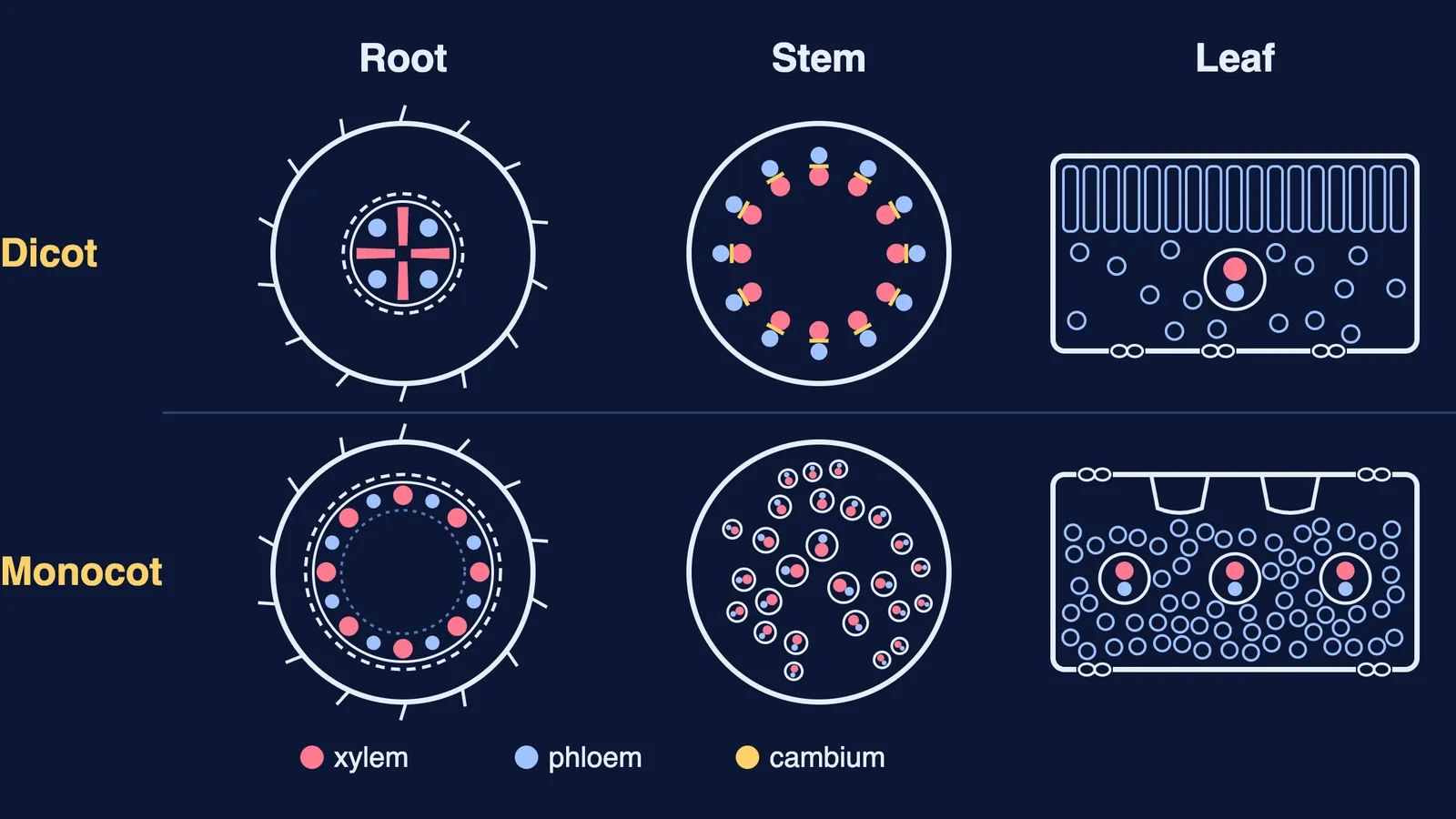
Root. Per NCERT section 6.2, a dicot root usually has two to four xylem patches and a small pith. A monocot root usually has more than six (polyarch) and a large pith. Both have radial bundles, an endodermis and a pericycle.
Stem. A dicot stem has a collenchyma hypodermis, an endodermis full of starch (the starch sheath), and bundles in a ring, each conjoint and open, with protoxylem toward the centre (endarch). A monocot stem has a sclerenchyma hypodermis and many scattered bundles, each conjoint, closed and wrapped in a sclerenchyma sheath; the outer ones are smaller than the central ones.
Leaf. A dicot leaf is dorsiventral: palisade cells on the upper side, spongy cells below, and more stomata on the lower surface. A monocot leaf is isobilateral: stomata on both surfaces and no palisade-spongy split. In grasses, large empty bulliform cells in the upper epidermis lose water under stress and roll the leaf inward.
Is secondary growth still part of the chapter?
Not as a topic. The 2026-27 chapter has no section on it, but a few lines remain and are fair game:
Open bundles can make secondary xylem and phloem because they carry cambium.
In a dicot root, the pericycle starts lateral roots and the vascular cambium, and a cambium ring later forms between xylem and phloem.
Monocot roots show no secondary growth; most dicot roots and stems do show it.
For the reason behind the monocot rule, read why monocots have no secondary growth.
How do you practise diagrams and avoid the traps?
Draw all six sections from memory, label five parts on each, write what gives it away, then check against NCERT figures 6.3 to 6.5.
Worked example: a section shows a ring of bundles with cambium between xylem and phloem, and a starch-rich layer at the inner edge of the cortex. Ring, open bundles and starch sheath: a dicot stem. Many alternating xylem and phloem patches around a wide pith instead point to a monocot root.
Common traps:
Calling root bundles conjoint. Roots are radial.
Putting bulliform cells on the lower surface.
Reversing bundle size in the monocot stem.
Forgetting that the parenchyma between root xylem and phloem is called conjunctive tissue.
If one idea keeps slipping, the Fermi Concept Library gives every biology concept its own lesson and its place in the map, so you can see how tissues build tissue systems.
What does a two-week plan look like?
Days 1-2: Class 9 Tissues in Action; one page on meristems and permanent tissues.
Days 3-4: Class 11 section 6.1; write the four bundle types with where each occurs.
Days 5-7: Section 6.2; build a root-stem-leaf comparison sheet and draw each section twice.
Days 8-9: Secondary growth lines and chapter exercises.
Days 10-12: Mixed questions; tag every wrong answer by trap.
Days 13-14: Timed drawing of all six sections from memory.
Unsure where to begin? Fermi's AI tutor can work out what you already know and build a plan for the session, so you sit down to a clear next step.
Next, try Plant Physiology for NEET.