On this page
If you have looked at a maize stem section in a school practical, you have already seen the answer. The bundles are scattered, each wrapped in a sheath, with no thin band of dividing cells between xylem and phloem. That missing band is the whole story.
Why is there no secondary growth in monocots?
Secondary growth is the increase in girth that comes from new xylem and phloem made by a cambium. NCERT's Class 11 Biology Chapter 6, Anatomy of Flowering Plants, notes in its summary that secondary growth occurs in most dicot roots and stems. The reasoning for monocots has three links:
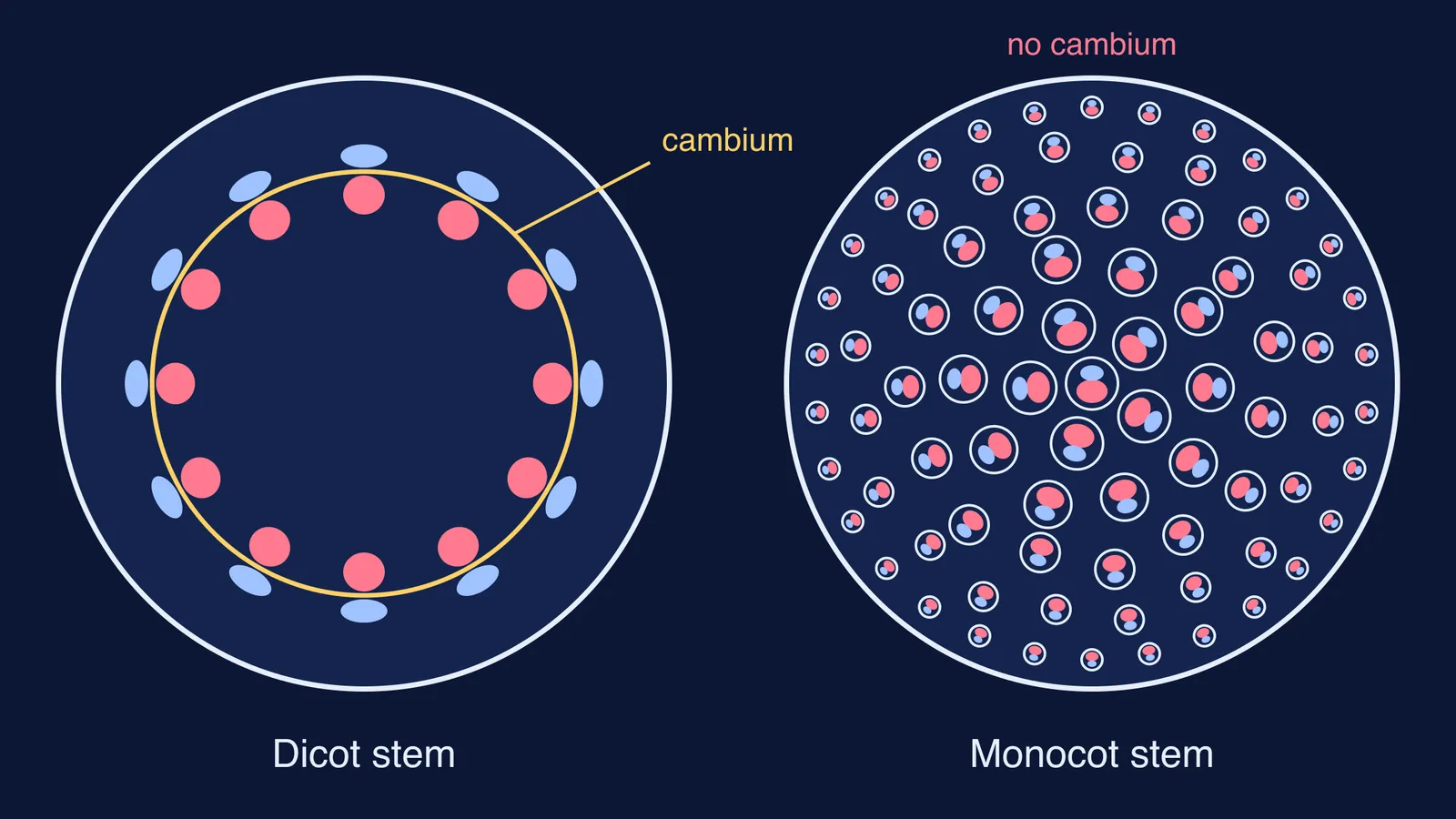
The bundles are closed. NCERT states that in monocotyledons “the vascular bundles have no cambium present in them”, and because they do not form secondary tissues they are called closed. Dicot stem bundles have cambium between phloem and xylem, so they are open.
No cambium means no new tissue. NCERT defines open bundles as those that can form secondary xylem and phloem because cambium is present. Take the cambium away and nothing new is added once the primary tissues have matured.
The bundles are scattered, not in a ring. NCERT calls the ring of bundles a characteristic of the dicot stem, while the monocot stem has “a large number of scattered vascular bundles”. Scattered, closed bundles are the pattern to recognise in a monocot section.
The same holds below ground. The chapter says plainly that “monocotyledonous roots do not undergo any secondary growth.”
For the dicot side, read our walkthrough of secondary growth in dicot stems and annual rings. For the bundle types themselves, see how to tell open and closed vascular bundles apart.
How do palm trees get so thick without secondary growth?
The difference is when the thickening happens. In a 1983 paper in *Radiocarbon*, L. H. G. Wiesberg and T. W. Linick wrote that palms “are thick at an early age and grow cylindrically in a vertical manner”, while non-monocot trees thicken with age and form tree rings (Wiesberg and Linick, 1983). Their survey of palm anatomy explains that primary thickening near the apex accounts for the wide stem, with no secondary growth of the kind seen in gymnosperm and dicot trees.
Some botanists had suggested that palms keep widening slowly through “diffuse secondary growth”. Wiesberg and Linick tested this with carbon-14 measurements on a coconut palm, which forms no annual rings. They found no diffuse secondary growth over the entire mature stem during the last 25 years of growth, except in a restricted zone in the centre at medium height.
The paper does note that some palms, such as *Caryota* and *Roystonea*, were reported to keep expanding, which may come from enlarging cells and ground tissue rather than new bundles.
So for your answer: a palm builds most of its width early, just below the growing tip, and then mostly grows upward. No cambium, no wood rings.
Do any monocots show secondary growth?
A few do, and *Dracaena* (the dragon trees) is the one to know. A 2025 study in *Planta* notes that most tree-like monocots, such as palms, yuccas and aloes, have fibrous roots of fairly uniform size, while *Dracaena* roots thicken with age through secondary growth (Marcinkiewicz and Jura-Morawiec, 2025). The authors note that this growth has a bundled structure and is formed by the “monocot cambium”. So if a question says “monocots never thicken”, the safe reply is “most monocots, but not *Dracaena*”.
How do you tell a monocot stem from a dicot stem in a TS?
NCERT's own Exercise 3 describes a section with conjoint, scattered bundles in sclerenchymatous sheaths and no phloem parenchyma, and asks you to name it. The answer is a monocot stem. Every point in this checklist comes from the same NCERT chapter:
Bundle arrangement: in a ring (dicot) or scattered (monocot).
Bundle type: conjoint and open (dicot) or conjoint and closed (monocot).
Cambium strip between xylem and phloem: present (dicot) or absent (monocot).
Bundle sheath: each monocot bundle sits in a sclerenchymatous sheath.
Hypodermis: collenchyma (dicot) or sclerenchyma (monocot).
Phloem parenchyma: absent in the monocot stem.
Water-containing cavities: present inside monocot bundles.
Bundle size: in monocots, peripheral bundles are generally smaller than central ones.
Pith and medullary rays: visible in the dicot; the monocot has a large, conspicuous parenchymatous ground tissue instead.
Check the first three rows first: they settle both the identity and whether secondary growth is possible. For the wider comparison of roots, leaves and flowers, see monocot vs dicot plants, feature by feature.
If cambium and closed bundles still feel like words rather than pictures, the Fermi Concept Library gives every biology concept its own lesson and its place in the map. To practise writing the reasons, the Fermi Problem Library has worked problems with a step-by-step solver that explains the reasoning rather than printing an answer.
Next time you see a stem section, look for the cambium strip first: find it, and you know the plant can grow wider.